For national security practitioners, just about anything may be framed as a national security risk—poor educational outcomes can leave people easier to radicalise, a dysfunctional economy may allow for grift and corruption by authority figures; reliance on fuel imports can create unequal power structures. Policymakers the world over regularly discuss climate change as a dire issue, but as scientists publish ever-bleaker projections and warn of the imminent collapse of vital ecosystems upon which populations rely, security apparatuses within governments are paying particular attention to how it will affect their work; some more than others.
The UK government recently published a national security assessment titled “Global biodiversity loss, ecosystem collapse and national security.” The 14-page document set out key judgements on food production, water insecurity, supply chain resilience, infectious disease outbreaks, and overall prosperity, offering analytical confidence rates into its assessments.
Meanwhile, the US under Donald Trump is the one prominent detractor from the view that climate change is a dire security risk. While the Trump administration has focused on a variety of perceived national security threats, such as immigration, it wholly omits climate change as an issue worthy of concern. While the UK’s security and environmental experts collaborate to better understand imminent threats to the UK and how to prepare for them, the US Defense Department has removed references to climate change from public-facing memos, and its head has declared that the department “does not do climate change.”
The UK’s national security assessment focuses heavily on food production and how reliant the country is on imports of fresh fruit, vegetables, and sugar, as well as nitrogen and phosphorus fertiliser. Threats to the food supply could have major downstream effects, and the report acknowledges that getting the UK to a point of food self-sufficiency would substantially increase prices and require “a wholesale change in consumer diets.” Critical ecosystems supporting global food production are at risk from climate change, as weather cycles change, water become scarcer, and crop yields degrade.
The report determined that the six regions of major concern to the UK were the Amazon rainforest, Congo Basin, coral reefs and mangroves of Southeast Asia, the Himalayas, and the boreal forests of Russia and Canada, which serve as substantial global carbon sinks. Significantly, the UK government plans to reduce its international climate financing for developing nations by 20%. International climate agreements stipulate those wealthier nations, which
polluted more by scaling their economies after the Industrial Revolution, should help fund climate smart infrastructure projects for Global South nations trying to grow their economies without relying heavily on fossil fuels. Given the security assessment’s determination that certain Global South regions are integral to UK security, the decision to cut funding appears short-sighted.
At the same time, the United States is seeking to reverse an Obama-era rule that underpins a host of climate policies. The “endangerment finding” claims that excessive greenhouse gas emissions endanger public health. The rule supports policies under the Clean Air Act, which regulates emissions from vehicles, power plants, and industry. By repealing the finding, the president’s party hopes to address their complaint about environmental regulations amounting to “burdensome overregulation that strangles the economy.” Environmental groups will likely file suit against the rule’s revocation.
The Trump administration articulates myriad national security threats and claims to want ultimate security and prosperity for America. The US leader blames undocumented immigrants for all manner of ills around the country and has directed the Department of Homeland Security’s Immigration and Customs Enforcement (ICE) agents to use draconian and unconstitutional tactics to address the supposed grave threat migrants pose to the country.
Meanwhile, the US continues to pollute more per capita than almost any other nation, adding to a serious global security threat, while abandoning efforts to prepare for its destabilizing effects. President Trump recently directed the Defense Department to rely more on coal for its energy needs, offering a $175 million infusion of funds for coal plants. Over recent decades, the US has largely phased out coal for energy needs, as it is considered one of the most polluting forms of power generation.
The West is splitting on important issues, as values diverge, and mistrust abounds. An interdependent world has delivered unprecedented prosperity for Global North nations. Now, as the threat of climate change looms ever closer, scientific projections claim that in the next few decades vital ecosystems may collapse, causing food and water shortages, mass migration, infectious disease outbreaks, social unrest, and political destabilisation. Experts at the highest levels of government understand the implications of climate change and the need for massive infrastructure shifts, and often still choose to put resources elsewhere.
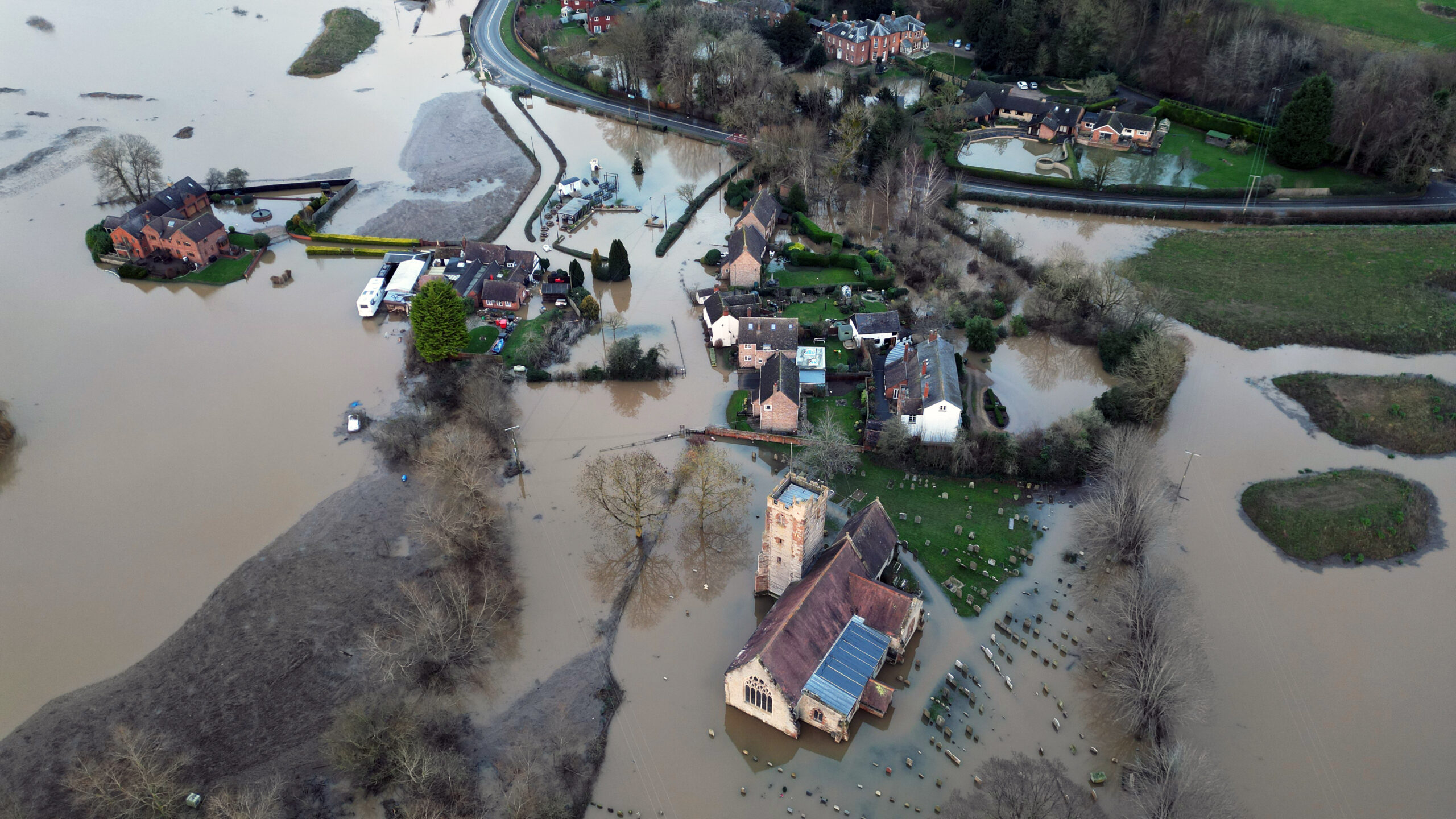
Feature photo: Floodwaters inundate homes and streets in Worcestershire after heavy rainfall caused rivers to swell on January 5, 2024. Climate-driven extreme weather events are increasingly being viewed by UK security officials as a growing national security concern. (Credit: Yunus Dalgıç/AA)Sarah Sakeena Marshall, Consultant, Writer, Editor, Climate Change, National Security