Despite US President Donald Trump’s claim that climate change is a hoax, his ambitions to annex Greenland for greater access to trade routes and critical minerals due to melting ice, imply that he knows that climate change is happening and wants to cash in on it.
Greenland boasts a strategic location between North America, Western Europe, and the Arctic, and 80% of its 2.17 million square kilometres landmass is covered in ice, though it is melting at an accelerated rate, losing an estimated 30 million tonnes an hour— the equivalent of 88 million Olympic swimming pools each year. Since the early 1990s, Greenland’s ice sheet has lost close to four trillion tonnes of ice, with the rate of loss now around seven times higher than it was three decades ago.
These warming conditions are opening shipping corridors in the Arctic and melting permafrost, which not only exposes critical minerals but also releases millions of tonnes of carbon and methane into the atmosphere, further accelerating global warming. Trump views these shipping routes and minerals as strategically important to dominating China and Russia in global trade and technological innovation.
Shipping routes
The US sees the Arctic as the next frontier of global trade. Travel times for cargo ships can be significantly shortened by traveling through the once largely inaccessible Arctic. A Chinese vessel, for example, cut its journey by half through the corridor.Arctic shipping traffic has more than doubled since 2013 as summer sea ice retreats, turning previously theoretical routes into commercially viable passages.
While ice remains in the region, specialized ice-breaking vessels are necessary to travel through it. Russia has 40 ice-breaker vessels, including a nuclear-powered fleet, compared to the US’s three and China’s five. The increase in Arctic shipping, which has more than doubled since 2013, also accelerates ice melt, as black carbon from vessels settles on ice and warms surfaces up to ten times faster than airborne emissions, threatening the fragile Arctic ecosystem.The very trade routes enabled by melting ice are now helping to hasten its disappearance. Both the US and China are building more ice-breakers to better compete in the region.
Critical minerals
Greenland is also endowed with a variety of rare earth minerals necessary for clean energy and AI tech. These critical minerals are used to make smartphones, TV’s, e-vehicle batteries, AI data centres, wind turbines and solar panels, and together represent 25 of the 34 minerals classified as critical by the EU and 40 of the 50 deemed necessary for US national security. Currently, China has an edge, boasting an abundance of these minerals domestically as well as the infrastructure to refine them.
Last year, Greenland’s foreign minister discussed the possibility of cooperating with EU countries to partner on critical mineral supply chains, amid Trump’s overtures to annex the island. And in October 2025, Greenland’s prime minister addressed the European Parliament to call for stronger collaboration on mining and strategic resources, emphasising that “Greenland needs the European Union, and the European Union needs Greenland”, including in areas such as critical minerals and sustainable development. Greenland already exports fish to the EU, and the areas are more aligned on environmental concerns regarding mining than they would be with the US under Donald Trump, who has done away with clean energy projects and much environmental oversight.
Last September, the UK signed a critical mineral cooperation agreement with Greenland as part of negotiations towards a UK–Greenland Partnership, Trade and Cooperation Agreement (PTCA), aimed at developing resilient and responsible supply chains. The Department for Business and Trade stated, “Developing these supply chains responsibly together with Greenland and our partners will safeguard strategically important industries, strengthen British and European long-term economic security and reduce dependence on volatile global markets.”
Such cooperation opens discussions about logistics and infrastructure projects, as many of the mineral-rich areas are remote and undeveloped.
Climate research and Ocean currents
In January of this year, the US President grew stronger in his rhetoric about annexing Greenland, going so far as to impose tariffs on UK and EU nations opposed to his plans. Trump’s recent brazen capture of Venezuelan leader Nicolas Maduro and decision to “run” the South American nation adds to their concerns. Should the US take Greenland through military action, the implications for the region would be far-reaching. Scientists who have done important climate research in Greenland are concerned that a US annexation would put valuable research on the back burner, given Trump’s general approach to climate change and scientific research.
Greenland has welcomed researchers from around the world to carry out influential studies that have uncovered historical climate trends and helped build predictive models. Each year, hundreds of scientists work across dozens of projects on the island, supported by major research facilities such as Summit Station, while international conferences attract researchers from across the globe.
Without such access, researchers could lose their ability to gather valuable data that much of the world relies upon to understand where climate change is headed. Rapid ice melting in Greenland could also alter the ocean current referred to as AMOC (Atlantic Meridional Overturning Circulation), which is a “really vital current not only for Greenland but for the whole of the northern hemisphere because it keeps the UK especially and Western Europe much warmer than it otherwise would be… any change to that could have really significant impacts for our climate and our weather,” says Dr Ella Gilbert, a climate scientist at the British Antarctic Survey.
Climate change has changed Greenland rapidly in recent years. The pristine and sparsely populated island has played a significant role in climate projections and now geopolitics. Trump’s pursuit of Greenland relies entirely on the realities of a warming planet — melting ice, newly navigable seas and newly exposed resources — laying bare the contradiction at the heart of his climate denial. Should the US’s ambitions succeed, the methods by which Trump opens the island’s economy could spell disaster for climate research.
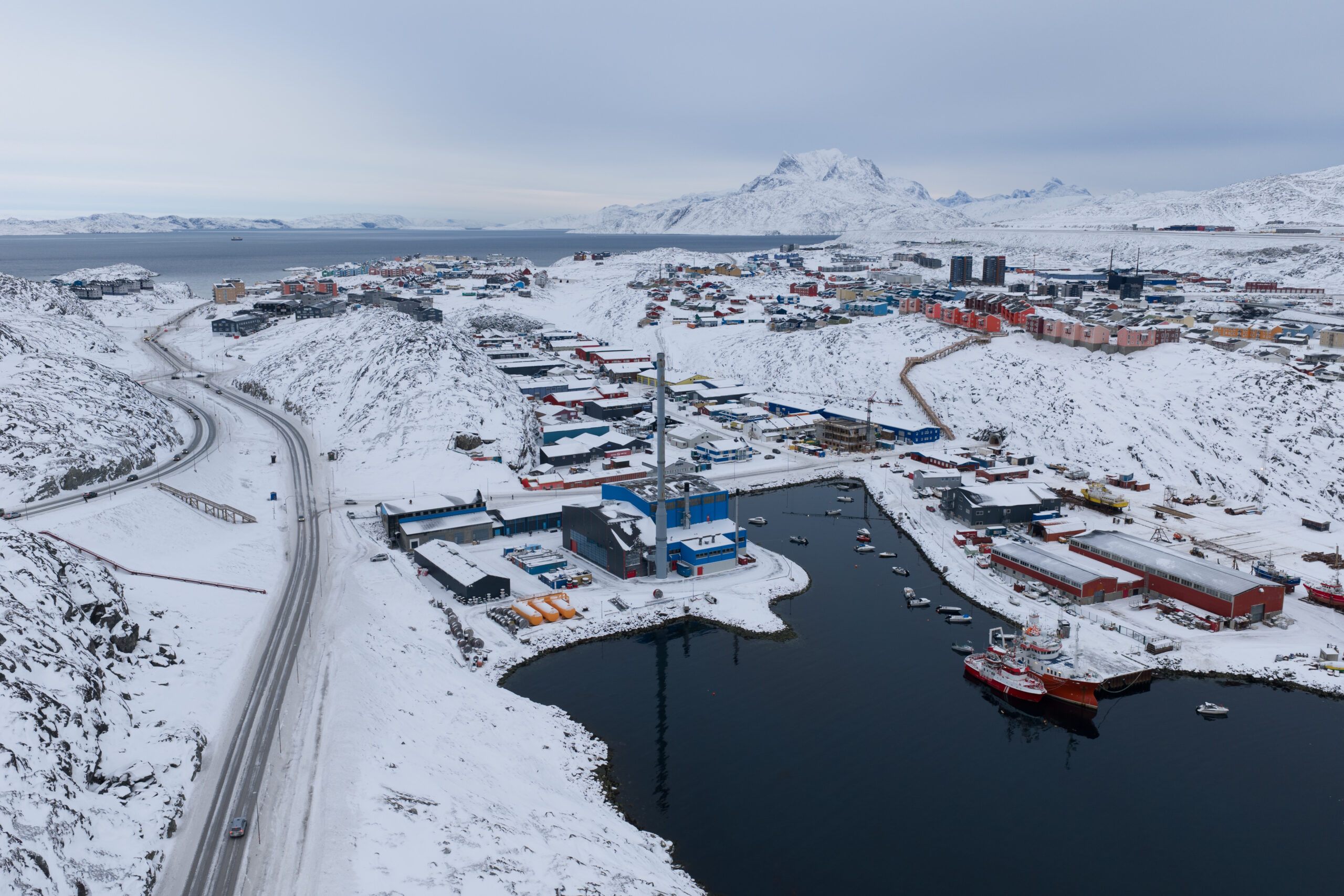
Photo: A view of Nuu Port in Greenland, the world’s largest island, on January 13. Greenland is home to some of the richest natural resource reserves globally, including critical raw materials such as lithium and rare earth elements that are vital for green energy technologies and the global energy transition. Alongside its mineral wealth, fishing remains one of the most important sources of income for the local population, forming the backbone of Greenland’s economy and sustaining many coastal communities. (Credit: Lokman Vural Elibol/AA)
Sarah Sakeena Marshall, Data Assistant