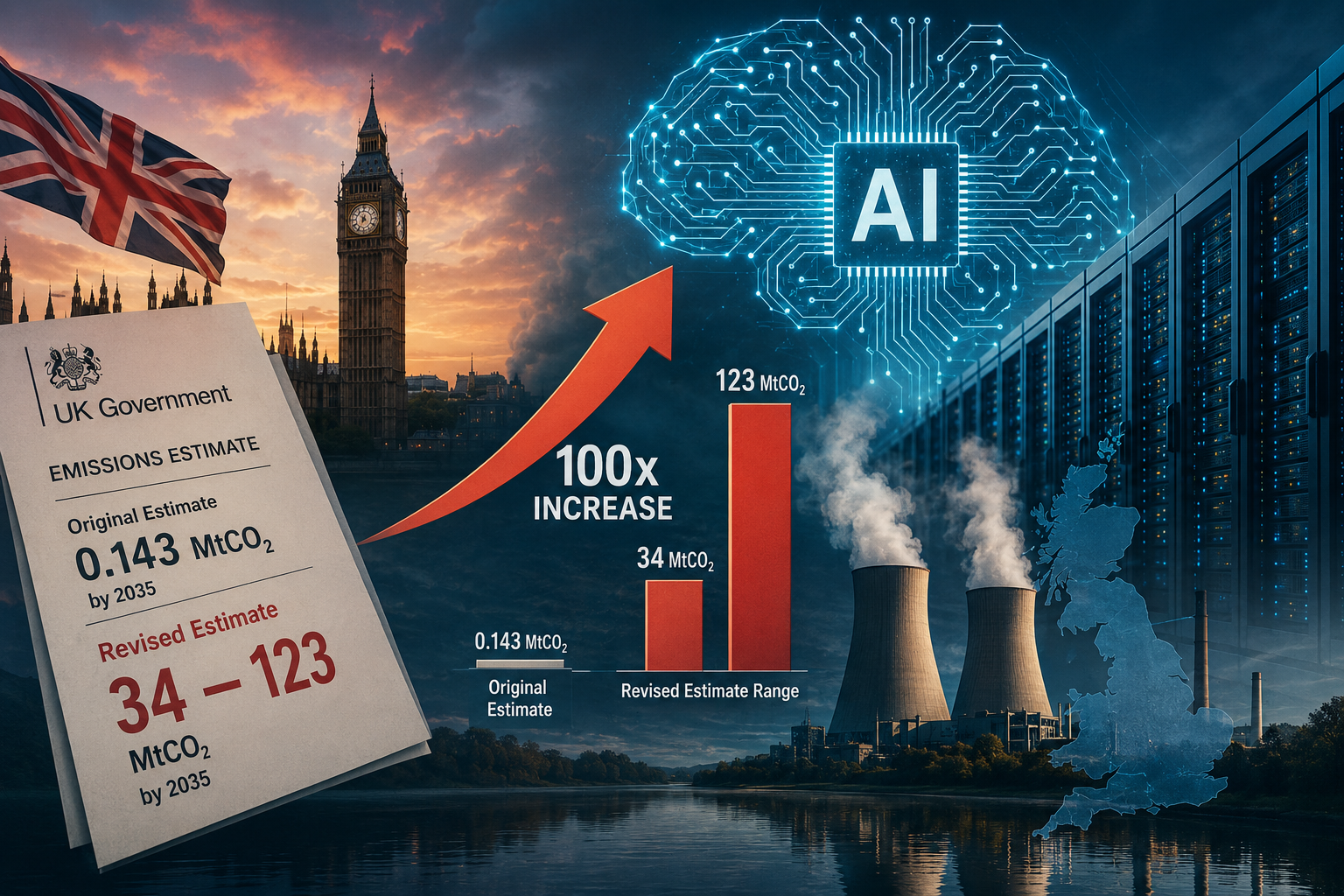
The UK Government quietly revised its estimate of emissions from AI data centres, increasing projection by more than 100 times following an analysis by Carbon Brief highlighting significant underestimation in the original figures.
The annex accompanying the UK Compute Roadmap outlines the energy grid strain brought on by data centres and the subsequent economic and national security risks that are possible, including increased carbon emissions and heavier water demand. In July 2025, the estimated annual carbon emission from AI-related data centres were projected at 0.143 MtCO2 by 2035. By March this year, the government revised this estimate significantly upward, presenting a new range of 34 to 123 MtCO₂.
Emissions projection comparison (MtCO₂ by 2035)
While the report states intentions for the UK to decarbonise its grid, aiming for 90% of energy consumption to come from renewables by 2030, the experts admit that gas will still be necessary to meet demand.
Carbon Brief’s article stated, “Last year, the government’s plan for meeting its 2035 climate target noted that AI growth was “not factored into” emissions projections, although Ed Miliband has said new data centres are captured in modelling of “overall electricity demand growth.””
Share of UK emissions impact
Given that the number of data centres that will be approved and built in the UK is currently unknown, it is difficult to predict emissions levels, or how well the UK will stick to its decarbonization timeline.
The type of energy used to power the data centres also largely affects carbon emissions projections. The government’s original estimate claimed that AI emissions in 2035 would equate to “below 0.05% of the UK’s projected total emissions,” whereas Carbon Brief estimates this could reach 20% of UK emissions and “estimates that future data centres could result in emissions equivalent to 11.4m homes, roughly a third of all UK households.”
Homes equivalent emissions impact
Politico was the first to report on the government report’s alteration, which garnered widespread backlash towards MPs from environmental and justice groups, who see the secrecy behind the change as evidence that officials are aware of AI’s disastrous climate effects and are trying to implement policies without public input. Earlier this year, the town of Potters Bar near London approved a data centre plan to build on farmland which residents vehemently protested, not wanting it to infringe on the greenbelt.
Last December, a housing development planning application for a nearby parcel was rejected on those grounds, stating, “The landscape impact and the loss of agricultural land were seen as harms they viewed to outweigh the benefits of provision of housing.” Protesters who spoke out against the AI data centre’s construction felt steamrolled after the local council granted planning permission despite petition signatures opposing the measure amounting to almost double those supporting it.
Many critics widely distrust the tech experts driving the AI boom, who are seeking government concessions to build behemoth projects that infringe on public resources. The situation is adding to mistrust of governments. Tim Bierley, campaign manager at campaign group Global Justice Now, criticized MPs for going along with the scheme merely to curry favour with Silicon Valley and the Trump administration. Patrick Galey, Head of Investigations at Global Witness, says of generative artificial intelligence, “Much like the fossil fuel industry, Gen AI developers have treated the Earth as their personal resource tap, taking lusty draughts of water and electricity while farting out CO2 in total ignorance or disdain for the needs of the planet and the 8 billion people who call it home.”
In September 2024, MPs designated data centres critical national infrastructure (CNI). Parliament’s Environmental Audit Committee is currently reviewing the inquiry “risks and opportunities to the sustainability of data centres in the UK.” There is a global race to implement artificial intelligence as quickly as possible, with the hopes that it will grow economies and keep nations competitive. Yet, experts constantly warn about the technology’s scale and impact. Revising a report is often a routine matter, but when values are off by orders of magnitude, and those numbers are correlated to real-world impacts, including water, electricity, and cost of living, it is important to get the analyses right. Just the way emissions estimates can be orders of magnitude higher than previously thought, so can job impacts—human impacts.
(Photo credit: Wim Klerkx /CC licence)
Sarah Sakeena Marshall, Consultant, Writer, Editor, Climate Change & National Security
Sarah Sakeena Marshall, Consultant, Writer, Editor, Climate Change & National Security