Nadine Osman
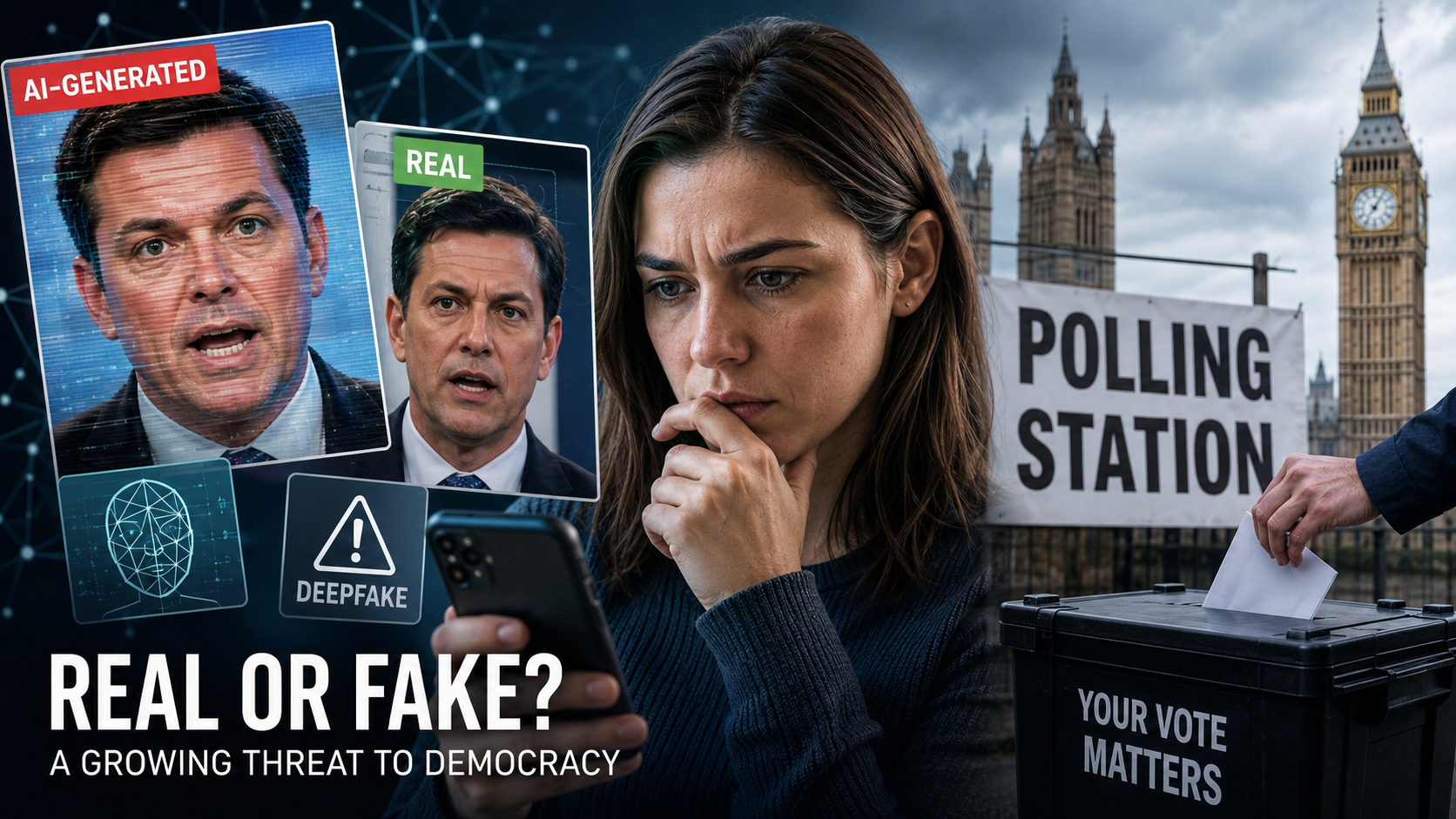
Nearly one in three UK adults performs worse than random guessing when asked to distinguish real from AI-generated content, according to new research from identity verification company Veriff, released as voters went to the polls in local elections across England on May 7.
The findings come as the Electoral Commission runs its first live pilot of an AI-detection system designed to identify political deepfakes during an election period marked by growing concern over the use of artificial intelligence in political messaging.
The research, conducted by Kantar among 1,000 nationally representative UK adults, found that just 16% of respondents achieved the highest level of accuracy when identifying AI-generated content, while 32% performed below chance level, 15% at chance level, and 37% slightly above. No participants achieved a perfect score.
Participants were asked to assess a mix of stand-alone images and videos, as well as side-by-side comparisons of real and AI-generated content. Video proved the most difficult format to assess, with only 27% correctly identifying AI-generated clips, compared with 41% for face-swaps and 53% for static images.
Veriff’s fraud platform lead, Ira Bondar, said video presents particular challenges for viewers, noting: “A face that moves, blinks and speaks naturally is harder to question than a still image. The visual tells people are taught to look for are being ironed out fast.”
The study also highlighted a gap between confidence and actual ability. While 44% of UK adults said they were confident in their ability to spot deepfakes, only one in five of this group reached the highest accuracy band. Men reported higher confidence than women, at 52% compared with 37%, but their actual performance was broadly similar.
Despite 74% of respondents saying they were familiar with the term “deepfake,” this awareness did not translate into improved detection ability. The UK recorded similar accuracy levels to the United States despite higher awareness, suggesting familiarity alone offers limited protection.
Heavy social media use provided only a marginal advantage, with those spending four or more hours daily on platforms scoring only slightly better than lighter users, indicating that exposure alone does not significantly improve detection skills.
More than three-quarters of UK adults expressed concern about deepfakes being used to spread political misinformation during elections, with 81% also citing concerns over fraud and scams, 76% over harassment or exploitation, and 78% over the erosion of trust in online content.
However, trust in platforms to address the issue remains limited, with only 42% of UK adults confident that major social media companies can effectively identify and label AI-generated content. Among those aged over 45, this falls to 22%.
Researchers say the findings highlight a widening gap between public confidence and actual ability to identify manipulated content, particularly during election periods when the risk of political misuse is heightened. Veriff’s Ira Bondar added that the safer approach is not to rely on visual judgement alone, but to verify content through independent sources before taking action.
EXCLUSIVE ENGLISH LOCAL ELECTION: Full list of newly elected Muslim councillors
EXCLUSIVE: Over 450 Muslim councillors elected in England’s local polls as Labour bleeds urban seats
EXCLUSIVE: England Local Elections – Muslim Councillors: Representation & Share