Dawood Ashaari
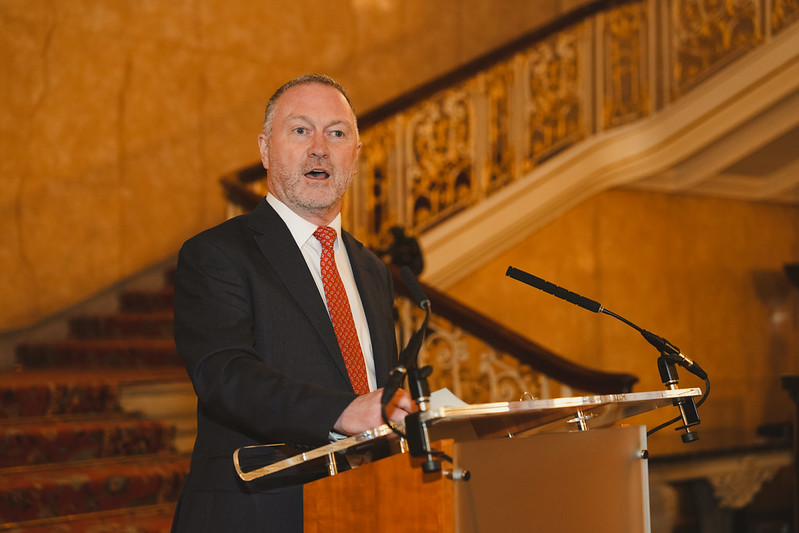
The Communities Secretary Steve Reed, unveiled the Government’s long-awaited definition of “anti-Muslim hostility.” on March 9, as part of a wider 47-page Social Cohesion Strategy.
Almost 10 years after the government adopted the IHRA working definition of antisemitism in December 2016, the Government issued the following definition of “anti-Muslim hostility”
Anti-Muslim hostility is intentionally engaging in, assisting or encouraging criminal acts – including acts of violence, vandalism, harassment, or intimidation, whether physical, verbal, written or electronically communicated – that are directed at Muslims because of their religion or at those who are perceived to be Muslim, including where that perception is based on assumptions about ethnicity, race or appearance.
It is also the prejudicial stereotyping of Muslims, or people perceived to be Muslim including because of their ethnic or racial backgrounds or their appearance, and treating them as a collective group defined by fixed and negative characteristics, with the intention of encouraging hatred against them, irrespective of their actual opinions, beliefs or actions as individuals.
It is engaging in unlawful discrimination where the relevant conduct – including the creation or use of practices and biases within institutions – is intended to disadvantage Muslims in public and economic life.
The definition is accompanied by a nine-page document with explanatory notes. However, the notes provide no examples of what would meet the threshold of this definition. Five examples are included of what the definition does not cover, in relation to the protection of “free speech and expression within the law.”
Notably, the document does not mention the word Islamophobia, despite it being an internationally recognised term for the hatred, discrimination and othering that Muslims face, including at the UN, the EU, Canadian Government, Australian Government and more.
Fraught history
The Muslim News reported in December of fresh delays to this definition being announced, following the recommendations of the Independent Working Group being submitted to the Government last October.
This follows the Labour Government U-turning on the 2018 definition of Islamophobia produced by the All-Party Parliamentary Group (APPG) on British Muslims, which the Labour Party accepted whilst in opposition but dropped after its General Election victory in July 2024. That definition was backed by more than 850 Muslim organisations, over 100 academics, upwards of 60 local authorities, and every major political party, including the Scottish Conservatives, with the notable exception of the then-governing Conservative Party.
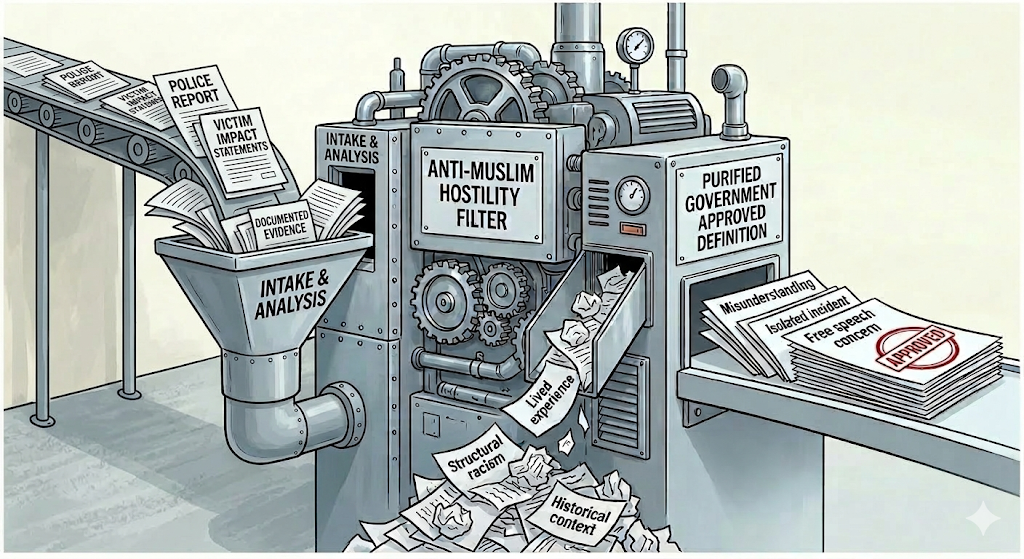
In early 2025, the Labour Government appointed a working group chaired by Dominic Grieve KC and comprising four Muslim members. However, having received and reviewed their recommendations since last October, the Government appears to have watered down the Working Group’s wording which was leaked to the BBC last December by removing the term racialisation.
For the last 12 months, there has been significant pressure by opponents of the Government to drop the process on grounds of free speech and so-called ‘blasphemy’, including from GB News, Policy Exchange, National Secular Society, Free Speech Union and numerous Conservative and Reform MPs.
Mixed reaction: A first step forward vs lack of community buy-in
The Government’s decision to away from the term “Islamophobia” in favour of “anti-Muslim hostility” has drawn mixed reactions from community leaders and legal experts alike, with many already warning this is an exercise in watering down to appease far-right activists, media and politicians.
Supportive reactions include from Labour MPs like Afzal Khan MP who said. “Where previous Conservative governments failed to act to tackle anti-Muslim hatred, this Labour Government has made it a clear priority. Having campaigned on tackling all forms of racism for decades… I know first-hand how rampant anti-Muslim hostility has become in Britain, and the importance of having a government committed to addressing this”
Shabir Randeree, Chair of the Government-funded British Muslim Trust (BMT), said, “The definition published today is welcomed and should be a step forward that will help guide institutions that have too often been too slow or too weak in their responses to incidents a tolerant and respectful country like ours must never accept.”
Baroness Shaista Gohir, who was part of the Independent Working Group and CEO of the Muslim Women’s Network, said, “I welcome the government’s decision to adopt most of the wording recommended by the Working Group, of which I was a member, including the term ‘anti-Muslim hostility.’ While the term ‘racialisation’ has been removed because it is not widely understood by the public, I am pleased that explanatory wording describing the process has been included in its place, including in the accompanying notes.”
However, there has also been much critical reaction. Shockat Adam, Independent MP for Leicester South, said, “The Government’s rebranding of Islamophobia as ‘anti-Muslim hostility’ dilutes the harsh reality British Muslims confront every single day. Renaming a wound cannot be called healing. Islamophobia today is not episodic hostility. It’s a rising tide of systematic othering and a media landscape poisoning public perception.
“With this definition, political comfort cannot come at the expense of community safety. In the dangerous gaps between words and action, racism thrives. Bridging that gap starts with truly listening to grassroots Muslim organisations, holding policies up to independent scrutiny and ensuring hate crimes are robustly monitored and confronted.”
Dr Wajid Akhter, Secretary General of the Muslim Council of Britain, said, “The Government’s working definition of Islamophobia which it has renamed anti-Muslim hostility… appears to be a diminished version of that recommended by the Government’s own Independent Working Group last year.”
“Given the concerns about dilution, the motivations of some of those driving the dilution, the lack of transparency and meaningful engagement with grassroots community representatives throughout the process and the need for us to consult widely on this important matter – we are unable to endorse such a definition at the present time. Rather, it is for the Government to convince and earn the trust of the British Muslim community that this definition will help stem the rising discrimination, systematic othering and harms that British Muslims are facing on a daily basis.”
Majid Iqbal, CEO of the Islamophobia Response Unit (IRU), said, “This definition sets an intent threshold that most discrimination cases cannot meet. Our casework shows that Muslims face bias, institutional barriers, and microaggressions that aren’t intentional, but are no less harmful.”
In their detailed analysis, the IRU also stated that “The internationally recognised term “Islamophobia”, like homophobia or transphobia—better captures the systemic, often unconscious nature of this form of prejudice. The government’s rejection of this terminology may signal a narrowing of what forms of discrimination are recognized as worthy of attention.”
The Muslim News asked the Government several times why they had removed the word Islamophobia, which has been used for decades not only in the UK, but across the world. Prime Minister’s spokesperson said in response, “I think that we’ve said on record previously that different terms have been used over a period, but the crucial thing here is that this plan sets out how millions of pounds are going to be pumped into restoring national pride. It sets out clear expectations for integration, and it sets out action taken to root out extremism and hatred.”
Social cohesion strategy
The announcement on 9 March has been tied to a new Government Social Cohesion Strategy which aims to “bring communities together and tackle extremism”.
The Social Cohesion Strategy recommends the Government appoints a Special Representative on “anti-Muslim hostility”, whose role is to “champion efforts across the UK to tackle hostility and hatred directed at Muslims.” The representative “will engage with communities and stakeholders, and support cross-sector action to strengthen understanding, reporting and response.”
The role appears to be modelled on the Government’s Independent Antisemitism Advisor – who since 2019 is Lord John Mann – who is supported by an annual grant from Government of £100,000 to the Antisemitism Policy Trust to provide secretariat support.
However, unlike Lord Mann, the proposed representative for “anti-Muslim hostility” is not described as independent, and no Terms of Reference have yet been published. The Muslim News understands that Labour parliamentarians are under consideration for the post.
Feature photo: Communities Secretary Steve Reed unveiled the Government’s controversial new definition of “anti-Muslim hostility,” replacing the widely recognised term Islamophobia, drawing mixed reactions from Muslim organisations and legal experts. (Credit: Ben Dance / FCDO)READ MORE Editorial – ‘Anti-Muslim Hostility’: A definition that sidesteps the problem