Irina von Wiese, Human Rights Lawyer
The government this month faces charges of giving Islamophobia a free pass as it refused to properly acknowledge the anti-Muslim hate mobs rampaging in Whitehall on Armistice Day, November 11.
Many of the far-right protestors are reported to have converged on the Cenotaph in the capital following weeks of media hysteria against the much larger National March for Palestine, which took place in response to Israel’s continued assault against Gaza
Participants in the so-called counter-protest included Tommy Robinson, a known far-right activist against Islam and Muslims who has served time for violence and fraud.
Some have held former Home Secretary Suella Braverman personally accountable for this violence. Those attending the violent counter-protest came along because of the hysteria whipped up by Braverman and her supporters in the media. One activist told the Observer newspaper that Braverman was the “only one making any sense at the minute. We’re sleepwalking into a race war.”
In the days leading up to the Saturday protest, the former Home Secretary agitated for the main pro-Palestinian and previous events to be banned, branding them as ‘hate marches’ and suggesting that the Palestinian flag should be banned. In an inflammatory article written in The Times, Braverman accused the police of being ‘bias’ following the Metropolitan Police’s refusal to ban the pro-Palestinian march.
The fallout from the former Home Secretary’s action was referenced in a statement by Met Police Assistant Commissioner Matt Twist, who said in a statement after the march that, ‘following a week of intense debate about protest and policing, these all combined to increase community tensions.’
Yvette Cooper, the shadow Home Secretary, condemned Braverman’s interventions as a “highly irresponsible, dangerous attempt to undermine respect for police at a sensitive time, to rip up operational independence, and to inflame community tensions.”
Sadiq Khan, Mayor of London, said: “The scenes of disorder we witnessed by the far-right at the Cenotaph are a direct result of the Home Secretary’s words.”
Yet, despite the violence from the far-right counter-protest and the largely peaceful pro-Palestinian protest attended by over 300,000 people, Braverman was unapologetic in her response, doubling down on her attacks against the pro-Palestinian march, and refusing to mention at all the background or nature of the counter-protesters.
Writing on X, the platform formerly known as Twitter, Braverman said the day after the march: “The sick, inflammatory, and, in some cases, clearly criminal chants, placards, and paraphernalia openly on display at the [pro-Palestinian] march mark a new low. Antisemitism and other forms of racism, together with the valorisation of terrorism on such a scale, are deeply troubling.”
The former Home Secretary was referencing the dozen or so antisemitic photos and chants made at the pro-Palestinian marches, which have yet to be prosecuted and which the organisers of the march, the Palestine Solidarity Campaign, have clearly condemned. Yet, the vast majority of the 150 or so arrested on Saturday were far-right counter-protestors.
Braverman refused to acknowledge any responsibility for her actions, even after being sacked as Home Secretary on November 13 after facing widespread criticism. In a strident resignation letter to Sunak, Braverman doubled down on her rhetoric, stating that ‘Britain is at a turning point in our history and faces a threat of radicalisation and extremism in a way not seen for 20 years.’
Rishi Sunak also took a similar line to Braverman on November 11 by condemning ‘Hamas sympathisers’ at the National March for Palestine. Unlike the Home Secretary, the Prime Minister acknowledged the far-right identity of the counter-protestors.
Despite replacing Braverman with James Cleverly, the government has yet to address the consequences of the former Home Secretary’s actions, particularly in stoking far-right Islamophobic sentiment as expressed on Armistice Day.
Both Sunak, Braverman, and now Cleverly have failed to acknowledge the anti-Muslim nature of the counter-protest groups while doubling down on alleged ‘Hamas extremism’ in the pro-Palestinian marches. Since October 7, Tell Mama has reported a 600% rise in incidents against Muslims.
When asked why the government was failing to give similar reassurances to Muslim communities as they did to Jewish communities during these crises, a government spokesperson told The Muslim News: “We are clear that there must be zero tolerance for antisemitism, anti-Muslim hatred, or any other forms of hatred, whether they appear online or offline. Any instance of hate crime is one too many. We expect the police to fully investigate these hateful attacks and make sure the cowards who commit them feel the full force of the law.”
The key question is whether the actions of the former Home Secretary’s rhetoric were an aberration or a feature of the governing Conservative Party, which faces accusations of widespread Islamophobia. Condemning Braverman’s actions as ‘divisive’, Conservative peer Baroness Sayeeda Warsi told Sky News on November 6: “We have now, sadly, some of my colleagues in government who project as patriots, but they are indeed arsonists. They set this country alight, they pit community against community, and they create these fires. And that is not the job of a government.”
In recent weeks, Muslims have been subjected to particularly intense and prejudiced commentary by Conservative Party-supporting commentators. This was exemplified by Conservative Party parliamentary candidate Nick Timothy, who called for a ‘muscular approach’ to end alleged ‘domestic separatism’ by, amongst other things, enforcing a ‘register of imams with unacceptable behaviours leading to preaching bans and closures’ and that ‘burqas should be banned in public spaces’.
These are similar views articulated infamously by the conservative commentator Douglas Murray, who said in 2006 that “conditions for Muslims in Europe must be made harder across the board: Europe must look like a less attractive proposition.”
While Murray has highly praised Braverman over her recent actions, he continues to court controversy, accusing the Muslim First Minister of Scotland, Humza Yousaf, of being ‘the First Minister of Gaza’. Yet, in September this year, Braverman insisted at the House of Commons that Murray was not an extremist and someone who ‘expresses mainstream, insightful, and perfectly decent political views’.
Prior to the latest crisis, the former Home Secretary had a record of stoking anti-Muslim hatred. Braverman claimed in a Mail on Sunday article published in April that those involved in child sexual abuse gangs were “almost all British-Pakistani” due to “cultural attitudes completely incompatible with British values” that “have been left mostly unchallenged both within their communities and by wider society.” This, of course, was disputed by the Home Office’s own experts and the Mail on Sunday was forced to retract this claim.
For many years, the Conservative Party has been mired in accusations of Islamophobia, with little progress on ongoing investigations. Critics point to numerous examples of Islamophobia among Tory representatives and members. Boris Johnson was accused of making bigoted remarks about Muslim women.
An independent report in 2021 found the Tory Party failing to take Islamophobia seriously. Polling by Hope Not Hate revealed nearly half of Conservative members hold Islamophobic views. Some Tory councillors and officials have shared anti-Muslim content online.
As convulsions in the Conservative Party continue in the run-up to the next general elections, it remains to be seen whether the party will be able to extricate itself from accusations of Islamophobia or whether it will see anti-Muslim hatred as a vote-winning strategy.
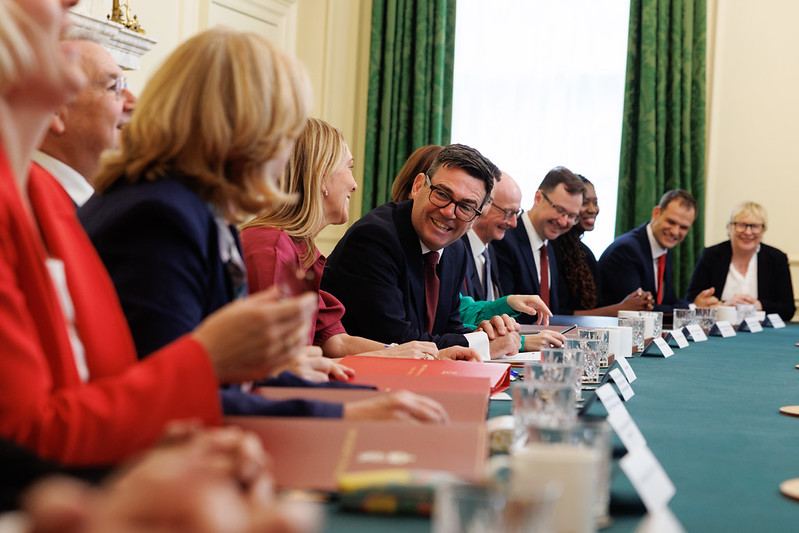
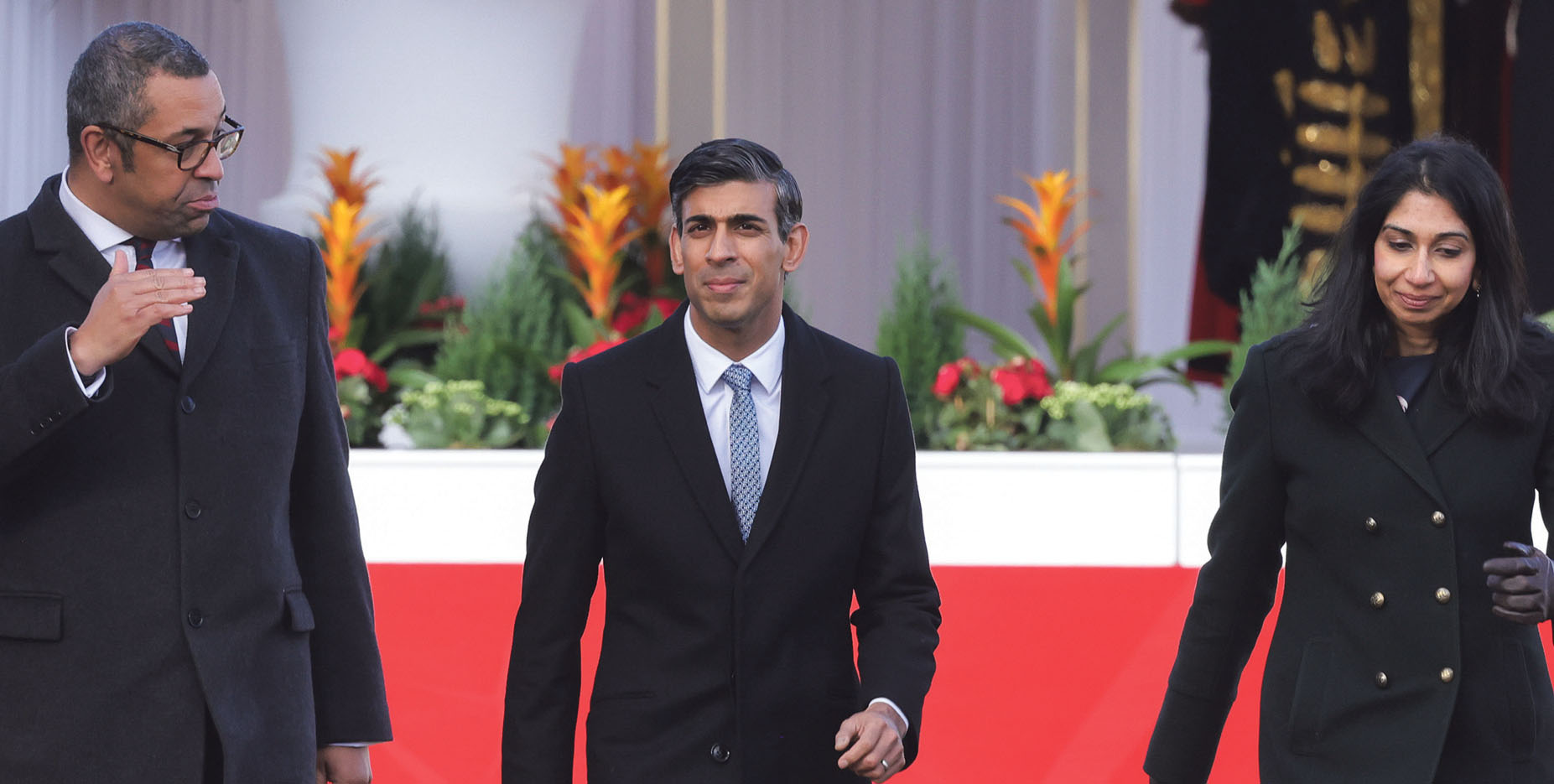
Photo: PM Rishi Sunak (centre), and the former and current Home Secretaries Suella Braverman, and Jame Cleverly have failed to acknowledge the anti-Muslim nature of the counter-protest groups while doubling down on alleged ‘Hamas extremism’ in the pro-Palestinian marches.
(Credit: Simon Dawson/No. 10 Downing St.)
Irina von Wiese,
Southwark Council, Councillor, Former MEP & Lib-Dems 2024 candidate for London Assembly
GAZA SIEGE | SPECIAL COVERAGE
GAZA: Bereaved British Palestinians recall harrowing loss as they appeal for ceasefire
Editorial: West’s deepening complicity in Israel’s ethnic cleansing, if not genocide of Gaza
Muslim MP bombarded with death threats for supporting besieged Palestinians
US: Over 1,200 incidents of anti-Arab and Islamophobic bias
FBI investigate anti-Palestinian abuse at American University
‘Free Palestine’ isn’t hate-speech superintendent says following student’s suspension
Anti-Muslim hate crimes soar in Germany
‘Witch-hunt’ referrals to regulator of pro-Palestinian physicians must end, say Muslim medics body
UK PM urged to combat on Islamophobia as figures show a sevenfold rise post Israel-Gaza conflict
Cut ties with Israeli institutions, over 600 academics tell Irish universities
Congress votes to censure Rashida over Israel criticism
‘Fascism and pure bigotry,’ Muslim congress members slam Republican Palestinian ban proposal
Stanford student hospitalised in suspected anti-Muslim hit-and-run