Home Correspondent
An independent inquiry has found that the 2022 Leicester violence began with an attack on a Muslim man in May, which police failed to investigate, but escalated into widespread communal disorder because of retaliatory violence from both Hindu and Muslim groups, compounded by policing failures, institutional neglect, and a destructive information environment featuring disinformation from Hindutva and political Islamist sources alike.
The Independent Commission of Inquiry into the 2022 Leicester Violence, chaired by Professor Juan Méndez, published its 217-page final report, Better Together: Understanding the 2022 Violence in Leicester, following a two-year investigation.
The Trigger
The report identifies the attack on the night of Sunday May 22, 2022 as the starting point. An 18-year-old Muslim man was driving home when he stopped to check on someone being assaulted. A large group of Hindu youths confronted him, asking “Are you Muslim?” When he confirmed he was, they attacked him with cricket bats, metal poles, and bottles. He suffered facial fractures and required hospital treatment.
According to the report, a witness recounted: “They just started beating him… and they just kept going for his face and his head.” Despite CCTV evidence and the family’s persistent complaints, no charges were brought. The report describes this failure to investigate as a critical error that “framed how some residents perceived events in August and early September.”
The report is explicit that the violence cannot be attributed to any single community. It states: “Our findings clearly show that no single community or group is ‘to blame’ for the violence, distrust, and tensions that erupted in 2022.” Instead, it documents a chain of retaliation involving individuals and groups from both Hindu and Muslim communities.
Escalation and Violence
Following the May attack, provocative behaviour increased. Car convoys of Hindu youths drove past mosques, waving flags and chanting “Jai Shree Ram.” These incidents went largely unchecked by police. One witness told the inquiry: “The police were of the opinion that it would all die down, there was no issue.”
In early September, during the Ganesh Chaturthi festival, an individual threw eggs at a Hindu home celebrating the occasion—an act the report describes as a “desecration.” In retaliation, a large group of Hindu youths violently attacked a Muslim man near Bridge Road on 5 September, leaving him seriously injured.
This attack prompted large gatherings of Muslim men outside the Jame’ Masjid. While many sought peaceful discussion, some broke away. Over the nights of 5–7 September, groups of Muslim youths roamed residential streets, attacking Hindu individuals and property. A Hindu man was stabbed in the hand. Homes identifiable by Hindu religious symbols were targeted. Hindu families described their terror as masked youths banged on doors and windows.
The September March and Counter-Mobilisation
On September 17, hundreds of Hindu youths, predominantly from the Daman and Diu community, marched from Belgrave to Green Lane Road, an area with a significant Muslim population. The report describes the march as “unprecedented” and “communal in its intention,” noting that participants chanted “Jai Shree Ram” and “Vande Mataram”—slogans it links to Hindu nationalist politics. Marchers carried weapons, and unprovoked attacks on Muslim individuals occurred along the route.
The march triggered a large counter-mobilisation of Muslim youths. Violence escalated through the afternoon and evening, with running battles in the streets. A Hindu man was dragged from his car and attacked on Gypsy Lane. A Muslim man pulled down and attempted to burn a saffron flag outside the Shivalaya Mandir—an act the report notes was immediately condemned by other Muslims present, who intervened to stop it.
Disinformation from Multiple Sources
The report provides a detailed analysis of misinformation and disinformation from all sides.
It documents a coordinated Hindutva disinformation campaign, primarily led by the anonymous organisation Insight UK, which promoted the hashtag #HindusUnderAttackInUK. This campaign presented the 17 September march as a “peaceful protest” and misrepresented the Muslim counter-mobilisation as “violent Islamists” and “Pakistani gangs.” Insight UK described the events as “an outright attack on Hindus by #Islamists.” The Commission observed that Insight UK’s subsequent campaign against the inquiry itself “made the work of fact-finding and community engagement significantly more difficult.”
However, the report is equally critical of disinformation from ‘political Islamist’ and local Muslim activists. It details how false stories, including an alleged kidnapping of a Muslim girl by a Hindu man, led to a Hindu family being surrounded by a mob and forced to flee their home. It names social media influencers like Mohammed Hijab and Ali Dawah, who travelled to Leicester and posted “highly inflammatory anti-Hindu messages.” The report concludes that a “bare handful of two or three Muslim activists in Leicester was causing major problems across communities.”
Policing and Institutional Failures
The report is highly critical of Leicestershire Police, finding that officers failed to investigate the May attack, ignored escalating tensions, and were “caught off guard” on 17 September, initially deploying only eight officers to accompany the march.
Perceptions of bias were widespread and ran in both directions. Muslim communities described being treated “aggressively and roughly” during early September gatherings. Hindu residents felt the police failed to protect them during the September 5–7 attacks. The report notes that “members of both Hindu and Muslim communities view the actions of the police as favouring the other community.”
Political leadership was also heavily criticised. The City Council “failed in all these respects,” the report states, with the City Mayor absent during the violence and later “consistently rejecting our attempts to meet.”
Lasting Division and Recommendations
The report warns that Leicester remains divided. “To date, no significant meetings of Hindu and Muslim organisations have taken place to discuss the 2022 events or ways to move forward together. This would seem to be a major priority,” it states. Residents described lasting fear and mistrust: “Everyone in my street looked at each other with uncertainty for some time afterwards.”
To prevent a recurrence, the Commission recommends 47 measures, including a permanent community unity forum, a rapid-response counter-disinformation unit, and renewed investment in youth services. It calls for the UK government to recognise Hindutva extremism alongside other forms of extremism, but also urges Hindu and Muslim communities to isolate extremists within their own communities. The report stresses that religious and community figures should publicly reject divisive rhetoric, noting that “there are always common grounds, good-faith actors, and goodwill.”
The Commission concludes that the 2022 violence was preventable, arising from “years of neglect, failed intelligence, and the unchecked spread of divisive, extremist ideologies, both foreign and domestic.”
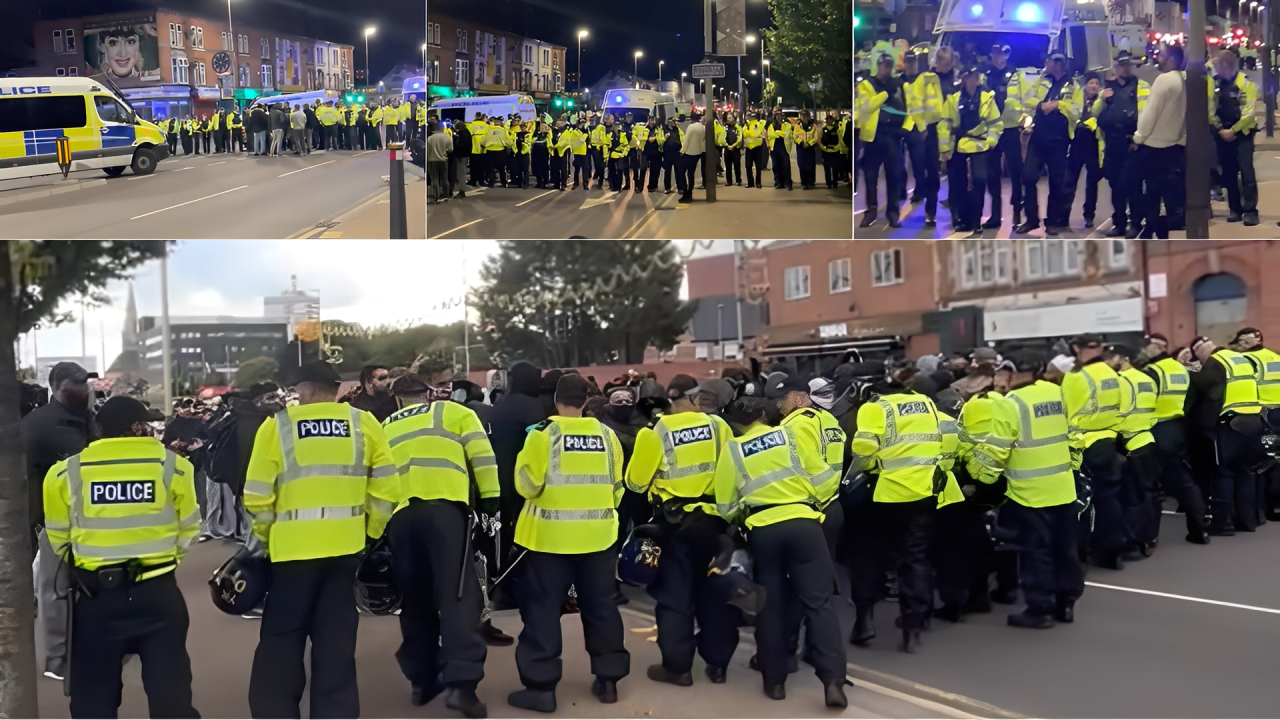
Feature photo: Police officers form a line during the 2022 unrest, which took place between August and September in Leicester, England. (Credit: Jaseem/UKIMC)