By Middle East Correspondent
London, (The Muslim News): The United Nations has urged Iranian authorities to exercise restraint as nationwide protests, sparked by economic hardship and the collapse of the national currency, continue to grip the country amid a prolonged internet blackout, rising casualty claims, and escalating rhetoric between Tehran, Washington, and Tel Aviv.
UN Secretary-General Antonio Guterres on Sunday called on Iranian authorities to avoid “unnecessary or disproportionate” force against demonstrators, warning of grave human rights concerns.
“The Secretary-General is shocked by the reports of violence and excessive use of force by the Iranian authorities against protesters in multiple locations across the Islamic Republic of Iran, resulting in scores of deaths,” UN spokesman Stephane Dujarric said in a statement.
Guterres stressed that Iranians must be able to express their grievances peacefully and without fear, emphasising that rights to freedom of expression, association, and peaceful assembly, enshrined in international law, must be “fully respected and protected.” He also urged Iranian authorities to take steps to restore access to information, including communications services.
As Iran entered its fourth consecutive day of a nationwide internet shutdown, London-based internet monitoring group NetBlocks reported that the country had been offline for more than 72 hours.
Telemetry data indicated that the nationwide internet restriction “remains firmly in place,” NetBlocks said, adding that national connectivity levels continued to flatline at around one per cent of ordinary levels.
The blackout has drawn sharp criticism from international observers, particularly as protests have intensified and reports of casualties have multiplied.

[Photo: People gather at Enghelab Square after a government call to rally against recent protests across the country, chanting anti-U.S. and anti-Israel slogans, in Tehran, Iran, on January 12, 2026. Photojournalist: Fatemeh Bahram/AA]
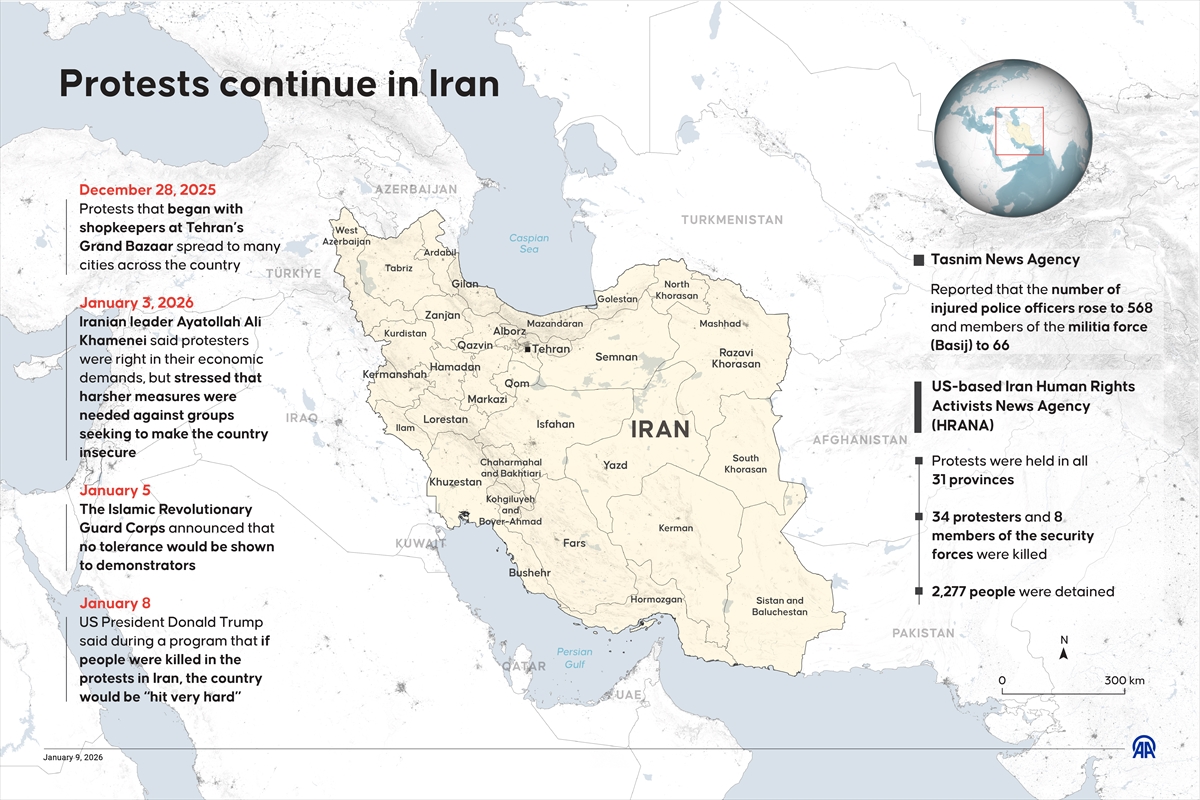
Iran has been rocked by protests since December 28, when demonstrations first erupted at Tehran’s Grand Bazaar over the sharp depreciation of the Iranian rial and worsening economic conditions. The unrest later spread to several other cities, evolving from economic grievances into broader anti-government demonstrations.
The current unrest is widely regarded as the largest since the 2022–2023 protest movement triggered by the death in custody of Mahsa Amini, a 22-year-old woman detained for allegedly violating Iran’s strict dress code for women.
There are no official casualty figures from Iranian authorities. However, estimates from rights groups, media outlets, and medical sources vary widely.
The US-based rights group HRANA reported that at least 116 people have been killed and more than 2,600 detained. In other reports, HRANA estimated up to 490 protesters and 48 security personnel killed, with more than 10,600 arrests.
A Tehran doctor told Time magazine on condition of anonymity that six hospitals in the capital recorded “at least 217 protester deaths, most by live ammunition.”
Separately, Qatar-based Al Jazeera, citing Iran’s Tasnim News Agency, reported that at least 109 Iranian security personnel were killed during the unrest, without specifying the number of protesters who died.
President Masoud Pezeshkian, in his first public remarks since the protests turned violent, said his government was determined to address Iran’s economic problems while accusing the United States and Israel of fomenting unrest.
Iran’s “enemies are seeking to sow chaos and instability” following the country’s 12-day war with Israel last June, Pezeshkian said in a televised address.
Condemning attacks on public property, including mosques, banks, buses, and government buildings, the president insisted that those responsible were not protesters but armed rioters.
“They have killed some with weapons, burnt others, and beheaded some. Truly, these crimes are beyond our people’s nature. These are not our people. They do not belong to this country. If someone protests for this country, we listen and address their concerns,” he said.
Pezeshkian acknowledged government failings, admitting to “shortcomings and problems”, particularly regarding the economy.
“The government is determined to solve economic problems and is ready to listen to the people,” he said, urging families “not to let their youth mix with rioters and terrorists who kill and behead.”
“Protest if you must; we will listen and solve your concerns. Let us work together to solve problems. But worsening the country’s economic situation through chaos serves no one,” he added.
He further argued that violent unrest would not be tolerated anywhere else in the world.
“Where in the world are such protests and behaviours accepted as protests? If this happened in the US, would Americans allow it? Would Europeans allow it? If someone attacked a military base or city centre, would they say, ‘Go ahead and loot it’,” he said.
Iranian officials have repeatedly accused Washington and Tel Aviv of backing what they describe as increasingly violent protests.
Pezeshkian alleged that the US and Israel were “training certain groups” and bringing “terrorists from abroad” to set mosques, markets, and public places on fire.
“The same people who destroyed this country and killed our youth and children now instruct these rioters to destroy more,” he said.
Iranian authorities have cited social media activity as evidence of foreign interference. The Mossad’s Farsi-language account posted shortly after protests began, “Let’s come out to the streets together. The time has come. We are with you. Not just from afar and verbally. We are with you in the field as well.”
Iran’s parliament speaker, Mohammad Bagher Ghalibaf, issued a warning on Sunday that Israel, US military bases, and shipping centres would be regarded as “legitimate targets” in the event of a military attack on Tehran by Washington.
“Within the framework of legitimate defence, we do not limit ourselves to responding only after an action. In the event of a US military attack, both the occupied territories (Israel) and US military and shipping centres will be legitimate targets for us,” he said from the parliamentary podium.
Ghalibaf said Iran was confronting the US and Israel on four fronts: economic, cognitive, military, and terrorist warfare, and described current unrest as part of that confrontation.
“The enemies planned to recruit local terrorists during the 12-day war, but they failed. Now, they have recruited local terrorists. We are fighting terrorists,” he said, as lawmakers chanted anti-US slogans.
US military officials, speaking anonymously to American media outlets, indicated that more time would be required to prepare US forces prior to any possible strike on Iran.
“All options are on the table for President Trump, but no decision has been made,” one US official told Axios, adding that discussions remain fluid and largely non-kinetic.
A senior military official cited by The New York Times warned that military action could unify the Iranian public behind its government or trigger regional retaliation.
Trump, meanwhile, said Iranians were “looking at freedom” and warned Iranian authorities against using lethal force.
Earlier, he tweeted that the US would “come to the rescue” of Iranian protesters should the government escalate its response. These remarks prompted strong criticism from senior Iranian officials, including Supreme Leader Ayatollah Ali Khamenei.
Iranian Foreign Minister Abbas Araghchi rejected the claims made by the US government, stating on X, “According to the US Government, Iran is ‘delusional’ for believing that Israel and the US are instigating violent riots in our country.”
“There is only one problem: President Trump’s own former CIA Director has openly and unashamedly highlighted what Mossad and its American enablers are really up to,” he added.
“The only ‘delusional’ aspect of the current situation is the belief that arson does not ultimately implicate arsonists.”
Ali Larijani, secretary of Iran’s Supreme National Security Council, called for “decisive action” against what he termed rioters, while stressing the need to distinguish between legitimate protest and violence.
“It is necessary to draw a distinction between protests and riots,” he said.
“The criminal activities, such as killing people and arson attacks, closely resemble the methods used by terrorist groups like Daesh (ISIS),” he warned, saying such actions would damage society and deepen economic stagnation.
Iranian media reported the assassination of Farajollah Shooshtari, a former acting deputy governor for political and security affairs in Semnan province, during unrest in Mashhad. Tasnim News Agency described the killing as an “assassination” by armed individuals.
Shooshtari was the son of Nourali Shooshtari, a senior IRGC commander killed in a 2009 suicide bombing.
In another incident, Tasnim reported that a three-year-old girl, Melina, was shot dead by armed rioters in Kermanshah while in her father’s arms as he went to buy medicine.
Amid the unrest, users reported that X updated the Iran flag emoji on its web platform, replacing the Islamic Republic emblem with the pre-revolutionary Lion and Sun symbol. The change appeared across official Iranian state accounts on web browsers, though not on mobile platforms.
Separately, Elon Musk’s SpaceX activated Starlink satellite internet in Iran during the blackout, offering free access for an unspecified period, a move Tehran views as part of a broader information war.
[An infographic titled “Protests continue in Iran” created in Istanbul, Turkiye on January 9, 2026. Photojournalist: Efnan İpşir/AA]