By Middle East Correspondent
LONDON, (The Muslim News): US airstrikes on Iran have triggered retaliatory attacks on American military bases in Kuwait and Bahrain, while Israeli forces launched a new ground offensive in central Gaza on Wednesday killing Palestinians and forcing families from their homes despite a ceasefire.
Israeli attacks also continued across the occupied Palestinian territories, with Israeli settlers torching Palestinian vehicles and attempting to burn homes near Hebron, while Israeli police escorted settlers into Al-Aqsa Mosque in occupied East Jerusalem.
Meanwhile, Italy’s parliament approved controversial legislation adopting the International Holocaust Remembrance Alliance (IHRA) definition of antisemitism, following a heated debate over Gaza, allegations of genocide and criticism of Israel.
TEHRAN HITS GULF BASES IN RETALIATION OF US BOMBING OF QESHM ISLAND
US fighter aircraft struck an Iranian missile-launch site on Qeshm Island in the Strait of Hormuz on Tuesday, 17 November.
However a US military official said the operation targeted an installation belonging to Iran’s Islamic Revolutionary Guard Corps (IRGC), in retaliation for attacks on American personnel and military assets.
The strikes followed an Iranian attack on a US radar installation in Bahrain, which US Central Command said had been intercepted.
Iranian authorities confirmed several explosions on Qeshm Island but said residential, commercial and essential infrastructure had not been damaged. Initial reports of casualties have not been independently verified.
On Wednesday, the Iranian military said it had targeted US drone and missile installations at Kuwait’s Ali Al Salem air base. Kuwait activated its air defences to intercept drones and condemned the attacks as a threat to its security and stability.
Bahrain also reported intercepting Iranian attacks. The kingdom, which hosts the US Navy’s Fifth Fleet, issued emergency alerts instructing residents to seek shelter before announcing that the immediate threat had passed.
The IRGC had previously claimed to have struck American radar installations in Bahrain and warned the kingdom over its security partnership with Washington.
The attacks have raised concerns among Gulf states hosting US forces that they could become further involved in the confrontation.
Shipping through the Strait of Hormuz, a major international route for oil and gas exports, has also come under threat.
Iranian military authorities reported several tanker incidents over the preceding 24 hours, claiming that vessels had struck naval mines. The circumstances remain disputed, and responsibility for individual attacks has not been independently established.
A tanker was reportedly struck near the Omani coast, forcing its crew to abandon ship. Another was hit by an unidentified projectile, while an attack on a UAE-owned tanker left 11 people injured and one crew member missing.
Saudi Arabia said its air defences intercepted two cruise missiles launched by Yemen’s Ansar Allah movement towards Riyadh, following coalition airstrikes in Yemen which the movement said had killed at least 17 people.
Oman and Qatar have continued mediation efforts between Washington and Tehran, with maritime security, sanctions, the US naval blockade of Iranian ports and Iran’s nuclear programme among the issues under discussion.
The arrival of the USS Theodore Roosevelt has further reinforced the American military presence in the region.
ISRAEL LAUNCHES NEW GROUND OFFENSIVE IN CENTRAL GAZA
Israeli forces launched a new ground operation in central Gaza on Wednesday, advancing beyond the so-called Yellow Line and forcing Palestinian families to flee.
The Israeli military said the operation covered three designated areas – 660, 661 and 666 – including Al-Mughraqa, the Wadi Gaza bridge area along Salah al-Din road and Al-Daawa, north of the Nuseirat refugee camp.
Tanks and bulldozers advanced amid heavy gunfire and artillery shelling. Witnesses reported that Israeli tanks moved onto sections of Salah al-Din road, one of Gaza’s main north-south routes.
The Israeli military’s Coordinator of Government Activities in the Territories (COGAT) said the operation targeted what it described as “terrorist infrastructure”. It closed sections of the road and instructed Palestinians to stay away until the operation ended, without providing a timetable.
It was the first publicly announced broad Israeli ground operation in central Gaza since the ceasefire took effect on 10 October 2025.
Under the first phase of US President Donald Trump’s ceasefire plan, Israeli forces withdrew to the Yellow Line but continue to control approximately 70 per cent of the Gaza Strip.
The advance forced families to flee Al-Daawa and surrounding neighbourhoods. A medical source at Al-Awda Hospital in Nuseirat said the body of a Palestinian killed in an Israeli drone strike in Al-Mughraqa, along with several injured people, had been brought to the facility.
Further attacks were reported across the territory.
In Deir al-Balah, Fadi Nahid Ismail, 35, was killed in a drone strike near the city’s police station, according to medical sources. Witnesses said another Israeli quadcopter dropped a bomb on a parked vehicle nearby.
In Gaza City, the body of Thaer Ismail al-Wadiyeh, 32, and several injured Palestinians were taken to Al-Shifa Hospital after an attack in the Sheikh Ajlin area, south-west of the city.
Israeli forces also demolished homes east of the Maghazi refugee camp using explosives dropped by quadcopter drones. Local sources said the aircraft released explosive-filled boxes onto rooftops before detonating them remotely.
Further south, Israeli military vehicles opened heavy fire towards residential homes and tents sheltering displaced Palestinians east of Khan Younis.
Gaza’s Health Ministry said Israeli violations since the ceasefire began had killed at least 1,658 Palestinians and injured 6,000 by Wednesday. A further 850 bodies had been recovered.
The overall death toll since October 2023 had reached 74,710 Palestinians, with 176,131 injured, according to the ministry. Women and children account for the majority of those killed.
Approximately 90 per cent of Gaza’s infrastructure has been damaged or destroyed, with the United Nations estimating reconstruction costs at $71.4 billion.
ISRAEL EXTENDS DETENTION OF GAZA HOSPITAL DIRECTOR WITHOUT CHARGES
An Israeli court extended the detention of Dr Hussam Abu Safiya, former director of Kamal Adwan Hospital in northern Gaza, by another six months on Wednesday, without bringing criminal charges against him.
The Beersheba court rejected a request for his release. His lawyer, Nasser Odeh, said the decision was based on the allegation that Abu Safiya posed a threat to the State of Israel.
Abu Safiya was arrested on December 27, 2024 during an Israeli military raid on the hospital and has remained in detention without charge or trial.
Physicians for Human Rights–Israel raised concerns over his deteriorating health and detention conditions. The organisation said an earlier request for an independent medical examination and second medical opinion had been rejected by an Israeli District Court in Lod.
On June 11, Israel’s Supreme Court rejected applications seeking the release of 14 Palestinian doctors from Gaza, including hospital directors and specialist physicians, who were also detained without charge or trial.
Rights organisations have reported allegations of mistreatment and medical neglect involving Palestinian healthcare workers in detention.
ISRAELI SETTLERS TORCH PALESTINIAN CARS AS AL-AQSA IS RAIDED
Israeli settlers set fire to three Palestinian vehicles and attempted to burn homes in as-Samu, south of Hebron, in the occupied West Bank on Wednesday.
Mayor Khalil Abu Awad said large numbers of settlers attacked the town, torching the vehicles and attempting to set residential properties alight. Residents extinguished the fires before they spread to the homes.
Approximately 750,000 Israeli settlers live in 156 settlements and 360 outposts across the occupied West Bank, including East Jerusalem.
The Palestinian Colonization and Wall Resistance Commission has recorded 14,742 settler attacks against Palestinians and their property since October 2023.
In June, 14 UN special rapporteurs warned that escalating settler violence, with the support and complicity of the Israeli state, posed an existential threat to Palestinian communities.
Attacks by Israeli forces and settlers in the West Bank since October 2023 have killed more than 1,220 Palestinians, injured approximately 13,750 and resulted in more than 26,000 arrests, according to Palestinian figures.
In occupied East Jerusalem, 115 Israeli settlers entered Al-Aqsa Mosque under police protection on Wednesday.
The Jerusalem Governorate said they entered in groups and performed Talmudic rituals and prayers inside the compound, known to Muslims as Al-Haram Al-Sharif.
Palestinian Muslim worshippers continue to face restrictions imposed by Israeli authorities at the site.
ITALY PASSES CONTROVERSIAL ANTISEMITISM LAW AFTER ROW OVER GAZA
Italy’s parliament gave final approval to legislation adopting the IHRA definition of antisemitism on Tuesday, following a heated debate over Israel’s war on Gaza and freedom of expression.
The Chamber of Deputies approved the bill by 147 votes to 93, with support from Prime Minister Giorgia Meloni’s governing centre-right coalition and Italia Viva.
The legislation formally adopted the IHRA working definition, which includes illustrative examples relating to Israel and its treatment of Palestinians.
Opponents argue that incorporating the definition into domestic law risks conflating antisemitism with legitimate criticism of Israeli government policies, potentially restricting pro-Palestinian advocacy.
Opposition parties sought to replace it with the Jerusalem Declaration on Antisemitism, developed by academics specialising in antisemitism, Holocaust studies and Jewish studies. Their amendments were rejected.
The law creates a national coordinator to combat antisemitism, a three-year strategy and a database to monitor antisemitic incidents and hate crimes, but does not introduce new criminal offences or financial penalties.
The parliamentary debate became confrontational when Brothers of Italy lawmaker Mauro Malaguti cited rising birth figures in Gaza to challenge allegations that Israel had committed genocide.
Liberal Democratic Party leader Luigi Marattin also rejected the characterisation, saying: “Saying there was genocide in Gaza makes you liars, not antisemites.”
Nicola Fratoianni, leader of the Greens and Left Alliance, condemned Malaguti’s remarks as a “dark page” in parliamentary history and demanded that he express shame.
A separate confrontation erupted when lawmaker Rossano Sasso praised Giovanni Gentile, the philosopher and education minister under Benito Mussolini’s fascist regime.
Democratic Party lawmaker Gianni Cuperlo denounced the remarks, prompting another parliamentarian to shout: “Shut up, fascists.”
The vote exposed divisions within the centre-left opposition, with some Democratic Party members abstaining rather than opposing the legislation.
Amnesty International condemned the decision. Erika Guevara Rosas, the organisation’s Senior Director for Research, Policy, Advocacy and Campaigns, described it as “a bleak day for freedom of expression”.
She warned that the legislation could create a chilling effect in schools, universities and on social media, potentially shielding Israeli government policies from legitimate public scrutiny.
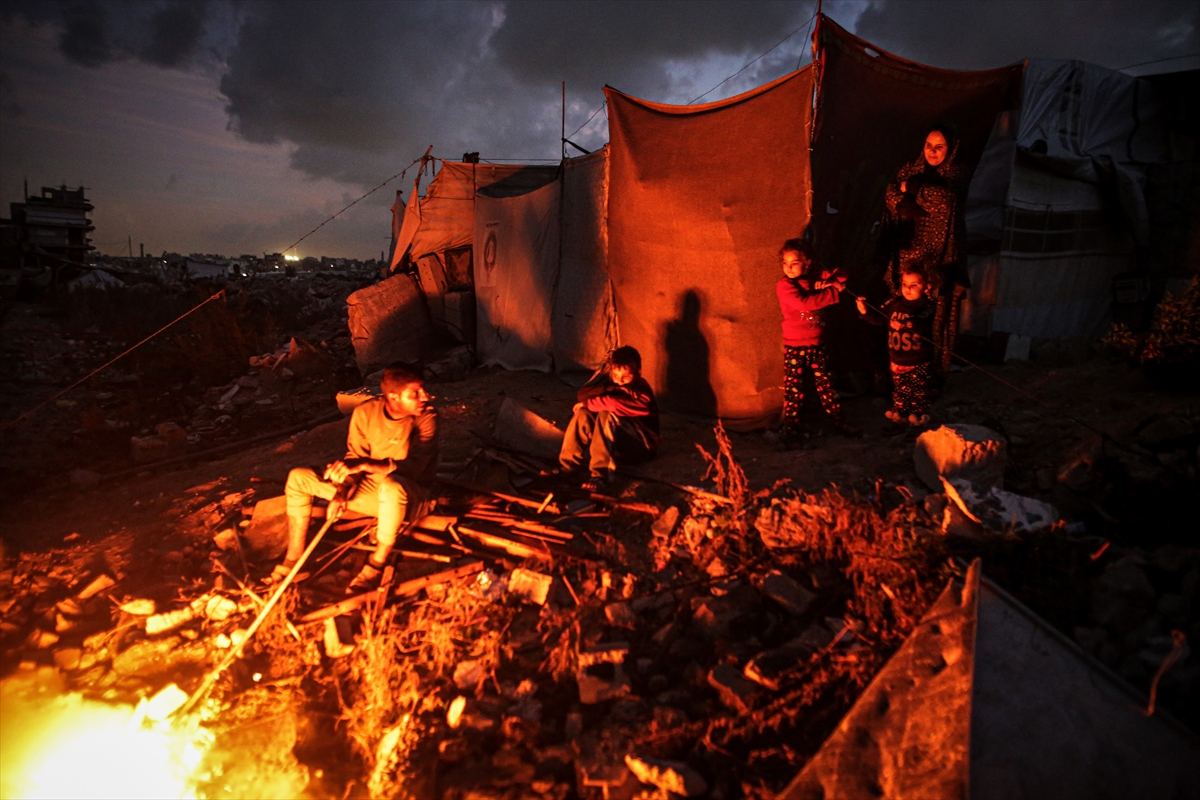
[Photo: Displaced Palestinians struggling to survive in tents set up amid the rubble of their destroyed homes light fires in makeshift stoves to keep warm in cold weather conditions amid Israeli attacks and blockade in Jabalia, northern Gaza Strip, Palestine, on November 17, 2026. Photojournalist: Saeed M. M. T. Jaras/AA]