By Ahmed J Versi
LONDON, (The Muslim News): The Prime Minister, Keir Starmer, has issued a forceful defence of Britain’s Muslim communities, condemning criticism of public Islamic prayer as “utterly disgraceful” and warning of a “dangerous” political campaign against multiculturalism.
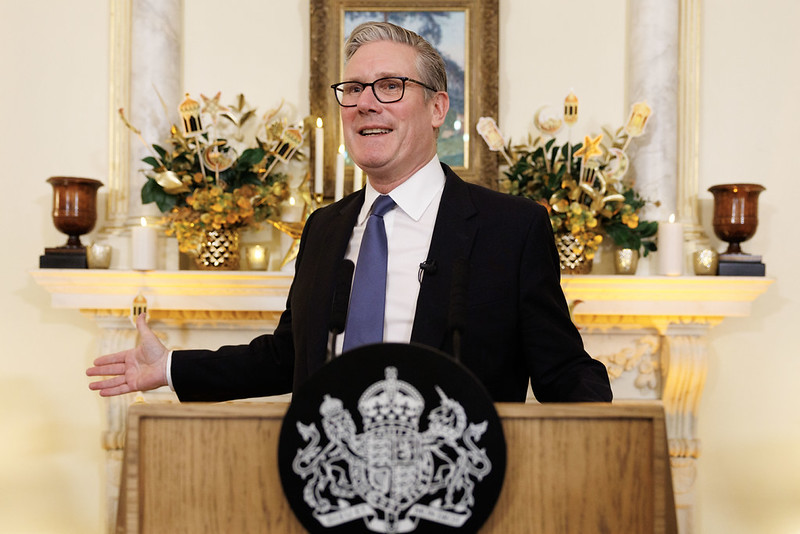
Speaking at a Downing Street Eid reception on March 23, Starmer used the high-profile gathering at 10 Downing Street to deliver one of his most direct interventions yet on identity, inclusion and rising anti-Muslim hostility.
In unusually blunt terms, he addressed the recent backlash against public Muslim prayer in Trafalgar Square, framing such expressions of faith not as a problem, but as a defining feature of British life.
“Utterly disgraceful. That is what makes us British… we should celebrate it,” he said.
His remarks were widely interpreted as a response to controversy that erupted days earlier, on March 18, following a large open iftar and congregational prayer held in Trafalgar Square during Ramadan. The annual event, attended by thousands and supported by the Mayor of London, has become a prominent fixture in the capital’s Ramadan calendar, bringing together people of all faiths in a shared public space.
The backlash was sparked by comments from Conservative frontbencher Nick Timothy, who described “mass ritual prayer in public places” as “an act of domination” and “straight from the Islamist playbook”, drawing widespread criticism across political and community circles.
The row escalated further when Nigel Farage suggested such gatherings could be seen as attempts to “intimidate and dominate”, intensifying debate over public expressions of faith and the future of Britain’s multicultural identity.
The issue soon reached the Commons, where Starmer raised the remarks during Prime Minister’s Questions, signalling a willingness to confront what he characterised as increasingly divisive rhetoric.
Positioning the debate within a wider global context, the Prime Minister acknowledged the anxiety felt by many British Muslims amid conflicts in Gaza, the West Bank and Iran. But he warned that international crises are being deliberately exploited domestically.
“They can reverberate back here at home and are exploited by people who want to sow division,” he said.
Drawing on his experience as a former Director of Public Prosecutions, Starmer expressed concern at the trajectory of hate crime in Britain.
“It is… a cause of great sadness and distress to see those numbers going completely in the wrong direction,” he said.
He also pointed to recent incidents, including attacks in Manchester and at a mosque in Peacehaven, reflecting on their impact while praising the resilience and solidarity shown by local communities.
In a notable departure from the typically conciliatory tone of such occasions, Starmer went further still, accusing elements on the political right of pursuing a coordinated anti-multicultural agenda.
“This is not just some careless comment,” he said. “It is actually a sustained political campaign… It is dangerous for our country.”
He suggested that the next general election could hinge on competing visions of Britain’s identity, pledging to stand “with” Muslim communities in defence of what he described as the country’s core values.
The speech also struck a note of solidarity beyond the Muslim community, with Starmer expressing support for Jewish residents following a recent antisemitic incident in Golders Green.
“An attack on any community is an attack on all of us,” he said.
The Eid reception, now in its second year, is being positioned by No 10 as an emerging tradition, with the Prime Minister keen to emphasise that British Muslims belong “at the centre of government”.
In a move likely to be welcomed by campaigners, he confirmed the adoption of a formal definition of “anti-Muslim hostility”, formerly, Islamophobia — the first of its kind by a UK government — describing it as a significant step towards strengthening protections.
Despite the sharp political messaging, Starmer closed on a more reflective note, paying tribute to what he described as the “extraordinary generosity” of British Muslims during Ramadan, from charitable giving to community service.
“We don’t say enough about the positives,” he said, highlighting contributions across the NHS, business, media and wider society.
The reception brought together community leaders and public figures to mark Eid, with the Prime Minister thanking British Muslims for their enduring role in shaping modern Britain.
[Photo: Prime Minister Keir Starmer speaking at Eid reception in 10 Downing Street on March 23. Picture by Lauren Hurley / No 10 Downing Street]