By Elham Asaad Buaras
LONDON, (The Muslim News): At least seven Palestinians were killed and 18 others injured in Israeli attacks across the Gaza Strip on Wednesday despite an ongoing ceasefire, according to Palestinian medical sources, while the United Nations warned that Israeli restrictions on access to 65 per cent of Gaza are hampering humanitarian relief and preparations for winter flooding. Six Palestinians were killed on Tuesday and several injured by Israeli forces in Gaza.
A Palestinian woman, Iman Abdul Aal, was killed and her husband critically injured in an Israeli airstrike on their home on Al-Wehda Street in Gaza City, a medical source at Al-Shifa Hospital told Anadolu. Witnesses said an Israeli helicopter fired at least one missile at the house.
Five Palestinians were also killed and at least 13 others injured when an Israeli strike hit a vehicle towing a passenger trailer in the Tel al-Hawa neighbourhood of southern Gaza City. The bodies of those killed and the wounded were taken to Al-Shifa and Al-Quds hospitals, with several of the injured reported to be in critical condition and receiving intensive care.
Earlier, three Palestinians, including a woman, were injured in Israeli airstrikes targeting two evacuated homes in the Shujaiya neighbourhood east of Gaza City, according to local sources and witnesses.
Israeli artillery also shelled areas east of Shujaiya and Zeitoun in Gaza City, while quadcopter drones attacked homes. In central Gaza, an Israeli drone dropped a bomb east of Bureij refugee camp and Israeli military vehicles stationed nearby opened fire towards Palestinian homes, with no casualties reported.
In southern Gaza, a Palestinian woman was injured by a bullet in the back when Israeli military vehicles opened heavy fire in the Qizan Abu Rashwan area south of Khan Younis, according to a medical source.
Journalist killed by Israeli forces
Separately, Palestinian imam and religious radio presenter Mohammed Abdul Aziz al-Najjar, 38, was killed in an Israeli drone strike while preparing a media report on Quran memorisation in the southern Gaza Strip.
Al-Najjar worked as a producer and presenter for Quran Radio, affiliated with Gaza’s Ministry of Endowments and Religious Affairs, and served as imam of the Ibad al-Rahman Mosque in Khuza’a, east of Khan Younis.
Ikrami al-Mudallal, the ministry’s media director, told Anadolu that al-Najjar was targeted while producing media material about Qur’an memorisation. A medical source at Nasser Hospital said his body and another person with moderate injuries were brought to the hospital following the strike in the Al-Mawasi area of Al-Qarara, northwest of Khan Younis.
Gaza’s Government Media Office said al-Najjar’s death brought the number of Palestinian journalists killed since the start of Israel’s war on Gaza to 263. It condemned what it described as the “targeting, killing and systematic assassination” of Palestinian journalists and called on international press organisations to condemn attacks on media workers and pursue accountability through international courts.
Gaza’s Health Ministry said Wednesday that Israeli violations of the October 2025 ceasefire agreement had killed 1,431 Palestinians and injured 5,026 others.
Since October 8, 2023, more than 74,000 Palestinians have been killed and over 175,000 injured in Gaza, according to Palestinian figures. Around 90 per cent of the territory’s infrastructure has been destroyed.
UN warns restrictions on access obstacle to humanitarian relief
The UN meanwhile warned that restrictions on access to 65 per cent of Gaza’s land are the main obstacle to humanitarian relief and efforts to protect displaced families from flooding as the rainy season approaches.
“Humanitarian partners stress that the main obstacle is restrictions on access of 65% of Gaza’s land,” UN spokesperson Stephane Dujarric told reporters. “The remaining 35% is already overcrowded.”
UN humanitarian agencies and partners are assessing three potential sites for temporary shelters for families living in flood-prone areas or near damaged structures at risk of collapse. They are also assessing more than 450 existing displacement camps considered vulnerable to severe flooding, housing roughly one-fifth of Gaza’s population.
Dujarric said large-scale voluntary relocation would require explosive ordnance to be cleared from proposed sites, sandy ground to be levelled, and water, drainage and lighting systems installed. Access roads would also need to be opened, and land-tenure issues resolved.
Humanitarian agencies are additionally seeking Israeli permits to bring heavy machinery, spare parts, engine oil and other essential supplies into Gaza, as well as funding for emergency fuel and materials needed to repair damaged structures.
Healthcare delivery is also being affected by shortages, with critical gaps in specialised cancer treatment, including chemotherapy and radiotherapy supplies. Diagnostic services face shortages of generator fuel and mechanical parts, according to Dujarric.
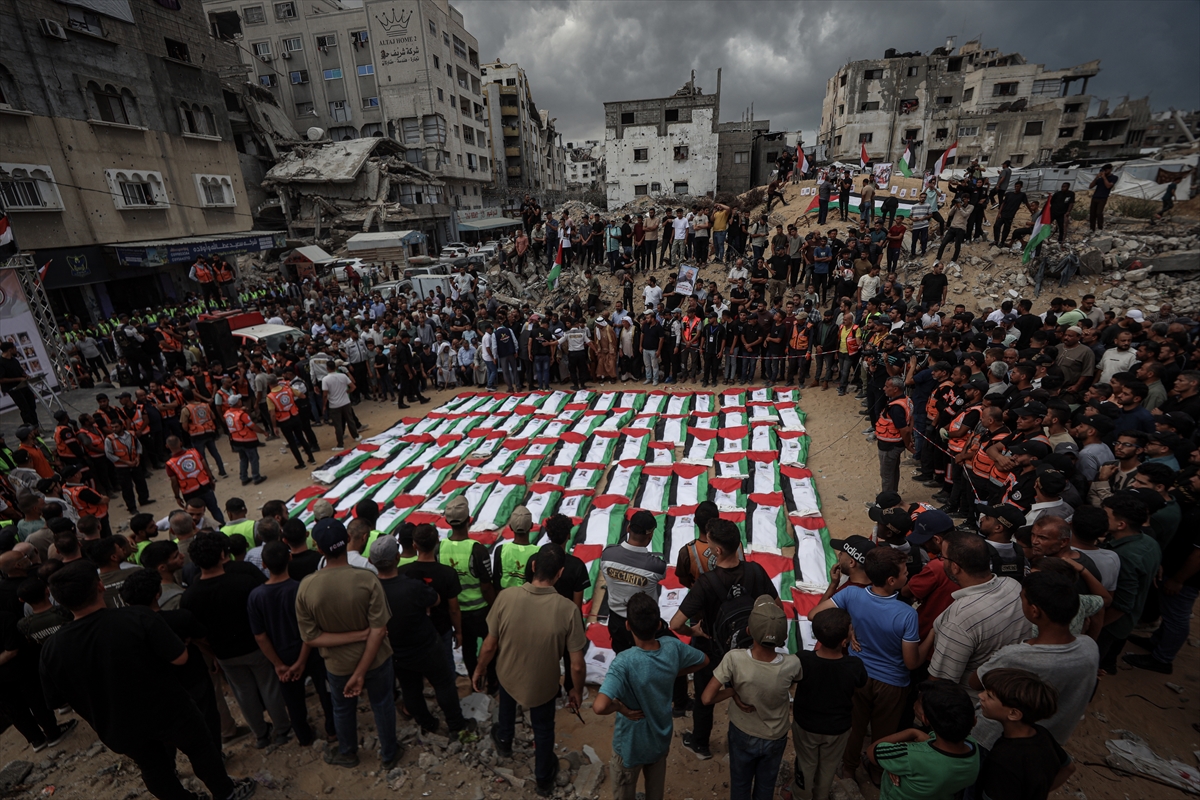
[Photo: People gather at the Sheikh Radwan cemetery in Gaza City, Gaza, Palestine on October 01, 2026, to conduct mass funeral prayers and burial for more than 100 Palestinians whose bodies retrieved from the rubble of destroyed residential buildings in the southern Yarmouk neighborhood. Civil defense teams and local volunteers spent several days conducting search and rescue operations through heavy concrete debris following intense Israeli bombardment in the area. The recovered remains were transported from local medical facilities to the central cemetery for communal burial amidst continuing humanitarian and emergency response operations across the northern enclave. Photojournalist: Abdalhkem Abu Riash/AA]