By Middle East Correspondent
LONDON, (The Muslim News): A 10-day ceasefire between Israel and Lebanon came into effect at midnight local time on Thursday, following an announcement by US President Donald Trump, prompting cautious international welcome alongside reports of continued Israel attacks on the ground.
Jordan, Saudi Arabia and Oman all issued statements supporting the temporary truce, while emphasising the need to reinforce Lebanese state authority and limit the possession of weapons to official institutions.
Jordan’s Foreign Ministry praised the “major positive role” played by Lebanese President Joseph Aoun, Prime Minister Nawaf Salam and Parliament Speaker Nabih Berri in securing the ceasefire. The ministry reaffirmed Jordan’s “absolute support” for the Lebanese state in asserting its sovereignty across all Lebanese territory, restricting weapons to the state and restoring national institutions.
Saudi Arabia similarly welcomed the agreement, commending the same Lebanese leadership. In a statement posted on the social media platform X, the Saudi Foreign Ministry reiterated the kingdom’s support for “the Lebanese state in extending sovereignty and restricting arms to the state and its legitimate institutions.”
Oman also endorsed the ceasefire, urging all parties to adhere to its terms and avoid escalation. The Omani Foreign Ministry expressed appreciation for US diplomatic efforts in securing the agreement.
Trump announced the ceasefire following what he described as productive discussions with both sides. “I just had excellent conversations with the highly respected President Joseph Aoun, of Lebanon, and Prime Minister Bibi Netanyahu, of Israel,” Trump said on his Truth Social platform.
“These two leaders have agreed that in order to achieve peace between their countries, they will formally begin a 10-day ceasefire at 5 P.M. EST,” he added.
The agreement followed US-mediated talks between Israeli and Lebanese delegations held earlier in the week at the State Department in Washington, DC.
The United Nations also welcomed the development. “The Secretary-General welcomes the announcement of a 10-day ceasefire between Israel and Lebanon and commends the role of the United States in facilitating the ceasefire,” said Stephane Dujarric, spokesperson for Secretary-General Antonio Guterres.
Iran’s Foreign Ministry described the truce as part of a wider regional understanding. “[Iran welcomes] the announcement of the ceasefire in Lebanon and noted that the cessation of the war in Lebanon was part of the ceasefire understanding between Iran and the United States, mediated by Pakistan,” said ministry spokesman Esmaeil Baghaei, according to state media.
Despite the diplomatic breakthrough, violence persisted in the hours surrounding the ceasefire’s implementation.
In northern Israel, at least seven people were injured by rocket fire from Lebanon, including one critically, according to Channel 12. Six people were wounded when a rocket struck Karmiel, while another was injured by shrapnel in Nahariya.
The attacks caused significant damage, fires, and power outages, with approximately 25 rockets launched toward the Western Galilee within an hour, alongside three drones that were intercepted.
Air raid sirens sounded repeatedly across several towns shortly after the ceasefire announcement.
In Lebanon, an Israeli airstrike on the southern town of Ghazieh, near Sidon, killed eight people and injured 33 others, according to the Health Ministry. The strike occurred minutes after the ceasefire was announced.
Further reports indicated ongoing hostilities even after the truce took effect. Lebanon’s National News Agency said Israeli artillery shelled the towns of Khiam and Dibbine in the south, accompanied by machinegun fire and intensified aerial reconnaissance over the western Bekaa Valley.
Separately, Israeli attacks killed four Lebanese paramedics and injured six others during an emergency mission in the town of Mayfadoun near Nabatieh.
The ceasefire follows months of escalating conflict. Israel has been conducting a military campaign in Lebanon since March 2, shortly after the outbreak of a broader regional war involving Iran. That conflict was itself paused under a separate truce on April 8, mediated by Pakistan.
The fighting in Lebanon has resulted in more than 2,000 deaths and displaced approximately one million people.
While the ceasefire marks a potential pause in hostilities, ongoing violations and continued military activity have raised questions over its durability.
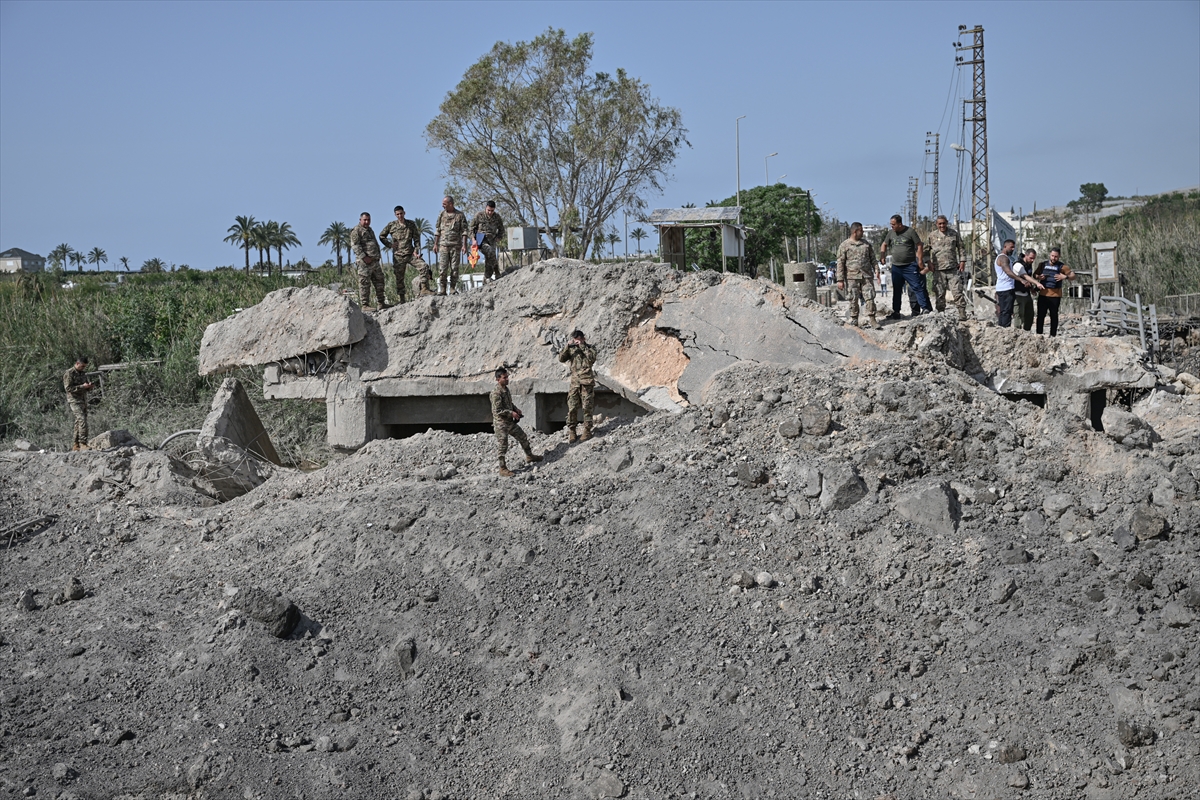
[Photo: People and army are seen on the rubble of the destroyed Qasimiyeh Bridge following the Israeli airstrike on the bridge near Tyre, Lebanon on April 16, 2026.
Photojournalist: Elif Öztürk/AA]