By International Correspondent
London, (The Muslim News): At least two Palestinians were killed on Sunday, as a severe winter storm swept through Gaza, flooding displacement camps and leaving families exposed. Alaa Marwan Juha, 30, died in Gaza City’s Al-Rimal neighbourhood when the wall of a building, previously damaged in Israeli air strikes, collapsed onto the tent sheltering her family. Several of her relatives were also injured.
In a separate incident, a seven-year-old child drowned after falling into an uncovered well in the Northern Governorate, one of many hazards left exposed amid months of bombardment and infrastructure collapse. Human rights groups have said both deaths were not inevitable, but the predictable consequence of Israel’s destruction of civilian infrastructure and restrictions on shelter and repair materials.
Torrential rain and strong winds have lashed the besieged enclave since Saturday night, flooding and uprooting thousands of tents erected after Israeli attacks rendered whole neighbourhoods uninhabitable. In Khan Younis, correspondents and witnesses said rising sea waves pushed inland, inundating hundreds of tents along the coastline and leaving families soaked, exposed and increasingly desperate.
Human rights organisations have insisted that the storm’s deadly toll was compounded by man-made conditions. Erika Guevara Rosas, Amnesty International’s Senior Director for Research, Advocacy, Policy and Campaigns, said the devastation “cannot be blamed solely on bad weather,” calling it an “utterly preventable tragedy.” She stated: “The flooding of tents and the collapse of already damaged buildings are foreseeable consequences of Israel’s destruction of civilian infrastructure and its continued blocking of the entry of shelter and repair materials needed to protect displaced families.”
The Palestinian Centre for Human Rights issued similar warnings, with its Director, Raji Sourani, saying Israeli restrictions had left more than a million displaced Palestinians defenceless against the elements. “People are being forced to survive in fragile tents among rubble and open sewage,” he said. “When homes are destroyed and reconstruction materials are denied, rain and cold become deadly.” Belkis Wille, associate crisis and conflict director at Human Rights Watch, warned that denying civilians the means to repair essential systems made further deaths inevitable. “Exposure to cold, flooding and disease is entirely foreseeable under these circumstances,” she said.
For displaced families, the situation is dire. “The tents don’t protect us from rain or wind,” said Sami Asaliya from the Nuseirat refugee camp. “They flood every time. We need proper shelter.” Nearby, an elderly woman, Hadiya Atiya Farajallah, stood helplessly before her waterlogged tent. “I lost five of my children,” she said. “My tent was flooded twice, and my husband is elderly and cannot do anything.”
The storm compounds a catastrophic humanitarian situation after months of intense conflict. Local health authorities report more than 71,200 Palestinians have been killed in Gaza since October, with the majority being women and children. Entire districts lie in ruins, leaving hundreds of thousands in makeshift shelters or damaged buildings vulnerable to collapse.
Illegal Jewish settlers attack Palestinian homes, uproot olive trees
Meanwhile, violence has also intensified across the occupied West Bank. Illegal Israeli settlers stormed homes in Hawara, south of Nablus, spray-painting threats and setting Palestinian vehicles alight, according to local sources. Further attacks were reported near Bethlehem, Ramallah, and East Jerusalem, where Jewish settlers uprooted dozens of olive trees. The Palestinian Agriculture Ministry said more than 8,000 olive trees were destroyed in a single week, with losses estimated at nearly $7 million. According to the Colonisation and Wall Resistance Commission, an official Palestinian body, settlers carried out 621 attacks against Palestinians and property in the West Bank in November.
Israeli military operations have escalated in parallel, with the town of Qabatiya placed under a severe lockdown for a second day. Armoured vehicles, bulldozers, and snipers were deployed, roads sealed, homes raided, and dozens of residents detained. Streets and infrastructure were reportedly deliberately damaged. According to Palestinian figures, Israeli forces and settlers have killed at least 1,103 Palestinians in the West Bank since October, injured nearly 11,000, and detained around 21,000.
Legal experts have repeatedly underscored that policies restricting shelter, reconstruction materials, and vital infrastructure repairs are contributing to a deepening humanitarian crisis in which predictable hazards such as rain and cold become fatal. In a landmark advisory opinion last July, the International Court of Justice declared Israel’s occupation of Palestinian territory illegal and called for the evacuation of all settlements in the West Bank and East Jerusalem. Despite the ruling, settlement expansion, military raids, and mass displacement have continued.
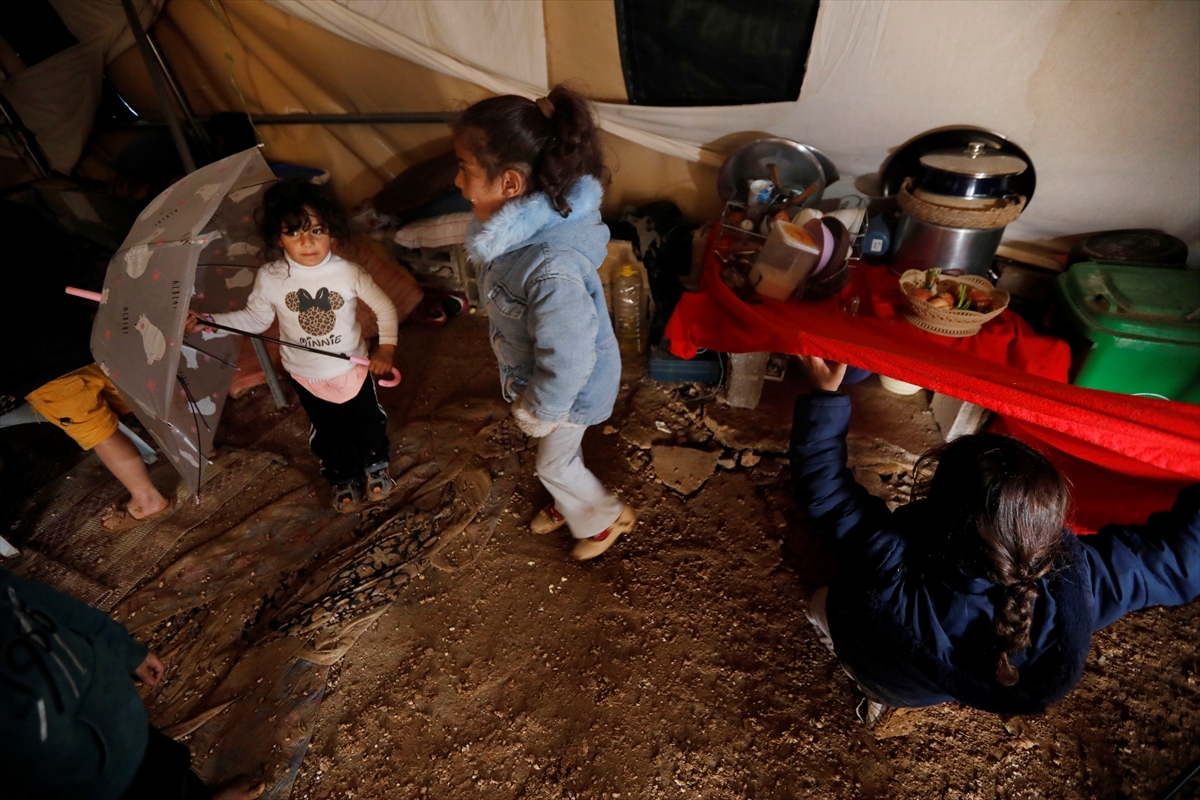
[Photo: A view of the tent, sheltering the Harb family after rainwater flooded in the Hallet al-Farah area west of Yatta, near the city of Hebron in the southern West Bank on December 29, 2025. Palestinian Harb family’s home was demolished by the Israeli army on December 9. Forced to live in a temporary tent amid cold weather, the family’s children move through pooled water and mud inside the shelter. Photojournalist: Mamoun Wazwaz/AA]