By Middle East Correspondent
London (The Muslim News): Israel is preparing to deploy drones capable of firing tear gas at Palestinians in the occupied West Bank, including East Jerusalem, as part of heightened security measures ahead of Ramadan, according to Israel’s Channel 12.
The broadcaster reported Saturday that the police tenders committee has approved the purchase of three drone-mounted systems designed to drop tear gas capsules. Valued at approximately $49,000, the systems, known as “Surprise Egg”, are built to be mounted on Matrice-type drones and disperse demonstrations from the air.
Israeli police already operate 19 similar systems, according to Channel 12. Tender documents described the acquisition as “urgent,” citing operational preparations “for expected events during Ramadan.”
The move comes as Israel’s National Guard, formed under far-right National Security Minister Itamar Ben-Gvir, faces mounting criticism. Opposition figures have previously described the force as “a militia effectively operating under his authority.”
Military buildup across the West Bank
The drone procurement is unfolding alongside a broader military reinforcement across the West Bank. Earlier this week, Channel 12 reported that the Israeli army had decided to bolster its presence during Ramadan, including the deployment of a commando brigade.
In addition to the 22 battalions currently conducting routine security operations, further units are expected to be deployed. Additional companies are also due to be stationed at checkpoints in anticipation of thousands of worshippers seeking entry to the Al-Aqsa Mosque compound in East Jerusalem.
According to the report, the army has recommended to Defence Minister Israel Katz that up to 10,000 worshippers be permitted to enter the compound each Friday during Ramadan. It also advised allowing entry for men over 55 and women over 50.
Yet Palestinian religious leaders have voiced alarm. Sheikh Ikrima Sabri, preacher at Al-Aqsa Mosque, told Anadolu Agency on Friday that he regretted Israel’s decision to restrict access during Ramadan and warned that the government was implementing “an aggressive plan targeting the holy site.”
Each year during Ramadan, hundreds of thousands of Palestinians travel from the West Bank to East Jerusalem to pray at Al-Aqsa. However, since the start of Israel’s war on Gaza in October 2023, Israeli authorities have imposed sweeping restrictions on West Bank residents crossing military checkpoints into Jerusalem.
Over the past two years, only limited numbers have been allowed entry after securing Israeli-issued permits, widely described by Palestinians as difficult to obtain. Israel has yet to announce any significant easing measures for this Ramadan.
Palestinians view East Jerusalem as the capital of a future state, while Israel considers the city, in both its eastern and western sectors, its capital.
Raids and settler violence intensify
As Ramadan preparations accelerate, violence on the ground continues unabated.
The official Palestinian news agency WAFA reported that Israeli forces raided the village of Al-Mughayyir, northeast of Ramallah, on Saturday evening.
Amin Abu Aliya, head of the Al-Mughayyir Village Council, said troops stormed the village, physically assaulted several residents and briefly detained them in one neighbourhood. Forces also raided a home and several shops, assaulting those inside and firing sound bombs and tear gas canisters towards homes. No injuries were reported.
Al-Mughayyir and the surrounding communities have faced repeated incursions by Israeli forces, alongside attacks by illegal Jewish settlers.
Further south, in Masafer Yatta near Hebron, armed settlers attacked Palestinian shepherds from the Abu Obeid family in the village of Al-Tabban, according to anti-settlement activist Osama Makhamreh.
Makhamreh said settlers from nearby outposts, built on residents’ land, pelted shepherds with stones and attempted to steal their livestock. Backed by Israeli forces, the settlers were eventually repelled by the shepherds.
Later that night, settlers reportedly stole a horse belonging to a Palestinian resident in the plains of Deir Sharaf, west of Nablus.
Foreign nationals in Israeli ranks
Meanwhile, Israeli daily Yedioth Ahronoth revealed that more than 50,000 Israeli military personnel hold at least one additional foreign nationality.
Citing official army data released following a freedom of information request by transparency group Hatzlacha, the newspaper reported that 50,632 soldiers possess foreign citizenship alongside Israeli nationality.
Of those, 12,135 hold US citizenship, the largest share by a considerable margin. A further 6,127 hold French nationality, and more than 5,000 hold Russian citizenship. The figures also include over 3,000 with German nationality and a similar number with Ukrainian citizenship. More than 1,000 troops, each holding British, Romanian, Polish, Ethiopian and Canadian citizenship.
According to the disclosure, 4,440 soldiers hold two foreign citizenships in addition to Israeli nationality, while 162 hold three foreign nationalities. The army did not clarify whether the data refer to active-duty personnel, reservists, or both.
Israeli media estimates place the number of active-duty soldiers at around 170,000, with between 400,000 and 460,000 registered reservists.
Ceasefire violations in Gaza
In Gaza, at least four Palestinians were wounded by Israeli gunfire on Saturday amid continued reported violations of the October 10 ceasefire agreement.
Medical sources told Anadolu that a young girl and an elderly man were shot east of Khan Younis. Another young girl was reportedly shot in the head in the Netzarim area of central Gaza, while a 60-year-old man was shot in the foot in Al-Mughraqa, south of Gaza City.
Eyewitnesses described heavy and indiscriminate fire east of Gaza City, followed by large-scale demolitions of residential buildings. Troops also opened fire in the eastern areas of the Bureij refugee camp and the Zeitoun neighbourhood.
Israeli fighter jets reportedly carried out airstrikes on Rafah and east of Gaza City. In the north, warplanes and artillery struck the Sheikh Zayed area east of Beit Lahia, amid sustained helicopter gunfire. Residents reported explosions across multiple locations, including areas under Israeli military control.
Channel 12 further reported that Israeli forces identified five fighters emerging from a tunnel shaft in the Beit Hanoun area and targeted them. Preliminary assessments suggested four were killed. The Israeli military did not issue a statement on the incident.
The October 10 ceasefire formally ended Israel’s two-year war, which began on October 8, 2023. Palestinian authorities state that more than 72,000 Palestinians were killed and over 171,000 wounded during the conflict, with approximately 90 per cent of Gaza’s civilian infrastructure destroyed. The UN has estimated reconstruction costs at around $70 billion.
Despite the ceasefire, Gaza’s Health Ministry says at least 591 Palestinians have been killed and more than 1,578 injured in Israeli attacks since the agreement came into effect, a fragile truce overshadowed by continued bloodshed as Ramadan approaches.
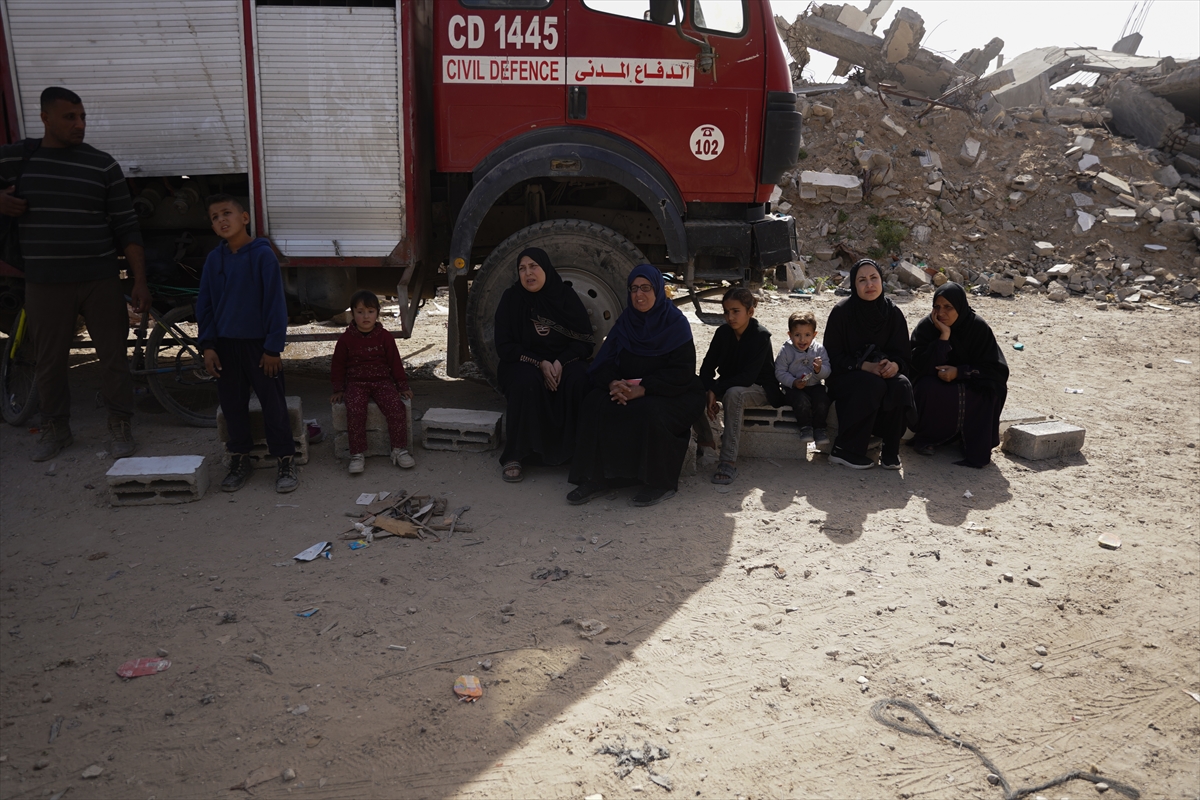
[Photo: Palestinians mourn for the Abu Nasr family, who had been trapped under the rubble of a building destroyed in Israeli attacks, in Beit Lahia, Gaza on February 15, 2026. Photojournalist: Anas Zeyad Fteha/AA]