By The Muslim News Reporter
Sana’a, Yemen, (The Muslim News): The Ansar Allah movement, colloquially known as the Houthis, is currently navigating what is perhaps the most precarious geopolitical tightrope in its history.
In their political and media discourse, they clearly declare themselves part of the Iran-led Axis of Resistance, expressing readiness to provide military support should the US-Israeli war on Iran escalate. However, they are keeping the decision for direct involvement tethered to the timing and scale of the escalation against Tehran. This declared stance, frequently echoed by their leaders under slogans of being on high alert and having their fingers on the trigger, reflects a careful balancing act: maintaining their image as an active regional proxy while calculating the heavy toll of engaging in an all-out, transnational war.
Over the past few years, the Houthis have emerged as one of Iran’s most prominent and impactful regional arms, transcending the local confines of the Yemeni conflict to become a key player directly tied to international geopolitics. Following the fallout of October 7 attacks, the group entered a new phase of regional involvement that expanded its political and military manoeuvrability, most notably by posing a direct threat to international shipping in the Red Sea and the Bab Al-Mandab Strait and engaging in open confrontations with the United States and Israel.
On the political decision-making front, senior Houthi officials, led by Political Bureau member Mohammed Al-Bukhaiti, have revealed that the decision to join the war alongside Iran has already been made. In a televised interview with Al Mayadeen Channel, Al-Bukhaiti stated, “The decision to stand with Iran has been taken. We are monitoring developments, and our hands are on the trigger.” He clarified that the group’s participation is merely “a matter of time,” without detailing the nature or operational scope of this involvement.
The rhetoric of the group’s leader, Abdul-Malik al-Houthi, has been even more explicit in expressing political and ideological alignment with Iran, though it ultimately appears closer to a rallying political declaration than an imminent military directive. In his recent address, he has called for solidarity with Tehran and urged the broader Islamic world to provide political and other forms of support. By framing the conflict as the “Battle of the Ummah,” Al-Houthi is attempting to export the conflict’s legitimacy beyond Yemen’s borders, seeking to mobilise a wider regional sentiment that transcends the group’s Zaydi roots.
These messages reinforce the impression that Houthis want to signal to both its allies and adversaries that the door to escalation is open, though the timing of a full-scale offensive remains contingent on variables beyond the Yemeni arena.
Despite this strong rhetoric, developments on the ground suggest a degree of restraint. In the period following recent attacks on Iran, the Houthis have not undertaken major escalatory actions against Israel or US interests beyond their established patterns. There has been no clear declaration of a full maritime blockade in the Red Sea, nor a significant expansion of operations. This divergence between rhetoric and action appears to indicate a preference for leveraging regional tensions politically and symbolically, rather than moving immediately towards full-scale war.
Recent precedents reinforce this pragmatic impression. In May 2025, the Sultanate of Oman brokered an agreement between the Houthis and the US that de-escalated tensions in the Red Sea following months of attacks on international shipping. This signalled the group’s willingness to recalibrate its military behaviour when the costs of escalation outweigh the benefits, particularly after paying a heavy price from sustained strikes carried out by US, UK and Israel on their sensitive military assets during 2024- 2025. Similarly, during the Twelve-Day War in June 2025, the Houthis opted to maintain a high ceiling of rhetorical solidarity without engaging in new direct military intervention, despite the symbolic weight of that moment within the Tehran-led axis.
In the Red Sea and Bab Al-Mandab, the group appears to lean towards an indirect participation model in any broader confrontation with Iran, utilising this maritime front as a strategic pressure tool. This corridor represents one of the most critical chokepoints for global trade and energy. Over the past few years, the Houthis have proven their ability to leverage it by targeting or threatening ships, thereby disrupting international supply lines and raising the cost of war for Tehran’s adversaries — without necessarily resorting to direct, massive missile strikes against Israel from Yemeni territory at every turn. This trajectory aligns with their approach during the Gaza war, where Red Sea attacks became an integral part of a regional pressure equation rather than an isolated, standalone front.
Another factor curbing the group’s appetite for uncalculated escalation is the military and economic toll exacted over the past two years. Houthi positions have endured repeated, intense strikes from the US, UK and Israel, resulting in significant losses to weapons depots, launch platforms, and military infrastructure. These strikes have also targeted field and political commanders and tightened the noose on supply and funding networks tied to their military capabilities. Consequently, think-tank estimates suggest that the group’s current readiness for a comprehensive confrontation is relatively lower than it was at the peak of the Gaza war, prompting a more cautious risk-benefit calculus.
Additionally, the Houthis’ ability to sustain a prolonged confrontation is further hampered by a rapidly deteriorating economic environment. In 2025, Yemen’s national real GDP contracted by 1.5 percent, according to World Bank estimates. Fuel imports declined by 31 per cent compared to 2024, largely due to damage to port infrastructure and reduced capacity, particularly affecting Red Sea ports. Adding to these pressures, World Food Programme (WFP) activities in Houthi-controlled areas have remained paused since September 2025 due to operational constraints.
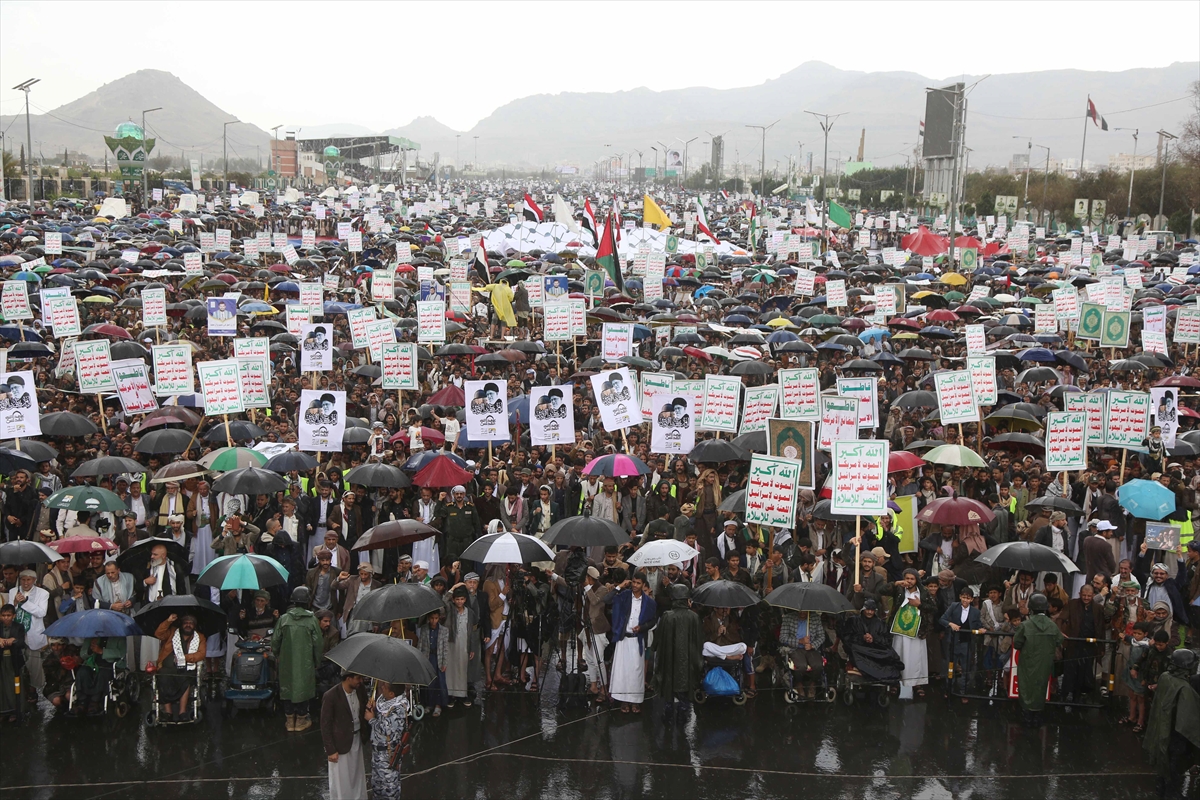
On the flip side of the equation lies a Yemeni public in Houthi-controlled areas caught between mobilisation rhetoric and severe living conditions. According to local media and research reports, the general mood in Sana’a and other northern governorates leans heavily towards caution regarding direct involvement in the war on Iran, despite the overwhelming presence of Axis of Resistance messaging in state media and organised mass rallies. A majority of the population fears that a massive military escalation could plunge Yemen back into the crosshairs of direct bombardment and blockade, at a time when the country is still enduring one of the world’s worst humanitarian crises.
While Houthi-affiliated media frequently broadcast scenes of pro-Iran demonstrations, a broad segment of citizens prioritises maintaining the minimum level of stability and preventing the collapse of fragile de-escalation efforts, rather than entering an open-ended regional conflict with uncertain outcomes.
Contrasting this cautious mood is an ideologised segment of the group’s hardline base, which views the war on Iran as an existential battle for the Axis of Resistance. This faction explicitly voices its political and ideological support for Tehran, both in daily discourse and through active participation in mobilisation efforts. However, observers and analysts note that this fervour does not reflect the broader societal sentiment, which is largely driven by pragmatism and fear. The wider public treats the wartime rhetoric more as the authorities’ language of mobilisation and negotiation rather than a genuinely consensual popular choice.
[Photo: People gather at Sabeen Square during a World Quds Day rally in support of Palestinians in Sana’a, Yemen, on March 13, 2026. Demonstrators condemned US and Israeli attacks on Iran and protested the killing of Iranian leader Ayatollah Ali Khamenei in airstrikes. Photojournalist: Mohammed Hamoud/AA]