By Middle East Correspondent
LONDON (The Muslim News): At least five people have been killed as Israeli airstrikes pounded southern Lebanon Thursday, as a spiralling regional conflict has already left more than 1,000 dead in Lebanon and over 1,340 killed in Iran in less than a month.
Lebanese state media said three people were killed when a strike hit the Saf al-Hawa area of Bint Jbeil, while two more were killed after warplanes flattened a residential and commercial building in Kfar Rumman, in the Nabatieh region.
The building was completely destroyed in the blast.
At the same time, Israeli forces launched heavy artillery fire, including white phosphorus munitions, across a string of southern towns, targeting areas near troop movements such as Deir Seryan, Qantara and Taybeh. There were no immediate reports of casualties from that shelling.
The latest strikes come as Israel intensifies its offensive in southern Lebanon following weeks of cross-border clashes with Hezbollah. Lebanese officials say at least 1,094 people have now been killed and more than 3,100 injured by Israeli bombings since the escalation began.
Hezbollah has hit back hard.
The Lebanese group claimed it carried out a staggering 87 attacks in a single day on Wednesday, the highest since the conflict erupted, using rockets, anti-tank missiles, drones, and artillery.
It also said it struck 21 Israeli Merkava tanks, along with bulldozers and military vehicles, with several reportedly destroyed and others forced out of action inside Lebanon.
Israeli media reported casualties among its troops, including an officer from the 401st unit.
On the ground, the situation is becoming increasingly dangerous for civilians and emergency crews.
Sky News correspondent Alex Crawford reported that medics in Nabatieh are now deliberately delaying their response to strike sites, fearing so-called “double-tap” attacks, where a second-strike hits rescuers arriving at the scene. Israel is targeting medics in Lebanon as it did in Gaza.
The Lebanon front is just one part of a rapidly widening war.
Since February 28, a joint US-Israeli illegal attack on Iran has killed more than 1,340 people, triggering a wave of retaliatory missile and drone strikes by Tehran targeting Israel, US bases in Gulf states.
Iran’s Revolutionary Guard claimed it coordinated 220 attacks with allied forces across the region, including 87 by Hezbollah, describing the campaign as the start of a “new era” of confrontation.
The fallout is spreading far beyond the battlefield.
Tehran has tightened control over the crucial Strait of Hormuz, forcing ships to coordinate passage with Iranian authorities and leaving dozens stranded, although vessels from “non-hostile” nations are still being allowed through.
Meanwhile, violence is also flaring elsewhere.
In northern Israel, one person was killed and three others wounded after rockets struck the city of Nahariya.
And in the occupied West Bank, eight Palestinians were injured by Israeli forces in separate attacks, including assaults on civilians and even an ambulance crew.
More than 1,100 Palestinians have been killed and nearly 12,000 wounded in the territory since October 2023.
With multiple fronts igniting and casualties mounting by the day, fears are growing that the conflict is rapidly sliding into a full-scale regional war.
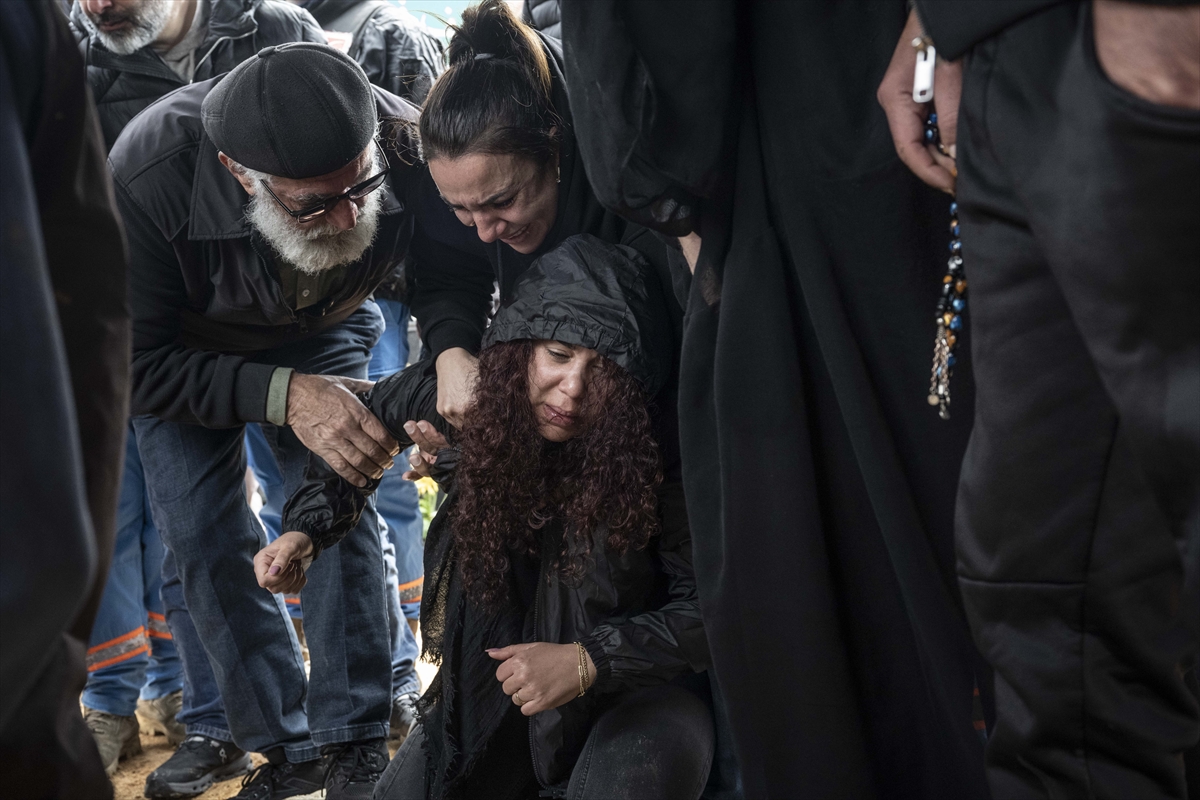
[Photo: Close family members mourn at the funeral of health workers Ali Jaber and Joud Sulelman, who were killed in an Israeli strike carried out a day earlier in the town of Haruf in Nabatieh province in southern Lebanon on March 25, 2026. Photojournalist: Murat Şengül/AA]