By Middle East Correspondent
LONDON, (The Muslim News): American and Israeli warplanes have killed at least 787 people in strikes across Iran, widening a Middle East conflict that has now spread to the Gulf, Lebanon and Pakistan, and triggering a diplomatic rift with Spain after Madrid refused to back the campaign and Washington threatened punitive trade measures.
According to the Iranian Red Crescent, raids on Tuesday hit 153 cities and 504 separate locations, with hospitals, residential districts and civilian infrastructure sustaining the heaviest damage. The conflict spread dramatically beyond Iran’s borders into Saudi Arabia, the UAE, Qatar, Lebanon and Pakistan.
In Tehran, explosions tore through neighbourhoods around Revolution Square and Ferdowsi Square, with witnesses reporting that one street was hit, then struck again after rescue crews arrived — a tactic international lawyers said could amount to a war crime. The square and surrounding Mehrabad districts suffered extensive damage as residential buildings were engulfed in smoke and debris.
Among the sites destroyed were the Sookhari Day restaurant and Café Lamiz on Motahari Street. Medical facilities were also hit: Gandhi Hospital in Tehran and a hospital in Bushehr were badly damaged as staff scrambled to evacuate patients.
By Tuesday evening, fresh explosions echoed across Tehran as the Israeli military announced “a large-scale wave of strikes targeting the Iranian terror regime’s infrastructure”, with correspondents on the ground reporting plumes of smoke rising from residential districts.
Middle East on edge: drones strike Riyadh, Dubai and Doha
The violence rapidly spilled beyond Iran’s frontiers. In Riyadh, two suspected Iranian drones struck the CIA station housed within the US Embassy compound on Monday, an attack confirmed by American and Saudi officials, though details of damage to intelligence facilities were not publicly disclosed. A State Department alert noted that parts of the embassy building had suffered structural damage, including roof collapse and interior smoke damage.
In Dubai, a drone strike caused a small fire near the US Consulate, which authorities said was quickly extinguished without casualties. Qatar’s air defences intercepted an aerial target over Doha, with explosions heard across the capital.
Tehran has denied responsibility for some of the alleged attacks. State media cited by multiple outlets said: “The attack on the Saudi Aramco refinery was carried out by Israel, and Iran did not strike any oil facilities in Saudi Arabia.” Tehran also rejected reports of strikes on Oman, describing the sultanate as a “friend and neighbour”.
In Lebanon, at least 52 people have been killed and more than 150 wounded in Israeli airstrikes since the conflict widened, according to Lebanese authorities. On Tuesday, strikes in the towns of Qabrikha and Tyre Debba killed civilians and destroyed homes. Hezbollah said it shot down an Israeli drone over Nabatieh and struck a Merkava tank in the Kfar Shouba Hills. Hezbollah said it attacked an Israeli military base in northern occupied Palestine, the Ramat David Airbase, located in northern Israel near Haifa, one of the Israeli Air Force’s main military airbases with drones.
In Israel, at least eleven people suffered minor injuries in Iranian missile attacks on central areas, according to Israeli emergency services, underscoring the intensifying violence along the northern frontier.
World leaders sound alarm as diplomacy falters
Global leaders have voiced sharply contrasting reactions as the crisis deepens.
In a joint statement on February 28, the British Prime Minister, Sir Keir Starmer, the French President, Emmanuel Macron, and the German Chancellor, Friedrich Merz, said: “We condemn Iranian attacks on countries in the region in the strongest terms. Iran must refrain from indiscriminate military strikes. We call for a resumption of negotiations and urge the Iranian leadership to seek a negotiated solution. Ultimately, the Iranian people must be allowed to determine their future.”
Starmer also defended Britain’s position, saying: “We are not joining the US and Israeli offensive strikes. The basis for our decision is the collective self-defence of longstanding friends and allies and protecting British lives.”
Macron described the escalating conflict as perilous and stressed the urgency of diplomacy, warning that the strikes must cease and be replaced by negotiations.
Russia’s Foreign Minister, Sergey Lavrov, condemned the US-Israeli raids as “an act of aggression”, warning that the conflict could spiral further and potentially trigger nuclear proliferation.
Spain defies Washington as Trump threatens trade war
Spain has emerged as one of Europe’s most outspoken critics of the campaign. On Tuesday, the US President, Donald Trump, launched a blistering attack on Madrid for refusing to allow Spanish military bases to be used for operations linked to the Iran war, saying: “Some European nations have been helpful, and some haven’t. Spain has been terrible. So we’re going to cut off all trade with Spain. We don’t want anything to do with Spain.”
The Spanish government responded by insisting that any review of commercial relations “must be done while respecting the autonomy of private companies, international law and bilateral agreements between the European Union and the United States”. The statement also noted that Spain remains a key Nato ally and a major trading partner with sufficient resources to mitigate any potential fallout.
The Spanish Prime Minister, Pedro Sánchez, has condemned the US-Israeli strikes as an “unjustified and dangerous military intervention” that risk destabilising the world and has called for a diplomatic resolution.
His Foreign Minister, José Manuel Albares, told local media that Spanish military bases had “not been used, nor will they be used, for anything that is not in the agreement with the United States or in accordance with the UN charter”.
Legal and expert analysis
The former Israeli negotiator Daniel Levy questioned the prevailing narrative surrounding the Iranian threat on British television, saying: “I think most [Israeli leaders] regard [regime change] as a kind of fairytale. They want Iran to implode, and if the spillover takes in Iraq, the Gulf and much of the region, so much the better.”
Levy argued that perceptions of Iran’s menace have been exaggerated and fuelled by fear.
Legal scholars and human rights authorities have also condemned the strikes. Ben Saul, the UN special rapporteur on human rights and counter-terrorism, described the attacks as “not lawful self-defence” and said they “risked constituting the international crime of aggression” because they lacked UN Security Council authorisation or a clear armed attack against the US or Israel to justify them.
Yusra Suedi, an Assistant Professor of International Law at the University of Manchester, said the raids were “not justified” in legal terms, citing the absence of an imminent threat. Human rights organisations have echoed similar concerns, warning that deliberate or indiscriminate attacks on civilian infrastructure undermine international legal norms.
Agnès Callamard, the Secretary General of Amnesty International, said civilians “should not pay the price for the unlawful and reckless acts by parties to the conflict, threatening the very foundations of international peace and security”. Human Rights Watch and other groups have stressed that violations of humanitarian law, particularly when civilians are targeted, must lead to accountability.
The UN human rights chief, Volker Türk, underscored: “International law is very clear: the protection of civilians is paramount. Violations of them must lead to accountability for those responsible.”
Regional and wider impact
The crisis has also reverberated beyond the Middle East. In Karachi, Pakistan, protesters outside the US Embassy were shot by American marines during demonstrations, resulting in 22 fatalities and further inflaming public anger.
The US and its allies have reported striking more than 1,700 targets inside Iran, prioritising facilities American military leaders say pose an imminent threat — including missile sites, naval assets and command and control centres — as the conflict shows no sign of abating.
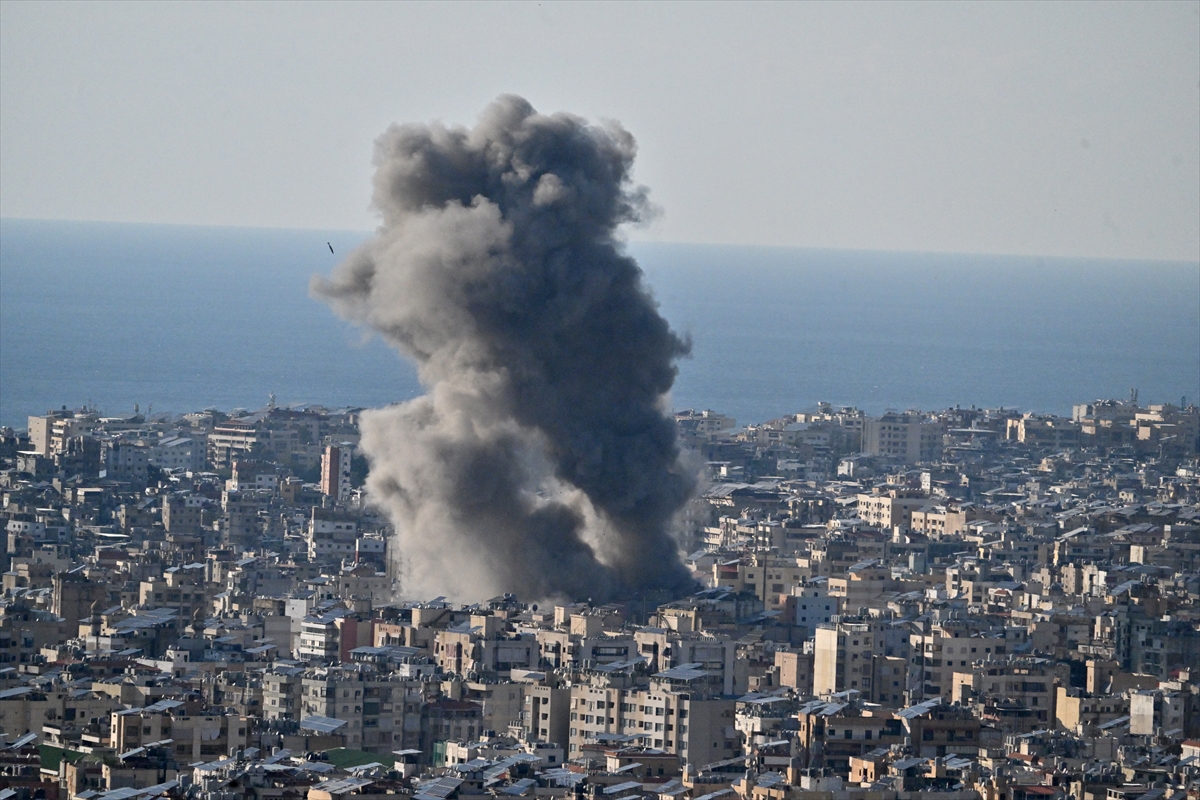
[Photo: Smoke rises over buildings following intense Israeli airstrikes targeting the Burj al-Barajneh area in southern Beirut, Lebanon, on March 02, 2026. Photojournalist: Houssam Shbaro/AA]