By Middle East Correspondent
London, (The Muslim News): Israel is pressing the United States to take military action against Iran, but President Donald Trump remains reluctant to authorise further strikes, according to US officials, as Washington builds up its military presence in the Middle East while keeping the door open to renewed diplomacy.
Multiple Israeli officials, including Israel Defence Forces Chief of Staff Lieutenant General Eyal Zamir and Mossad Director David Barnea, have travelled to Washington in recent weeks amid intensifying regional tensions and a significant US force deployment. Zamir briefed Chairman of the Joint Chiefs of Staff General Dan Caine over the weekend on Israeli contingency plans, though the discussions appear to have had little impact on the White House’s stance.
“It’s really the Israelis who want a strike. The president is just not there,” one US official told Axios, adding that nothing in the consultations altered the views of either Caine or Trump. Another senior official said the president “really does not want to do it”.
Trump nevertheless sharpened his rhetoric this week, warning that “probably bad things will happen” if nuclear talks with Tehran collapse, while highlighting what he described as the “biggest and the best” US Navy warships moving towards the region.
The warnings come as negotiations between Washington and Tehran are due to resume. White House spokeswoman Karoline Leavitt said talks involving US special envoy Steve Witkoff remained scheduled “as of right now”, though she stressed that diplomacy “takes two to tango”. Witkoff had been expected to meet Iranian Foreign Minister Abbas Araghchi in Istanbul on Friday, but Axios reported that Tehran is now seeking to change both the venue and format, pushing for direct talks in Oman instead.
Tensions were further inflamed on Tuesday when a US fighter jet shot down an Iranian drone in the Arabian Sea after it approached the USS Abraham Lincoln aircraft carrier. US Central Command said the Iranian Shahed drone ignored “de-escalatory measures” while operating in international airspace, prompting the engagement to protect American personnel and assets.
“Continued Iranian harassment and threats in international waters and airspace will not be tolerated,” CENTCOM spokesman Captain Tim Hawkins said, warning of the risks of miscalculation and regional destabilisation.
Iran later acknowledged the loss of a drone, identified by Iranian media as an Islamic Revolutionary Guard Corps Shahed-129, saying contact was lost after it had successfully transmitted reconnaissance data while conducting what Tehran described as a “routine and legal mission” in international waters.
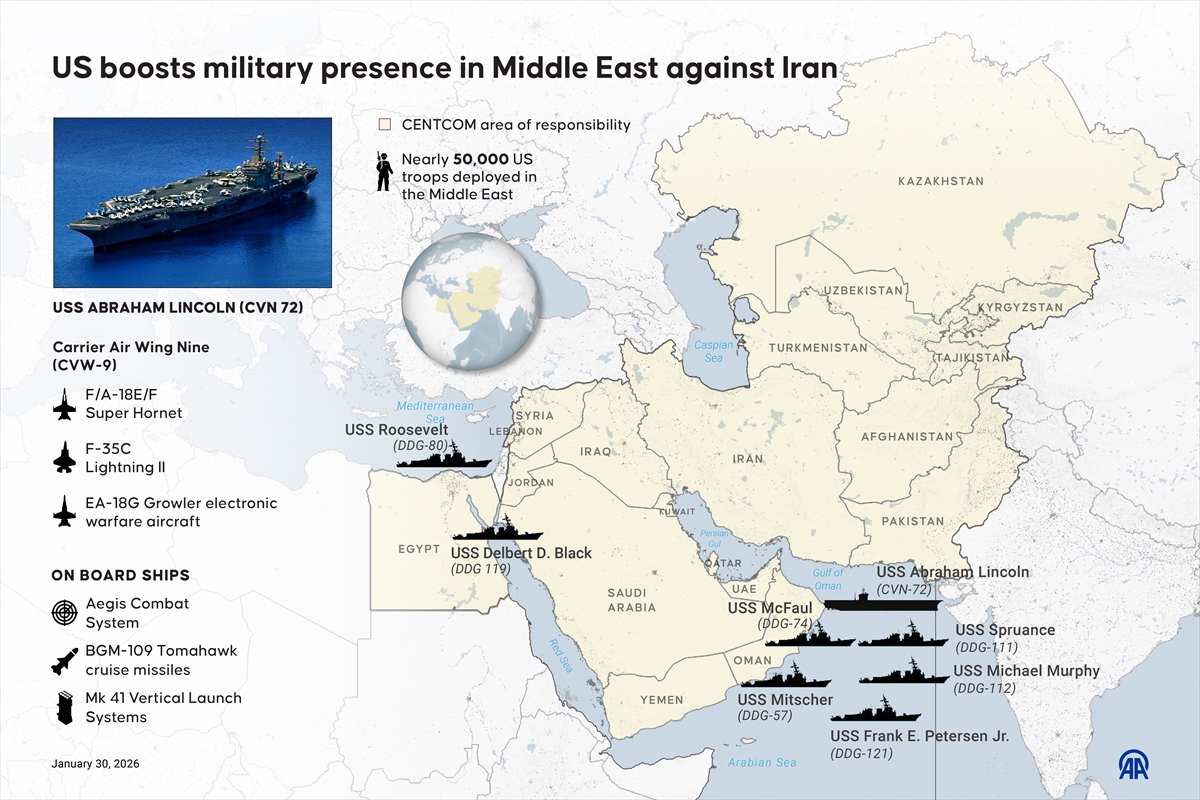
The drone incident unfolded against the backdrop of a rapidly expanding US naval presence. The Pentagon has dispatched additional vessels to the region, including the guided-missile destroyer USS Delbert D. Black, joining the Abraham Lincoln carrier strike group and several destroyers and littoral combat ships. Trump reiterated this week that a “massive armada” was heading towards Iran, while expressing hope that the show of force would push Tehran back to the negotiating table.
“It would be great if we didn’t have to use them,” Trump told reporters, adding that his message to Iran was clear: “No nuclear, and stop killing protesters.”
Defence Secretary Pete Hegseth said Washington was prepared to use “all options” to prevent Iran from acquiring nuclear weapons, while insisting that the administration continued to favour a diplomatic outcome. “When the president says we’re not getting a nuclear Iran, he means it,” Hegseth said, signalling that military plans were ready should talks fail.
The current crisis follows a brief but intense conflict in June last year, when Israel, backed by the US, launched a 12-day unprovoked assault on not only Iranian military and nuclear facilities, killing senior commanders and scientists but also civilian areas killing over 2,000 civilians. Iran retaliated with missile and drone strikes on Israeli targets before US forces struck Iranian nuclear sites, bringing negotiations over Tehran’s nuclear programme to an abrupt halt.
Regional actors have moved to distance themselves from any prospective conflict. Azerbaijan said it would never allow its territory or airspace to be used for attacks against Iran, while Saudi Arabia reiterated that it would not permit US strikes to be launched from its soil.
Saudi Defence Minister Prince Khalid bin Salman is in Washington this week for talks with senior US officials, where he is expected to stress diplomatic avenues, even as Israel’s military intelligence chief, Major General Shlomi Binder, holds consultations at the Pentagon, CIA and White House.
Iran has warned that any attack would trigger a “decisive and swift response”, while the US has demanded that Tehran reach a deal on its nuclear programme before it is “too late”, cautioning that any future strikes would be “far worse” than those carried out last year.
The escalating military posturing comes amid economic unrest inside Iran, driven by sharp currency depreciation and rising living costs, adding further uncertainty to an already volatile standoff between the long-time adversaries.
[An infographic titled “US boosts military presence in Middle East against Iran” created in Ankara, Turkiye on January 30, 2026. Photojournalist: Mehmet Yaren Bozğun/AA]