By Middle East Correspondent
LONDON, (The Muslim News): Regional tensions intensified on Tuesday as Israeli forces killed Palestinians in Gaza despite an ongoing ceasefire, Yemen’s internationally recognised government launched a major offensive against Ansar Allah, and Iran warned of a stronger response to any renewed US or Israeli attack.
The developments came alongside fresh attacks involving Saudi Arabia, continuing violence in the occupied West Bank and diplomatic efforts by Qatar to ease tensions between Washington and Tehran.
Gaza ceasefire violations continue
Three Palestinians were killed and several others injured in Israeli attacks across Gaza on Tuesday, medical sources said.
A man was killed and another injured when an Israeli drone struck pedestrians near the Municipal Park on Omar Al-Mukhtar Street in central Gaza City.
A 34-year-old man died from wounds sustained in an Israeli strike targeting civilians near the Taiba Towers in Khan Younis on Monday. Another Palestinian was killed and several others injured in a strike on Aidiya Street west of Gaza City.
A displaced Palestinian was shot inside his tent in the Mawasi area of Rafah when Israeli military vehicles opened fire towards tents sheltering displaced people.
In central Gaza, a girl sustained moderate injuries when Israeli forces opened fire towards homes east of the Bureij refugee camp.
Israeli forces also demolished evacuated Palestinian homes and buildings east of Gaza City. Explosions were reported near Shujaiya and Al-Tuffah.
Israeli warships opened machine-gun fire towards fishing boats off the Gaza City coast. No injuries were reported.
Gaza’s Health Ministry said Israeli forces have killed at least 1,460 Palestinians and injured 5,116 since the 10 October 2025 ceasefire.
Since October 2023, more than 74,000 Palestinians have been killed and over 175,000 injured, according to Palestinian figures. About 90 per cent of Gaza’s infrastructure has been destroyed.
East Jerusalem demolition sparks anger
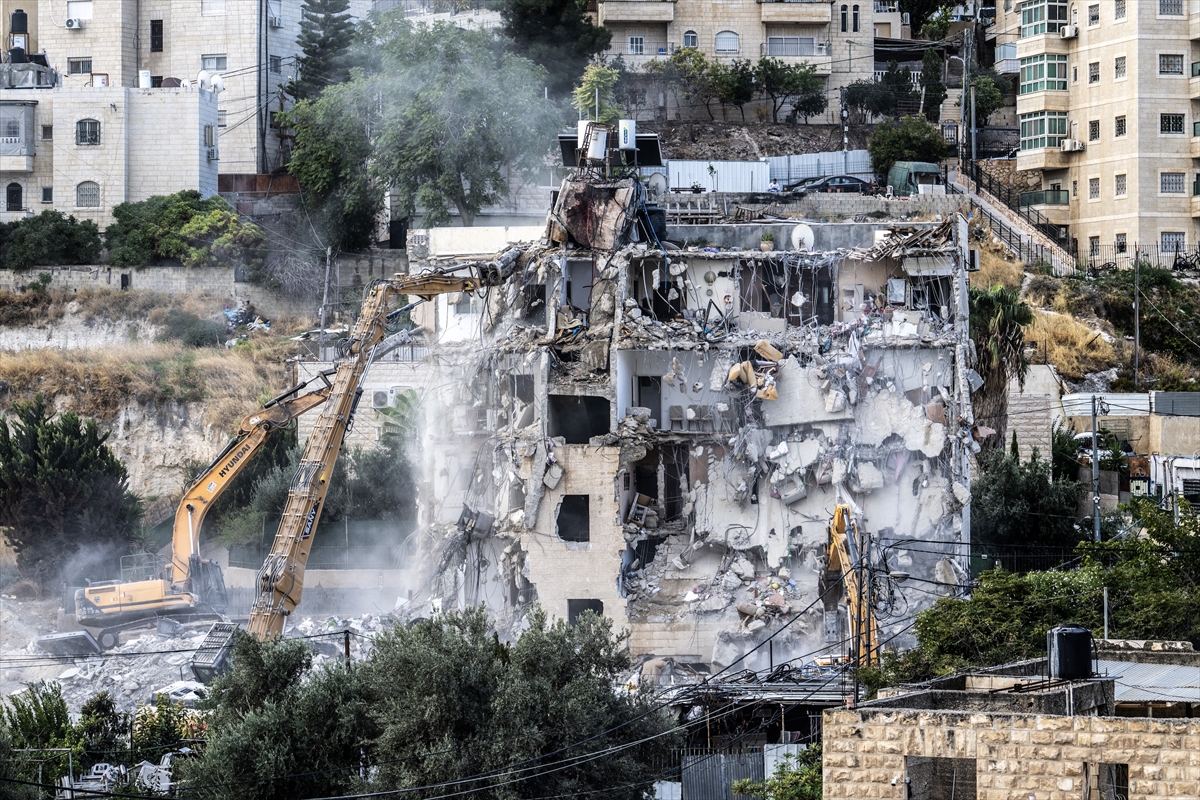
Israeli forces demolished a five-storey residential building containing 10 apartments and housing about 70 Palestinians in the Al-Tur neighbourhood of occupied East Jerusalem.
Residents received a final demolition notice the previous day.
The Jerusalem Governorate said Israeli authorities had pursued residents for years with demolition orders and fines while refusing to issue building permits.
National Security Minister Itamar Ben-Gvir attended the demolition under police protection.

The governorate accused Ben-Gvir of using the demolition for “electoral exploitation” and described his participation as “official incitement” against Palestinians in East Jerusalem.
Israeli authorities carried out 139 demolition and land-levelling operations in East Jerusalem between July and September 2026 and issued 150 demolition, eviction and property-seizure orders.
The UN humanitarian office has documented about 170 Palestinian structures demolished in the occupied city since the beginning of 2026, mostly over the lack of Israeli-issued building permits.
West Bank violence spreads
Two Palestinians were injured in illegal Israeli settler attacks in Aqraba. A 23-year-old man was shot in the foot, while a 50-year-old man was beaten.
Israeli forces raided Bani Naim, east of Hebron, searched homes and declared the area a “closed military zone”. Troops converted three houses into military posts and prevented students from reaching some schools.
In Tell village, southwest of Nablus, Israeli forces and settlers returned to a home previously used as a military post and forced a Palestinian family to leave shortly after they had been allowed to return.
Settlers also torched four vehicles in Aqraba and sprayed racist slogans calling for revenge.
Another group attempted to set fire to a poultry facility in Farkha, west of Salfit, and sprayed slogans on a livestock farm before residents confronted them.
The Palestinian Colonization and Wall Resistance Commission said Israeli settlers have carried out more than 14,742 attacks across the West Bank, including East Jerusalem, since October 2023, killing 66 Palestinians.
Al-Aqsa and Ibrahimi mosques restrictions
Israeli settlers entered Al-Aqsa Mosque in occupied East Jerusalem 26 times in September 2026, while Israeli authorities prevented the Muslim call to prayer at the Ibrahimi Mosque in Hebron 150 times.
The Palestinian Ministry of Awqaf and Religious Affairs reported increased religious rituals inside the Al-Aqsa compound.
At the Ibrahimi Mosque, restrictions on some prayer times continued for 100 consecutive days. The mosque was completely closed for six days during Jewish holidays, while its eastern gate remained shut and its windows were covered with barriers.
Israeli settlers also set fire to the Imad Al-Din Zengi Mosque in Nablus and sprayed racist slogans on its walls.
Israeli forces demolished the Al-Duwaysat prayer hall in the Al-Jiftlik area of Jericho Governorate.
Yemen launches major offensive
Yemeni government forces launched the “Dawn of Yemen” offensive against Ansar Allah [Houthis] Al-Wazi’iyah district in southwestern Taiz Governorate.
The Nation’s Shield Forces said the operation aims to restore state institutions and end Ansar Allah’s control.
Presidential Leadership Council Chairman Rashad Al-Alimi said the wider campaign aims to retake Sana’a and restore government control.
Government forces reported advances along Yemen’s western coast, including the strategic Bab el-Mandeb area and Dhubab district. The Nation’s Shield Forces also said they captured strategic hilltops overlooking Al-Mansoura after Ansar Allah fighters withdrew.
The Saudi-led coalition said 100 fighter jets took part in the opening phase and that 324 “high-value targets” had been destroyed while providing air support to government forces.
The Yemeni army said about 100 Ansar Allah fighters were killed and 150 wounded in Monday’s operations across Taiz, while government forces reported recapturing several strategic positions.
The claims have not been independently verified.
The escalation is among the most significant rounds of fighting in Yemen since a UN-brokered truce in April 2022 ushered in a period of relative calm.
Ansar Allah claims Saudi attacks
Ansar Allah claimed a series of missile and drone attacks against Saudi Arabia on Tuesday.
Military spokesman Yahya Saree said a ballistic missile hit Abha International Airport and that missiles were also fired at Saudi military positions in Jazan.
Saudi Arabia’s General Authority of Civil Aviation said attacks targeted King Abdullah bin Abdulaziz International Airport in Jazan and Najran International Airport.
Three people suffered minor injuries and material damage was reported. The authority did not identify those responsible.
Ansar Allah also claimed attacks on sites in Jazan and Najran, King Khalid International Airport in Riyadh, Abha Airport, an Aramco refinery in Rabigh and military positions.
Saudi Arabia condemned the attacks, while the UK Embassy warned British nationals that further missile and drone attacks could target cities, airports, military sites and energy infrastructure.
Saudi oil pipeline capacity restored
Saudi Arabia restored the East-West pipeline’s capacity to pump 5.8 million barrels of oil per day, Industry and Mineral Resources Minister Prince Abdulaziz bin Salman said.
The pipeline links oil-producing areas in eastern Saudi Arabia with Red Sea export ports and has been used to reroute crude to Yanbu amid disruption to flows through the Strait of Hormuz.
Bin Salman announced the restoration during a panel discussion at the GCC 2026 Forum in Manama, Bahrain.
Qatar pushes for de-escalation
Qatari Emir Sheikh Tamim bin Hamad Al Thani met Iranian Interior Minister Eskandar Momeni in Doha to discuss regional tensions, efforts to reduce escalation and the issue of missing Iranian pilots.
Momeni said the two sides had agreed that a technical delegation would hold further talks.
Iran says three pilots were detained by Qatari forces after their aircraft were downed in Qatari airspace in March 2026.
Qatar denies the claim, saying its search-and-rescue teams recovered the remains of one pilot and found no evidence that the others were detained.
Qatar has invited an Iranian technical team to review the search-and-rescue operation.
Doha also said contacts aimed at advancing talks between Washington and Tehran were continuing as part of mediation efforts led by Qatar and Pakistan.
The conflict began in late February 2026, when US and Israel illegally bombed Ira, while an agreement reached in June 2026 has failed to produce a lasting end to hostilities.
Iran warns of stronger response
Iran warned that any renewed US or Israeli attack would face a stronger response.
Defence Ministry spokesman Reza Talaei-Nik said retaliatory targets had already been prepared and that Iran had expanded its missile, drone, air-defence, naval and ground capabilities.
He said weapons and defence production had increased 2.5-fold compared with levels before the war that began on 28 February 2026, with production of some weapons more than tripling.
Talaei-Nik added that defence cooperation with Russia and China remained active, alongside continuing political and military exchanges.
[Photo: Israeli far-right National Security Minister Itamar Ben-Gvir poses [photos above] on a bulldozer after taking part in the demolition of a five-story building belonging to Palestinians in East Jerusalem on October 06, 2026. Israeli forces began demolishing the five-story building in the Tur neighborhood with bulldozers in the morning hours. Israeli forces took security measures in the area. Photojournalist: Mostafa Alkharouf/AA]