By Middle East Correspondent
LONDON, (The Muslim News): Poland’s Foreign Minister has condemned Israel’s conduct in Gaza, as fighting and diplomatic tensions continue to escalate across the Middle East, with renewed violence by Israel reported in Lebanon, Syria, and ongoing international negotiations involving the United States and Iran.
Radoslaw Sikorski said Thursday that Warsaw strongly opposes Israel’s actions in Gaza, accusing it of breaching international law.
“Israel is committing abuses and violating international humanitarian law in Gaza. We not only condemn this, we often criticize settlement activity, fund aid for Palestinian refugees, and vote at the UN to hold Israel accountable for the territories it occupies and the people living there,” he told broadcaster RMF, according to Poland’s Foreign Ministry.
His remarks came as Israel expanded military operations beyond Gaza, including intensified strikes in southern Lebanon. The Israeli army issued evacuation warnings to residents south of the Zahrani River, citing ongoing operations against Hezbollah.
In a statement posted on X, military spokesman Avichay Adraee urged civilians to leave immediately.
“Airstrikes are ongoing as the army operates with great force in the area. For your safety, we again call on you to evacuate your homes immediately and head north of the Zahrani River,” he said.
He warned that anyone near Hezbollah infrastructure or fighters would be at risk, adding that remaining in the area or moving further south could expose civilians to danger.
The escalation follows continued Israeli attacks despite a ceasefire that took effect in November 2024. Lebanese health authorities say more than 2,000 people have been killed and over one million displaced by Israel since March.
Amid the fighting, diplomatic uncertainty remains over reported contact between Israeli and Lebanese leaders. Donald Trump said Wednesday that the two sides would speak directly for the first time in decades, but Lebanese officials denied any knowledge of such plans.
“We do not have any information at this time about a possible call between the Lebanese presidency and the Israeli side,” two Lebanese official sources said.
In Israel, Science Minister Gila Gamliel said Prime Minister Benjamin Netanyahu was expected to hold a call with Lebanese President Joseph Aoun, though no confirmation followed.
On the ground in southern Lebanon, violence has continued. Five Israeli soldiers were wounded in a Hezbollah rocket attack in the illegal occupied town of Bint Jbeil, with one reported seriously injured. The area remains under Israeli siege and has seen heavy fighting in recent days.
The conflict has also impacted healthcare infrastructure. Director-General of the World Health Organization (WHO) Tedros Adhanom Ghebreyesus said strikes near Tebnine Government Hospital damaged the facility and injured 11 workers.
He noted that the emergency department, pharmacy, and outpatient clinics were affected, and that since March the World Health Organization has recorded 133 attacks on healthcare facilities in Lebanon, resulting in 88 deaths and 206 injuries.
“I reiterate the call for the immediate protection of health care facilities, health workers, ambulances and patients,” he said, urging safe and unhindered humanitarian access.
Israeli forces attack Quneitra, Syria
Elsewhere in the region, Israeli forces were reported to have carried out a raid in Syria’s Quneitra province. Local media said troops entered the village of Al-Asbah with military vehicles, conducted house searches, and intimidated residents. There was no immediate comment from Syrian authorities.
US Senate rejects two resolutions to block arm sales to Israel
The developments come against the backdrop of wider geopolitical tensions. The United States and Iran signalled possible flexibility in ongoing negotiations following talks in Islamabad, though no agreement has yet been reached. Discussions have focused on Iran’s uranium enrichment programme, a key sticking point between the two sides.
Meanwhile, domestic political divisions in the United States remain evident. The Senate rejected two resolutions introduced by Senator Bernie Sanders to block nearly $500 million in arms sales to Israel. The measures failed despite increased Democratic support.
“We are making progress,” Sanders said after the vote, noting growing opposition to continued US military support for Israel’s actions.
In Germany, criticism has also emerged. Lawmaker Ulrich Thoden of the Left party accused the government of Chancellor Friedrich Merz of fuelling conflict through arms exports to Israel, calling for an immediate halt despite Berlin’s longstanding support for Israeli security.
As violence continues across multiple fronts, humanitarian concerns are mounting, with international organisations warning of rising civilian casualties and increasing strain on already fragile infrastructure.
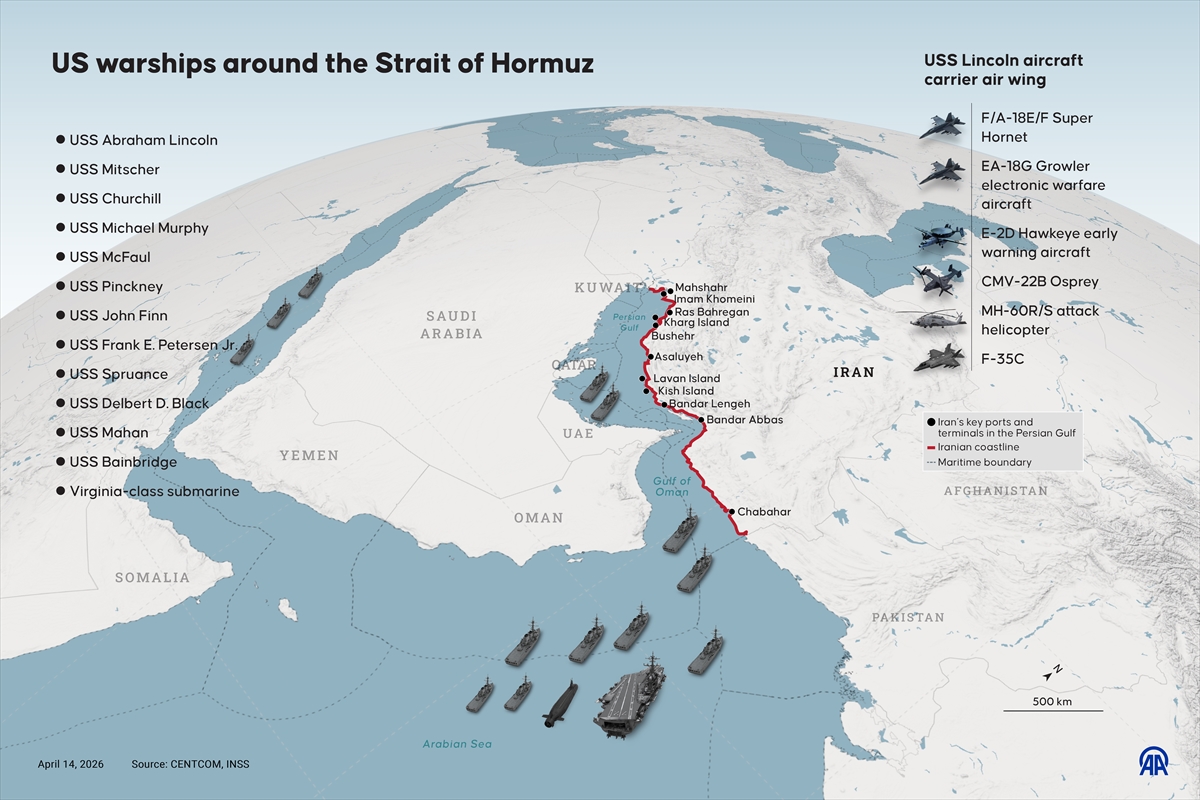
[An infographic titled “US warships around the Strait of Hormuz” created in Ankara, Turkiye on April 14, 2026. Photojournalist: Yasin Demirci/