By Elham Asaad Buaras
London, (The Muslim News): Israeli attacks have killed 1,534 Palestinians in Gaza since the ceasefire took effect, while 23 attacks on Palestinian farmers, their land and solidarity activists were reported across the occupied West Bank in just 12 hours on Wednesday, as Israeli military manoeuvres near Iran and intensifying fighting in Yemen underscored the widening regional conflict.
Three Palestinians were killed and several others injured in Israeli attacks across Gaza on Wednesday, while a 10-year-old boy died from wounds sustained in an earlier strike.
In Yemen, government forces claimed to have carried out 835 strikes against Ansar Allah [Houthi] positions and military movements in 24 hours, amid reports of a drone interception at Saudi Arabia’s Shaybah oil field and explosions in southern Iran.
Two Palestinians were killed and several others injured, including one critically, when an Israeli drone targeted an electric bicycle near al-Sinaa Street in western Gaza City, a medical source told Anadolu. Witnesses said the strike killed the bicycle’s rider and a passer-by near the al-Sinaa intersection.
The area is densely populated and surrounded by tents sheltering displaced Palestinians, according to an Anadolu correspondent.
Earlier on Wednesday, Ramadan Mohammed Abu Shahada was killed and another Palestinian injured in an Israeli drone strike in al-Mawasi, in the al-Qarara area north of Khan Younis, a medical source said.
In Gaza City, 10-year-old Abdul Rahman Khalil Awad died from injuries sustained in an Israeli strike on the Sheikh Radwan neighbourhood two days earlier.
A woman was also wounded by Israeli army gunfire near Hamad City, north of Khan Younis, witnesses said.
Israeli naval vessels opened machine-gun fire off the coast of Gaza City on Wednesday morning, disrupting Palestinian fishing activities. Sporadic gunfire and artillery shelling were also reported in eastern Gaza City and Jabalia refugee camp in northern Gaza, areas under Israeli military control.
The latest casualties came despite a ceasefire that took effect on October 10, 2025. Gaza’s Health Ministry said Israeli violations of the agreement had killed 1,534 Palestinians and injured 5,486 others.
Israel’s military campaign in Gaza since October 2023 has killed more than 74,000 Palestinians and injured over 175,000, according to figures cited in the reports. Approximately 90 per cent of civilian infrastructure has been affected by widespread destruction.
23 attacks were documented within 12 hours in West Bank by Israeli forces
In the occupied West Bank, the Palestinian Wall and Settlement Resistance Commission documented 23 attacks and violations against farmers, agricultural land and crops, as well as solidarity activists, across seven governorates within 12 hours on Wednesday.
The incidents occurred between 6am and 6pm local time during the olive harvest season. The commission recorded 10 incidents in Nablus, six in Ramallah and al-Bireh, two each in Salfit and Hebron, and one each in Qalqilya, Jenin and Bethlehem.
The reported violations included shootings, physical assaults, arrests, preventing farmers from harvesting olives, the theft of crops and equipment, and the burning and bulldozing of agricultural land.
In the village of Osarin in Nablus governorate, a Palestinian farmer was shot in the hand with live ammunition while harvesting olives. Another farmer suffered severe breathing difficulties after being sprayed with pepper spray in the Wadi Abbas area of Qarawat Bani Hassan in Salfit governorate.
In Nahalin, southwest of Bethlehem, Israeli forces attacked farmers and solidarity activists in the al-Habla area, arresting an elderly woman and several activists, including Brad Lander, a Democratic candidate for the US Congress, according to the commission. Israeli forces also confiscated harvested olives.
The commission also reported the arrest of a Russian solidarity activist participating in the olive harvest in Taybeh, a predominantly Christian town in the central West Bank, and a young Palestinian harvesting olives in Kafr ad-Dik.
In Nablus governorate, illegal Israeli settlers set fire to agricultural land in Burqa, while Israeli bulldozers levelled olive-planted land in the Rajmanat area of Madama.
Settlers attacked olive pickers near Jalud School and opened fire towards them before Israeli forces arrived and physically assaulted the farmers, the commission said.
In Beit Furik, settlers threw harvested olives onto the ground and seized crops at gunpoint, forcing families to leave their fields. Similar incidents involving the theft of olives and agricultural equipment were reported in Qaryut, Awarta and Tell, while farmers were expelled from the Wadi Abuwayn area of al-Lubban ash-Sharqiya.
Israeli forces also pursued farmers in the al-Jiza area of Beita, preventing them from harvesting olives and opening fire in their direction.
In Ramallah and al-Bireh governorate, farmers were prevented from accessing their land in the al-Harayiq area of Deir Jarir. Farmers, journalists and commission staff were also expelled from agricultural land in Turmus Ayya after Israeli forces declared the area a closed military zone.
Landowners were prevented from harvesting olives in al-Mughayyir, while settlers brought livestock onto olive-planted land in Burqa and Kafr Malik.
In southern Hebron governorate, armed settlers opened fire towards olive pickers in the Birin area, while farmers and activists were prevented from harvesting in Idhna. In Qalqilya governorate, settlers cut down olive trees in Farata, east of the city.
Farmers in Deir Abu Daif, east of Jenin, were also forced to leave their land despite having obtained prior coordination and approval to access it, the commission said.
It said the incidents involved direct attacks, military closures, arrests and crop confiscations that were making access to farmland increasingly difficult during the olive harvest. The commission called for measures to guarantee farmers safe and continuous access to their land and to hold those responsible accountable.
The harvest, which began in early October, provides a vital source of income for thousands of Palestinian families.
According to Palestinian figures, approximately 750,000 illegal Israeli settlers live in the occupied West Bank, including East Jerusalem, across 194 settlements and around 400 settlement outposts. Israeli settlements built on occupied Palestinian territory are illegal under international law.
Palestinian, Israeli and international human rights organisations have repeatedly accused Israeli authorities of failing to prevent attacks by settlers or hold those responsible accountable.
Israel fighter jets flew close to Iran’s border to provoke Iranian military response
Meanwhile, dozens of Israeli fighter jets reportedly flew close to Iran’s border earlier this week in a manoeuvre that may have been intended to provoke an Iranian military response, Israeli media reported on Wednesday, citing US sources.
Israel’s Channel 12 reported that the operation took place overnight from Monday into Tuesday and involved dozens of fighter jets accompanied by Israeli Air Force refuelling aircraft.
The aircraft flew over Syrian and Iraqi territory before turning back towards Israel after approaching the Iranian border, according to the broadcaster.
US sources told Channel 12 that Israel may have hoped Iranian forces would open fire on the aircraft, potentially providing a justification for an attack on Iran.
The report came amid Israeli warnings of a possible Iranian attack during Israel’s elections scheduled for October 27.
Separately, several explosions were heard on Wednesday night near the Strait of Hormuz in southern Iran, the official IRNA news agency reported.
The explosions occurred in the Kerpan area of Sirik city in Hormozgan province. There were no immediate reports of casualties or damage, and local sources had not provided details about the cause or nature of the incident.
The explosions came amid heightened regional tensions and disruptions to maritime traffic through the Strait of Hormuz, a strategic waterway through which a significant share of global oil supplies passes.
Iran was also preparing to unveil a new weapon described as the “father of all bombs”, a spokesman for the Islamic Revolutionary Guard Corps (IRGC) said on Wednesday.
“We are in the stage of preparing to unveil the ‘father of all bombs’. This is something new for the enemy,” Hossein Mohebi said in remarks carried by Iran’s Young Journalists Club news agency, without providing further details.
US may use 9,800kg bomb against Iran
On Friday, US President Donald Trump hinted at the possible use of the GBU-43/B Massive Ordnance Air Blast bomb, known as the “mother of all bombs”, against Iranian nuclear facilities.
Weighing approximately 9,800kg, the GBU-43/B is one of the largest non-nuclear conventional bombs in the US arsenal. It was first used in April 2017, during Trump’s first presidential term, against a tunnel complex belonging to the Islamic State group in Afghanistan.
Mohebi claimed that Iran’s missile stockpile had increased by 1.5 times following the 12-day war between Iran and Israel in June 2025, without providing figures.
“The quality of the missiles has improved significantly, and their range, destructive power and accuracy in hitting targets have increased,” he said.
The IRGC spokesman said Iran was shifting its military doctrine towards establishing permanent deterrence, including offensive responses to attacks.
“Previously, Iran’s defence doctrine was purely defensive. We used to say that if a country attacked us, we would respond,” Mohebi said.
“Now, we say that if a country attacks us, we will not only respond but also launch an offensive,” he added.
He said Iran would increasingly rely on asymmetric warfare, adding: “We will attack the enemy in a way that makes them feel the intensity of our response.”
The statements came amid continuing confrontation involving Iran, Israel and the US. The supplied reports said Israel and the US launched a war against Iran on February 28, while Tehran responded with attacks on Israel and US military facilities in Arab countries.
Washington and Tehran signed a memorandum of understanding in June before negotiations later collapsed over disagreements concerning freedom of navigation and security in the Strait of Hormuz, according to the reports.
Yemen govt carries out 835 attacks against Ansar Allah last 24 hours
In Saudi Arabia, two foreign nationals were killed and two others injured after air defences intercepted a drone attempting to target a facility at the Shaybah oil field in the Eastern Province, the Saudi Energy Ministry said.
A ministry official said debris from the interception caused a fire in a contractor’s vehicle outside the facility’s perimeter, according to the Saudi Press Agency. The incident did not affect operations at the oil field.
The two people killed were Philippine and Nepalese nationals, while the injured were Pakistani and Indian nationals. Authorities responded to the incident and took the necessary measures, the ministry said.
The incident came amid escalating hostilities involving Ansar Allah in Yemen and the Saudi-led coalition supporting Yemen’s internationally recognised government. Ansar Allah has recently threatened to target Saudi energy infrastructure, including facilities operated by Saudi Aramco, according to the reports.
Egyptian President Abdel Fattah al-Sisi said on Wednesday that Egypt’s military support for Saudi Arabia would not include attacks on Yemen, stressing that Cairo’s role was limited to defending the Kingdom’s territory and borders.
Sisi made the remarks during a session entitled “Security of the Nation and Citizens” on the third day of the Egypt Forum 2026, attended by Prime Minister Mostafa Madbouly, ministers and senior officials, according to a statement from the Egyptian presidency.
“The Egyptian military effort is intended to defend the Kingdom’s territory and does not include an attack on Yemen,” Sisi said.
He said Egypt’s military role could include defending Saudi Arabia and any other Arab country requesting Cairo’s assistance, but would not extend beyond Egypt’s borders or those of an Arab country whose security and stability it sought to protect.
Sisi described Arab national security as “indivisible” and said the stability of Gulf countries was closely linked to Egypt’s own national security.
His remarks followed discussions in Egypt about support for Saudi Arabia amid escalating attacks attributed to Ansar Allah. On Sunday, Egypt’s National Defence Council expressed solidarity with Saudi Arabia and discussed measures to safeguard Egyptian national security. The Egyptian parliament subsequently convened to consider measures related to regional developments.
Fighting has also intensified inside Yemen, where government forces said they carried out 835 strikes against Ansar Allah positions and military movements over the previous 24
hours as part of Operation “Dawn of Yemen”.
Army spokesman Majed Abdullah al-Nuzayli said in a statement on X that the operations involved fighter jets, drones, field artillery, rocket launchers and sniper units.
The strikes targeted troop movements, gatherings, reinforcements, weapons, armoured vehicles, firing positions, fortifications and supply routes, according to the statement.
The military claimed that approximately 285 fighters and commanders had been neutralised and around 190 military vehicles, pieces of equipment and drones destroyed or damaged.
These figures were not independently verified in the supplied report.
In Taiz province in southwestern Yemen, government forces and local fighters repelled attempts by Ansar Allah forces to retake positions, al-Nuzayli said. He added that additional troops and reinforcements had been deployed but had failed to achieve their objectives.
On the northern and eastern fronts west of Marib, government armoured units, artillery and drones continued targeting movements, fortifications and weapons systems, according to the spokesman.
Earlier on Wednesday, Yemeni media reported airstrikes against Ansar Allah positions east of the coastal city of Mokha, a missile attack on Aden airport and renewed clashes west of Taiz.
Yemen TV reported the airstrikes near Mokha without providing details of casualties or damage. The broadcaster also reported that Ansar Allah had targeted Aden airport with a ballistic missile, although it was unclear whether the missile hit its intended target.
Ansar Allah separately claimed responsibility for a ballistic missile attack on Aden, saying it had targeted a Saudi military operations room at Badr Camp.
Al-Jumhuriya TV reported heavy clashes between government forces and Ansar Allah fighters near the old airport and Mount Han, west of Taiz city.
On Tuesday, the Yemeni army said it had carried out 834 attacks against Ansar Allah positions over the preceding 24 hours, claiming to have neutralised around 200 fighters and destroyed or damaged 90 military vehicles and other assets.
The latest operations followed an offensive launched by Yemen’s government earlier this month to recapture territory held by Ansar Allah, including the capital, Sana’a, with support from the Saudi-led coalition.
Yemen’s conflict escalated after Ansar Allah seized Sana’a and several other provinces in 2014, prompting a Saudi-led coalition to intervene in March 2015 in support of the internationally recognised government. Ansar Allah controls much of northern and western Yemen, while government forces and their allies hold Aden and large parts of the south and east.
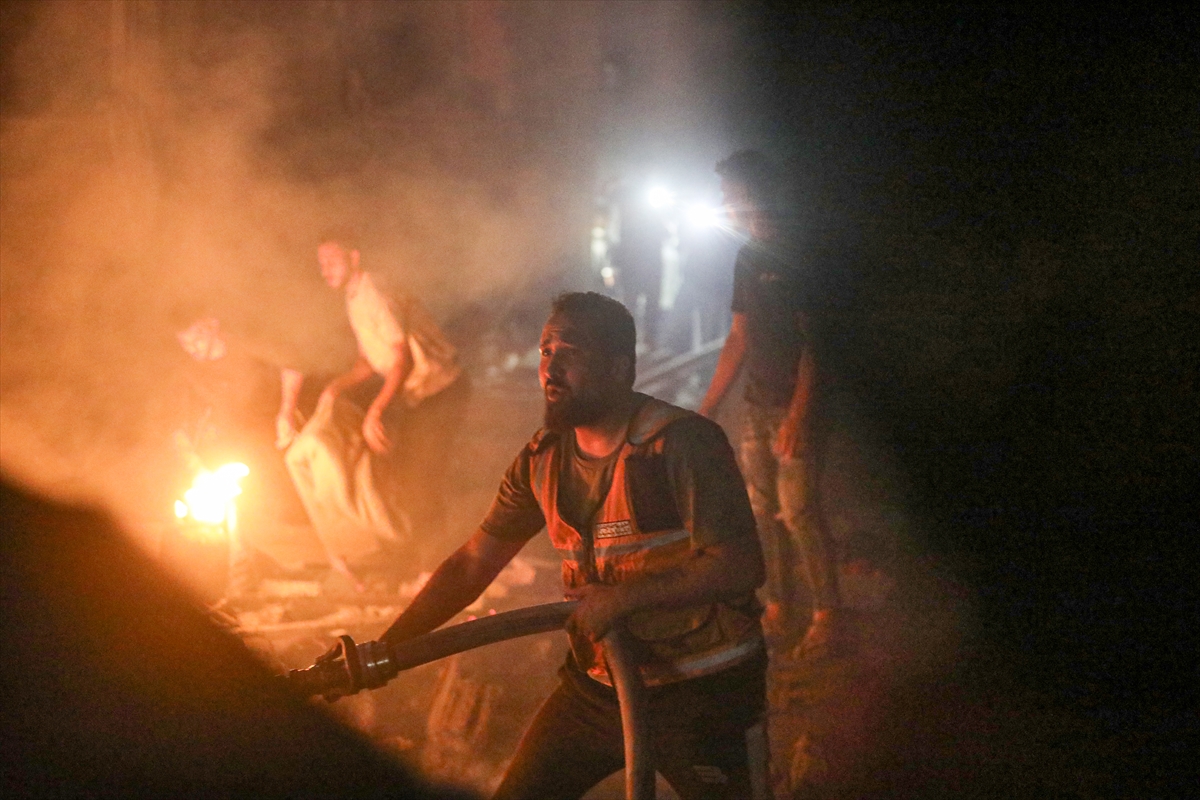
[Photo: A fire breaks out after the Israeli army bombed a home belonging to the Hamd family following an evacuation warning in the Nuseirat refugee camp, central Gaza Strip, Palestine on October 22, 2026. The attack destroyed the house and caused damage to surrounding structures. Photojournalist: Ahmed Maqadema/AA]