By Ahmed J Versi
LONDON, (The Muslim News): It is a familiar scene: the United Kingdom placing itself at the centre of the map, convening global powers to address a crisis to which its own policies, particularly on Gaza, have not been entirely peripheral.
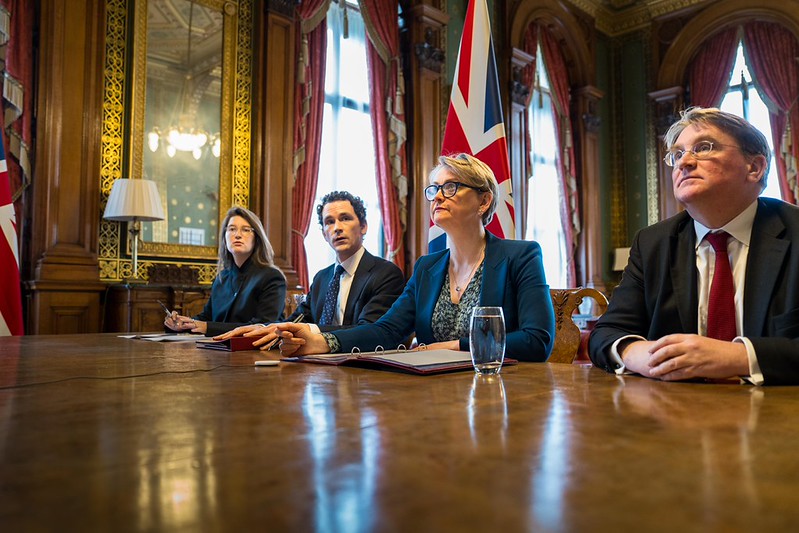
Earlier today, Foreign Secretary Yvette Cooper hosted a virtual summit of some 40 nations to address an “emergency” in the Strait of Hormuz. The stated mission? To “secure freedom of navigation” through a waterway that serves as the jugular of global energy trade.
Officially, the talk is of “diplomatic measures.” Yet for those fluent in the dialect of British statecraft, the subtext is plain. Beneath the veneer of international cooperation lies the scaffolding for military contingency, a move that risks steering the West into direct confrontation with Tehran.
The most striking feature of the crisis is the widening chasm between the Prime Minister’s rhetoric and his department’s reality. At Downing Street, Keir Starmer has been at pains to reassure a war-weary public, flatly insisting, “This is not our war.” It is a line calibrated for domestic consumption, a promise that British boots will not touch Persian soil.
But walk a few hundred yards to King Charles Street, and the tone shifts from cautious to confrontational. The Foreign, Commonwealth & Development Office’s (FCDO) latest statement is not the work of a government staying out of a fight; it is the work of one picking its side. While Starmer speaks of avoiding conflict, Cooper is busy deploying the vocabulary of combat, accusing Tehran of holding the global economy “hostage.” One does not usually negotiate with “hostage-takers” through non-involvement.
The FCDO is quick to highlight the stakes: any disruption here has “immediate and far-reaching consequences” for global prices. With 20 per cent of the world’s oil and LNG flowing through this narrow passage, the volatility is undeniable.
Yet the transition from talk to troop movements is already underway. Next week, the dialogue shifts to the Permanent Joint Headquarters in Northwood, where military planners will begin the task of making the Strait “accessible and safe.”
Starmer’s insistence that this planning is only for the period “after the fighting has stopped” relies on a convenient fiction: that one can prepare the post-war architecture of a vital chokepoint without being complicit in the escalation that precedes it.
The Foreign Secretary’s rhetoric has been remarkably focused. Cooper has framed Iran as the lone aggressor – conveniently forgetting the real illegal aggression by the US and Israel – accusing Tehran of “recklessness” while pointedly describing Gulf states as “not involved.”
It is a convenient, if lopsided, history. This narrative carefully omits that Gulf states host the very US military bases used for strikes against Iran as recently as 28 February, strikes widely cited as the catalyst for the current escalation. By airbrushing these provocations, the UK establishes a familiar moral binary: Iran as the villain, Britain as the reluctant, principled guardian.
Perhaps the most telling aspect of the 2 April summit was the empty chair usually reserved for the United States. With Washington currently signalling that the region is “not a priority,” a strategic window has opened. London has stepped into the breach with practised ease, positioning itself as the “responsible leader” of the rules-based order. But one must ask: is this a genuine effort to stabilise the markets, or a calculated attempt to reassert British relevance in a post-American Middle East?
Starmer’s “not our war” pledge looks increasingly like a semantic fig leaf for a Whitehall that has no intention of sitting this one out.
This script, moral high-grounding followed by strategic entrenchment, is a Whitehall staple. We saw it in Iraq (2003) and Libya (2011), where “humanitarian missions” morphed into long-term geopolitical footholds. Even the recent conflict in Gaza follows the pattern: rhetorical concern for international law paired with the strategic maintenance of arms flows.
The Hormuz crisis appears to be the latest iteration. The UK presents itself as a neutral arbiter of maritime law, even as it assembles a coalition and activates its planners at Northwood to “bear down” on Iran through coordinated sanctions and “operational confidence.”
At its heart, the Hormuz crisis is a contest for leverage over one-fifth of the world’s energy. While diplomacy is the public face, history suggests that “freedom of navigation” is often the preferred euphemism for securing geopolitical advantage.
As the planners at Northwood take up their pens, the global public should look beyond the FCDO’s polished press releases and the Prime Minister’s pacifist assurances. Britain may be posing as the principled protector of trade, but the patterns of the past suggest that power, influence, and the securing of vital chokepoints remain the true lodestars of British strategy.
.
[Photo: Foreign Secretary Yvette Cooper hosts Strait of Hormuz Call speaking to 40 countries including France, Germany and the Gulf States. Picture by Michael Peat / FCDO]