By Harun Nasrullah
London, (The Muslim News): Israeli Prime Minister Benjamin Netanyahu has ruled out any withdrawal of Israeli forces from occupied areas of the Gaza Strip until Hamas is “fully” disarmed, reinforcing Israel’s hardline stance on ceasefire negotiations as Israeli military operations intensified across Gaza, Lebanon and the occupied West Bank. At the same time, regional tensions widened beyond Israel’s borders, with Yemen’s Houthi movement escalating attacks on Saudi shipping in the Red Sea and Iran accusing the United States of obstructing negotiations over a new maritime arrangement in the Strait of Hormuz.
In a video statement posted on Facebook on Tuesday, Netanyahu rejected a US-backed roadmap that envisages the phased disarmament of Hamas alongside a gradual Israeli withdrawal from Gaza.
“I remain committed to our security interests,” he said. “We will not withdraw from our current positions until Hamas is fully disarmed.”
His comments underscored continuing disagreements over a proposal put forward by US President Donald Trump’s Board of Peace. While Hamas has accepted the framework, Israel insists that Hamas must first surrender all of its weapons before any withdrawal can begin.
Netanyahu said the United States believed Hamas could be disarmed and Gaza demilitarised but confirmed Israel had rejected the draft proposal.
“They sent us a draft that we did not approve, and we sent them our comments on it,” he said.
The roadmap envisages Gaza being administered by a Palestinian technocratic committee, supported by an international stabilisation force. At the same time, responsibility for weapons would pass to a National Committee for Gaza Administration under international supervision. It also proposes that Hamas’ disarmament, Israel’s withdrawal and Gaza’s reconstruction proceed in parallel.
However, following talks between the board’s envoy, Nikolay Mladenov, and Netanyahu, the Board of Peace made a U-turn and said a full Israeli withdrawal would not take place until heavy and light weapons had been surrendered and Hamas’ tunnel network dismantled.
Hamas reiterated its commitment to the agreed second phase of the ceasefire process.
Israeli forces currently occupy around 70 per cent of the Gaza Strip following a military offensive that Palestinian authorities say has killed more than 73,000 Palestinians and wounded over 174,000 since October 2023. Palestinian officials also accuse Israel of repeatedly violating the ceasefire that took effect on 10 October 2025, saying a further 1,252 Palestinians have been killed and 4,120 injured since then.
While negotiations over Gaza remained deadlocked, Israeli military activity continued elsewhere in the region.
Israel continues ceasefire violations by continuous bombing Lebanon
In Lebanon, Israeli forces carried out a series of reported ceasefire violations on Tuesday despite a fresh round of US-mediated negotiations between Beirut and Tel Aviv in Rome.
According to Lebanon’s National News Agency (NNA), Israeli military vehicles advanced from Haddatha towards the outskirts of Aita al-Jabal in the Bint Jbeil district, accompanied by artillery shelling, machine-gun fire and extensive drone surveillance.
The agency also reported large explosions between Mansouri and Majdal Zoun in the Tyre district and in Haddatha itself. An Israeli drone reportedly struck the Roueiss neighbourhood on the outskirts of Nabatieh al-Fawqa, while artillery shelled nearby Zawtar al-Sharqiya.
Israeli Merkava tanks and a military bulldozer also advanced towards Haddatha and Aita al-Jabal, with one tank reportedly firing directly at a residential house.
Israeli fighter jets flew at low altitude over Baalbek, the Bekaa Valley and northern Bekaa, while drones maintained continuous flights over Beirut and its southern suburbs.
The military activity coincided with the seventh round of US-sponsored negotiations between Lebanon and Israel, following a framework agreement signed in June providing for a phased Israeli withdrawal from occupied Lebanese territory. Under the agreement, the Lebanese army would gradually assume responsibility for security in designated pilot zones while armed groups, including Hezbollah, would be disarmed.
Despite a ceasefire that took effect on 16 April, Israel has continued its offensive in Lebanon. According to the Lebanese Health Ministry, 4,333 people have been killed and 12,250 injured since March. Israel continues to occupy areas of southern Lebanon, some held for decades and others seized during the 2023–24 war.
Israeli army continues attacks on Palestinian civilians in West Bank
Military operations also intensified in the occupied West Bank.
Early on Wednesday, Israeli forces launched a large-scale raid on the Qalandiya refugee camp and the nearby town of Kafr Aqab, north of occupied Jerusalem.
The Jerusalem Governorate said Israeli forces imposed a curfew, deployed large numbers of military vehicles and prevented dawn prayers from taking place in every mosque inside Qalandiya camp. Residents also received text messages informing them that a major military operation had begun.
During the raid, Israeli forces arrested the father of Laith al-Shawani, while an Israeli military vehicle reportedly ran over a young Palestinian near the camp. No immediate information was available about his condition.
The raid forms part of Israel’s daily military operations across the occupied West Bank, where Palestinians seek to establish an independent state with East Jerusalem as its capital.
According to Palestinian officials, more than 1,182 Palestinians have been killed, around 13,000 injured and nearly 24,000 arrested across the occupied West Bank since October 2023.
The operations have also included widespread demolitions, destruction of farmland, attacks on mosques, forced displacement and continued settlement expansion, which Palestinians say are intended to pave the way for the formal annexation of the territory.
The scale of Israel’s arrest campaign was further highlighted on Tuesday when the Palestinian Prisoner Society said Israeli forces detained 630 Palestinians during military raids across the occupied West Bank in July alone, including women, children and former prisoners.
The arrests brought the total number of Palestinians detained since October 2023 to more than 25,000.
“The arrest campaigns were accompanied by escalating violations, including field interrogations, violent night raids on homes, systematic destruction of property, assaults on detainees and their families through beatings, threats and humiliation, holding family members hostage, stealing money and belongings, and carrying out field executions,” the organisation said.
It added that illegal Israeli settler attacks, carried out under Israeli military protection, had contributed to widening the scope of arrests in Palestinian communities targeted for settlement expansion.
Around 9,500 Palestinians are currently held in Israeli prisons, including 92 women and 370 children, according to Palestinian and Israeli human rights organisations.
Rights groups say dozens have died in custody from starvation, torture and medical neglect, while Israel’s 2002 Unlawful Combatant Law allows Palestinians to be held indefinitely without charge or trial.
Yemen’s Houthi movement attacks Saudi ships
The conflict’s regional repercussions were also felt further south.
Yemen’s Houthi movement claimed on Wednesday that it had struck the Saudi oil tanker Wafaa with several ballistic missiles in the northern Red Sea off the coast of Yanbu.
Military spokesman Yahya Saree said the missiles had hit the tanker “accurately”, describing the attack as part of the group’s maritime blockade of Saudi Arabia and its “blockade for blockade” strategy.
According to Saree, eight Saudi oil tankers have now been targeted since the blockade began on 22 July, while 29 others have either been prevented from transiting the Red Sea and Arabian Sea or forced to turn back.
He claimed Saudi Arabia had redirected its oil exports to the northern Red Sea after the Houthis imposed what they described as a blockade at the Bab al-Mandab Strait, vowing that attacks on Saudi shipping would continue “regardless of the consequences.”
Saudi authorities did not immediately comment on the claims.
Iran and Oman negotiations on Strait of Hormuz continues without US involvement
Meanwhile, diplomatic efforts to secure freedom of navigation through the Strait of Hormuz remained uncertain as Iran accused the United States of delaying negotiations with Oman over a new shipping arrangement.
“The main reason for the delay in the agreement with Oman regarding the Strait of Hormuz is US interference and Trump’s threats,” an informed Iranian source told Sepah News.
“As long as there is US interference and the threat of a military attack on Iran, the agreement will be delayed… Iran will not reach any agreement under the shadow of threats.”
The comments followed reports from Iranian officials that Tehran and Muscat had entered “a new phase” of negotiations aimed at establishing a secure commercial shipping corridor through one of the world’s most strategically important waterways.
Iranian officials said an agreement remained within reach if Washington ceased interfering in the talks, while accusing President Trump of attempting to influence the negotiations and claim political credit for any breakthrough.
Foreign Ministry spokesperson Esmaeil Baqaei said negotiations were continuing at both technical and political levels to establish safe inbound and outbound shipping lanes while safeguarding the sovereign rights and national security interests of Iran and Oman.
US Secretary of State Marco Rubio said on Tuesday that Washington and Tehran had made progress in discussions over navigation through key international waterways but had yet to reach a final agreement, expressing hope that a deal could be reached “very shortly.”
The negotiations stem from a memorandum of understanding signed by Iran and the United States on 18 June following the end of the conflict that began in February. The memorandum called for negotiations on future shipping arrangements through the Strait of Hormuz, but implementation has stalled amid continuing disputes over navigation and wider regional security tensions.
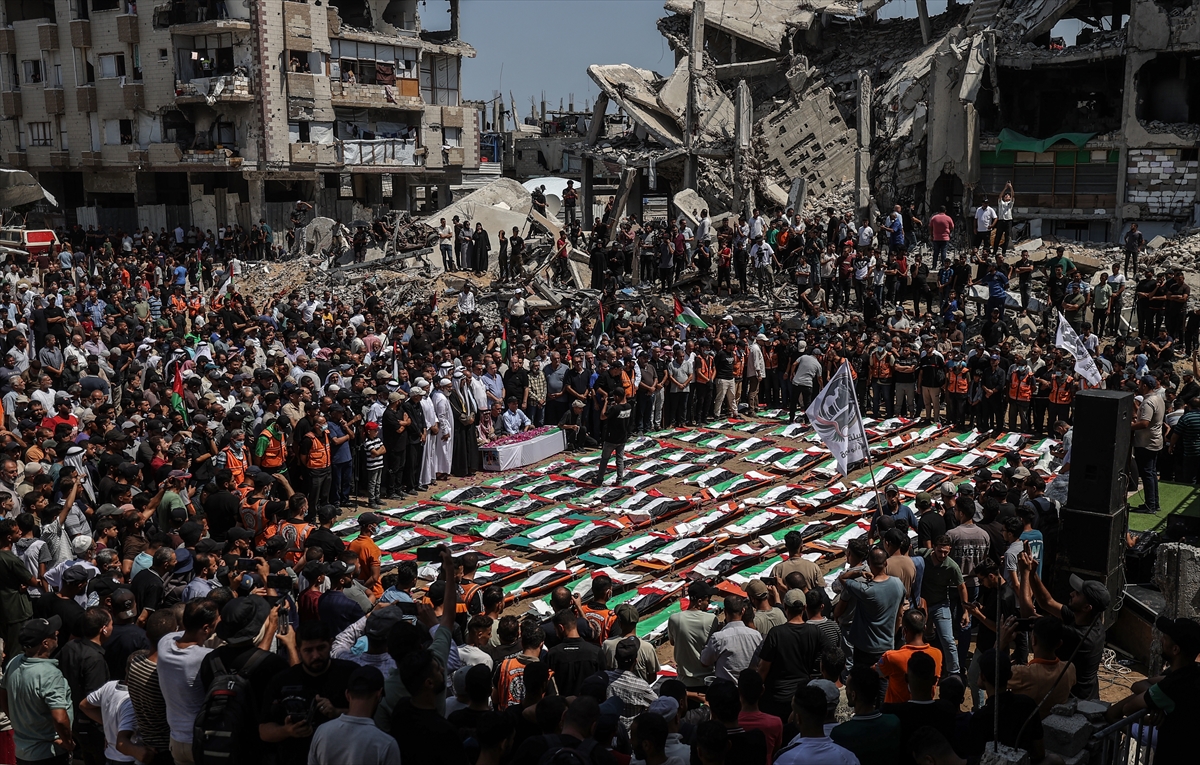
[Photo: An aerial view of Palestinians taking part in a funeral for 112 Palestinians in Gaza, Palestine, on August 04, 2026. The 112 Palestinians were killed in Israeli attacks targeting the area where the Hasayine and Abu Sharia families lived in the Sabra neighborhood of Gaza City in November 2023, and their bodies were retrieved from the rubble nearly three years later. Photojournalist: Ali Jadallah/AA]