By Abdul Adil
London(The Muslim News): Israeli military operations across Lebanon and Gaza, an expanding offensive in the occupied West Bank and Tehran warns of wider conflict if attacked bu US-Israel underscore growing regional instability despite ongoing diplomatic efforts.
Israeli forces carried out fresh airstrikes, explosions and machine-gun fire across southern Lebanon early Saturday, while attacks continued in the Gaza Strip and the occupied West Bank amid heightened regional tensions and stalled diplomatic efforts.
At the same time, Iranian officials issued fresh warnings against renewed US-Israel military action, dismissed reports of planned negotiations with Washington and reported an attack on fishing boats off the country’s southern coast.
Israeli attacks target southern Lebanon
Lebanon’s National News Agency reported that Israeli military operations targeted several locations across the southern districts of Nabatieh, Bint Jbeil, Marjayoun and Tyre.
Israeli warplanes struck areas between Nabatieh al-Fawqa and Kfar Tebnit, as well as the outskirts of Baraachit in Bint Jbeil district.
In Marjayoun, Israeli forces carried out an explosion in Tallousa, while a drone flew at low altitude over nearby towns. Israeli troops also opened machine-gun fire from the direction of Khiam toward agricultural land in Ibl al-Saqi.
Another airstrike targeted an area between Adshit al-Qusayr and Taybeh, the agency reported.
In Tyre district, Israeli drones flew over the city and surrounding towns, reaching both banks of the Litani River in the Qasmiyeh area.
An Anadolu correspondent also reported continued Israeli drone flights over Beirut’s southern suburbs from the morning.
The attacks came despite a US-brokered framework agreement signed by Lebanon and Israel in June and renewed diplomatic efforts to resolve security disputes between the two sides.
The latest escalation followed US-sponsored military and technical talks between Lebanese and Israeli representatives in Tampa, Florida, on Oct. 20-21. The meetings ended without a breakthrough or joint statement, although reports indicated that both sides agreed to continue negotiations.
Disagreements reportedly remain over Israel’s refusal of withdrawal from Lebanese territory and the disarmament of Hezbollah.
The June framework provides for a gradual Israeli withdrawal from occupied Lebanese territories in exchange for the deployment of the Lebanese army and the disarmament of armed groups.
Despite the agreement, Israeli military operations have continued. Since March 2, the attacks have killed at least 4,386 people, wounded 12,407 and displaced more than 1 million, according to Lebanon’s Health Ministry.
Iran rejects reports of planned talks with US
Iranian Foreign Minister Abbas Araghchi said Saturday that Tehran had no plans to hold talks with US officials, dismissing reports suggesting that diplomatic contacts were being arranged.
According to the official IRNA news agency, Araghchi said Iran had carefully examined a message reportedly sent by US Vice President JD Vance to senior Iranian security official Mohsen Rezaei. He added that the matter remained under review by the relevant authorities.
Araghchi stressed that no negotiations with US officials were planned and that reports suggesting otherwise were inaccurate.
The Wall Street Journal, citing US officials, previously reported that Vance had sent a message to Rezaei at President Donald Trump’s direction in an effort to revive peace negotiations.
Trump denied the report, saying Vance’s role was limited to helping provide medical supplies needed by Iran.
The remarks came amid mediation efforts led by Qatar and Pakistan to revive negotiations between Washington and Tehran, with reports indicating progress in indirect discussions in Doha.
The diplomatic efforts seek possible understandings on Iran’s nuclear programme, sanctions and freedom of navigation in the Strait of Hormuz.
The US and Israel launched illegal attacks on Iran on Feb. 28, prompting Iranian retaliation against Israel and US assets across the region before a ceasefire was reached in April.
Washington and Tehran signed a memorandum of understanding on freedom of navigation in the Strait of Hormuz on June 18, but its implementation has stalled amid disagreements over security arrangements.
Iran’s Supreme Leader warns of wider conflict
Iran’s Supreme Leader Mojtaba Khamenei warned Saturday that Tehran would determine the timing and conditions for ending any renewed conflict if its enemies launched further attacks.
“If the enemies once again launch military or terrorist attacks, it is the armed forces of the Islamic Republic and the Iranian nation that will determine the time and conditions for their end,” Khamenei said in a statement carried by state broadcaster IRIB.
The statement followed a meeting with senior military officials.
Khamenei instructed military commanders to ensure an immediate and effective response to any potential threat, without geographical restrictions. He also ordered an update to the list of targets to ensure that US and Israeli assets remained within the reach of Iranian forces.
Earlier Saturday, Iranian army spokesperson Mohammad Akraminia warned that renewed hostilities could engulf a much wider area if US President Donald Trump launched another military operation in the region alongside Israel.
Regional tensions have remained high since the February attacks, despite subsequent diplomatic initiatives and efforts to establish security arrangements in the Strait of Hormuz.
Drone attack on fishing boats leaves two missing
Separately, Iranian media reported that an unidentified drone attacked two fishing boats off Qeshm Island in southern Iran, injuring two fishermen and leaving two others missing.
The incident occurred approximately 14 miles south of the island, according to the semi-official Fars news agency.
The injured fishermen were transported to Qeshm, while search operations continued for the two missing crew members, the agency reported.
Iranian strikes on US bases leave billions in damage
The financial cost of the conflict has also continued to mount, with hundreds of buildings at US military installations across the Middle East reportedly damaged by Iranian strikes.
The Wall Street Journal reported Friday that an analysis of satellite imagery identified damage to 274 structures across 24 installations hosting US military personnel during the first six months of the war.
One of the hardest-hit facilities was Muwaffaq Salti Air Base in Jordan, where an Iranian strike on July 17 killed three American service members and damaged at least 19 buildings, including accommodation facilities.
The Washington-based Center for Strategic and International Studies estimated that rebuilding the damaged structures alone would cost more than $4 billion, excluding the replacement of equipment and internal systems.
The Pentagon has estimated damage to US military bases at a minimum of $5 billion, with the figure potentially reaching $15 billion, according to US officials cited by the Journal.
These expenses are in addition to the estimated $47.1 billion cost of the war as of Oct. 16.
More than 20 US service members have been killed and over 400 wounded since the conflict began on Feb. 28.
Democratic opposition lawmakers have accused the Trump administration of understating the war’s financial and human costs.
Israeli attacks kill Palestinians in Gaza despite ceasefire
Meanwhile, at least two Palestinians were killed and several others injured in Israeli strikes across the Gaza Strip on Saturday, while another Palestinian died from wounds sustained in an earlier attack, medical sources told Anadolu.
One Palestinian was killed and others wounded when an Israeli strike hit a tent sheltering displaced people west of Khan Younis in southern Gaza, according to a medical source at Nasser Medical Complex.
Separately, Diaa Abu al-Rous was killed in an Israeli strike north of the Nuseirat refugee camp, a medical source at Al-Awda Hospital said.
Four Palestinians were also injured when an Israeli strike targeted a group of civilians near the Abu Namous roundabout, east of the Maghazi refugee camp.
Witnesses said an Israeli drone carried out the attack near the headquarters of a power company north of the camp.
Another Palestinian, Arafat al-Arair, died from serious injuries sustained several days earlier in an Israeli strike targeting a vehicle in the Tel al-Hawa neighbourhood, southwest of Gaza City. Al-Shifa Hospital confirmed his death.
Local sources also reported Israeli artillery and gunfire targeting several areas, including eastern Beit Lahia, Gaza City, Khan Younis and Deir al-Balah.
Israeli warships shelled the Gaza City coastline and opened machine-gun fire toward the shore, while military vehicles fired at homes near the al-Sanafour intersection in the eastern Tuffah neighbourhood.
In southern Gaza, Israeli military vehicles opened fire toward tents sheltering displaced Palestinians in the al-Iqlimi and Bir 19 areas south of Khan Younis. Several tents were hit, although no injuries were reported.
The attacks came amid continued violations of a ceasefire agreement by Israel that has been in effect since October 2025.
According to Gaza’s Health Ministry, Israeli violations of the truce had killed 1,580 Palestinians and wounded 5,711 others as of Saturday.
Since October 2023, Israel’s military offensive has killed more than 74,000 Palestinians and injured over 175,000, while destroying approximately 90% of Gaza’s civilian infrastructure, according to ministry figures.
Israeli offensive intensifies in Hebron
In the occupied West Bank, Israeli forces tightened restrictions in residential neighbourhoods of Hebron on Saturday as a military offensive entered its ninth consecutive day.
The operation, which began Oct. 23, has displaced thousands of Palestinians, resulted in dozens of arrests and involved demolitions of residential and other structures.
Witnesses told Anadolu that Israeli forces imposed a military closure on the Ein Deir Bahha neighbourhood on Friday evening, raided homes and detained several young men.
Military vehicles entered the area before soldiers announced through loudspeakers that it had been designated a closed military zone, prohibiting residents from remaining in or moving through the neighbourhood.
Footage circulated by local media showed Israeli soldiers deployed across the area, warning residents against staying there.
Other footage showed soldiers detaining Palestinians, forcing them to place their hands on their heads and taking them to an undisclosed location.
Local sources and witnesses also reported that Israeli forces demolished the homes of Hamouda Wael Mohammed al-Jaaba and Ahmed Bassam Mohammed Ashour al-Jaaba in the Ain Deir Baha area.
The demolitions followed Israeli allegations that the two men carried out a shooting attack in the Farsh al-Hawa area west of Hebron on Oct. 23.
Israeli settler attacks target Palestinian olive harvesters
Separately, five Palestinians were injured Friday when illegal Israeli settlers attacked a family harvesting olives in the Tel Rumeida neighbourhood of central Hebron, according to the Palestinian Colonization and Wall Resistance Commission.
The commission said the settlers beat family members, used pepper spray and threw stones before stealing their olive harvest.
It also reported that settlers completely burned an agricultural room and equipment in Masafer Yatta, south of Hebron.
Palestinian farmers were prevented from working in the towns of Dura and al-Shuyukh, the commission added.
Since the beginning of the offensive, Israeli forces have imposed closures on Hebron and surrounding villages, seized homes in the Jilada and Ain Deir Baha neighbourhoods and converted them into military positions.
The operation has involved forced displacement, demolitions of homes and commercial properties, and damage to infrastructure.
Nearly 5,000 Palestinians displaced
The Hebron Municipality said Tuesday that the Israeli offensive had displaced 4,969 Palestinians belonging to 780 families.
The Palestinian Prisoners’ Society reported that Israeli forces arrested 110 Palestinians across the governorate between Friday and Wednesday.
Military closures and the ongoing siege have also disrupted education at 66 schools, affecting 2,872 students.
Of those affected, 2,198 remain under direct siege, while another 674 have been forcibly displaced and cannot reach their schools.
Displaced residents have called for an end to the military closures and the lifting of restrictions on their neighbourhoods, allowing them to return home and resume their daily lives.
The developments across Lebanon, Gaza, the occupied West Bank and Iran highlight the fragility of regional ceasefire arrangements and the challenges facing ongoing diplomatic efforts to prevent a wider escalation.
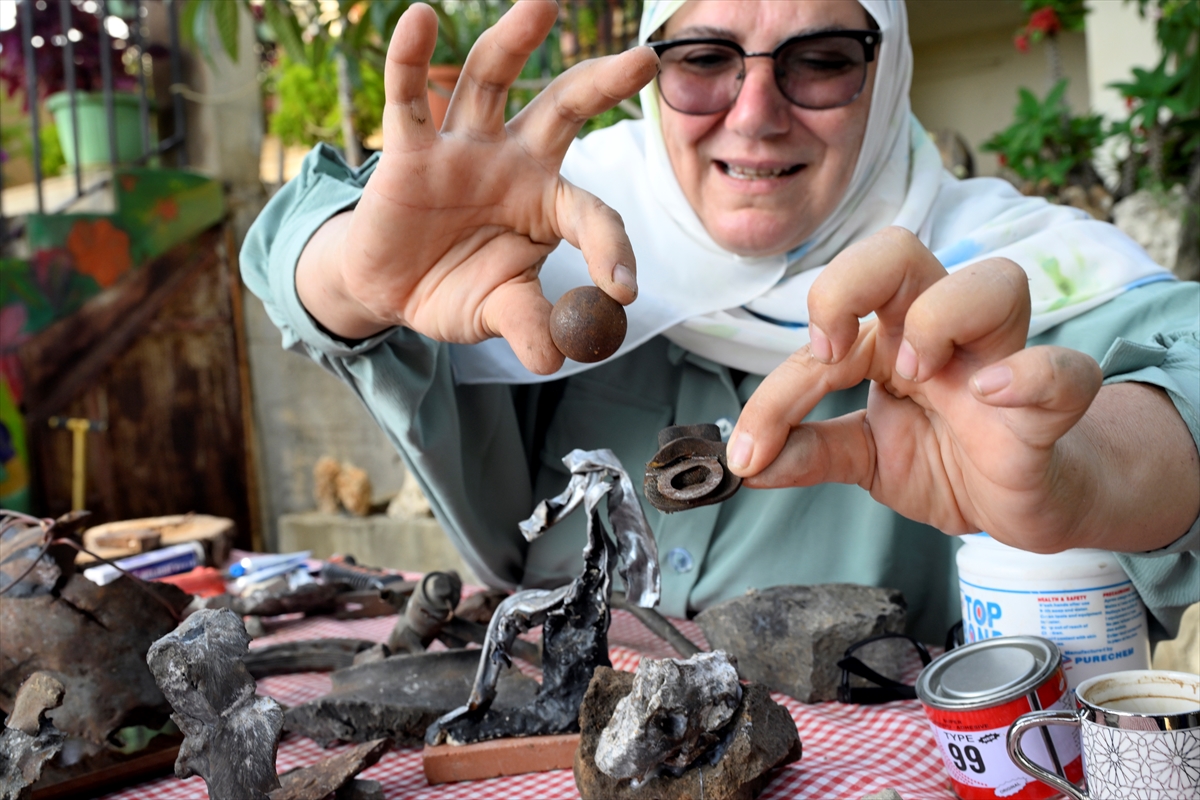
[Photo: Lebanese visual artist Lina Cuni transforms shrapnel, iron and other remains collected from around buildings targeted by Israeli strikes into sculptures and various objects, in Nabatieh, Lebanon on October 24, 2026. Cuni, who lives in Nabatiye, aims to preserve traces of the war and make the destruction caused by Israeli attacks visible through her art. Photojournalist: Houssam Shbaro/AA]