By Middle East Correspondent
LONDON, (The Muslim News): France’s President Emmanuel Macron condemned Israel’s deadly strikes on Lebanon on Wednesday, delivering the message directly in separate calls with Lebanese President Joseph Aoun and Prime Minister Nawaf Salam, as Paris voiced full solidarity in the aftermath of the attacks.Lebanon’s Health Ministry Thursday says that the Israeli army escalated airstrikes across Lebanon since Wednesday, killing at least 303 people and injuring 1,150 others despite the announcement of a two-week ceasefire between the US and Iran.
“I expressed France’s full solidarity in the face of the indiscriminate strikes carried out by Israel in Lebanon today, which resulted in a very high number of civilian casualties,” Macron wrote on X.
The Lebanese Health Ministry reported that at least 112 people were killed and 837 injured in the strikes, cautioning that the figures remain preliminary. The expanded Israeli offensive on Lebanon since March 2 has killed 1,888 people and wounded 6,092 others, according to the Health Ministry.
The World Health Organization (WHO) chief on Thursday called on Israel to reverse an evacuation order affecting hospitals in Beirut, warning it endangers hundreds of patients and civilians.
In a post on US social media company X, Tedros Adhanom Ghebreyesus said the Israeli military had ordered the evacuation of the Jnah area, which includes Rafik Hariri University Hospital and Al Zahraa Hospital.
He said: “No alternative medical facilities are available to receive approximately 450 patients from the two hospitals (including 40 in the ICU), rendering their evacuation operationally unfeasible.”
Both hospitals are operating at full capacity, including treating those injured in Israeli strikes on Wednesday, while the area also houses the Health Ministry complex and shelters hosting more than 5,000 people.
“I urge Israel to reverse this order and ensure the protection of all health facilities, health workers, patients and civilians,” Tedros said.
The US will host direct talks between Israel and Lebanon next week as part of ongoing ceasefire negotiations, a State Department official confirmed to Anadolu.
“We can confirm that the Department will host a meeting next week to discuss ongoing ceasefire negotiations with Israel and Lebanon,” the official said.
According to media reports, the US delegation will be led by Ambassador to Lebanon Michel Issa, with Israel represented by its Ambassador to Washington Yechiel Leiter, and Lebanon by Ambassador Nada Hamadeh-Moawad.
As the scale of the violence became clearer, international condemnation quickly widened. The Committee to Protect Journalists denounced the killing of at least three journalists in Gaza and Lebanon within a single day, warning of a growing pattern of attacks on media workers.
“These are not isolated tragedies; they reflect a systematic failure to uphold the most basic protections owed to civilian journalists under international law,” said Sara Qudah, adding that without accountability such attacks would continue to escalate.
Among those killed was Mohammed Samir Washah, a correspondent for Al Jazeera Mubasher, who died in a drone strike on Gaza’s coastal al-Rashid Street. In Lebanon, strikes also killed Ghada Dayekh of Sawt Al-Farah and Suzan Khalil, affiliated with Al-Manar TV and Al-Nour Radio.
Meanwhile, regional developments hinted at a fragile diplomatic shift. Syria, Iraq and Bahrain reopened their airspace following a ceasefire agreement between the United States and Iran, even as Israeli bombardment intensified elsewhere.
In Beirut, heavy airstrikes struck the Dahiyeh area in the southern suburbs, with loud explosions and plumes of smoke reported. The Israeli military said it had carried out more than 100 strikes in 10 minutes across Lebanon as part of an offensive that began on March 2, targeting multiple aeas including Beirut’s southern suburbs, southern Lebanon and the Bekaa Valley.
The escalation has also raised concerns over global economic stability. According to a report by The Wall Street Journal, Iran is planning to restrict ship through the Strait of Hormuz to roughly a dozen vessels per day while imposing transit fees payable in cryptocurrency or Chinese yuan—down from more than 100 daily crossings before the conflict.
European leaders have responded with increasing urgency. Spain’s Prime Minister Pedro Sanchez called on the European Union to suspend its 1995 Association Agreement with Israel, describing the latest assault as the harshest since the offensive began and condemning what he called an “intolerable” disregard for international law.
Indonesia on Thursday “strongly” condemned Israeli attacks on Lebanon.
“Such attacks constitute serious violations of international law, including international humanitarian law, and risk further exacerbating regional tensions and undermining global security,” according to the Foreign Ministry.
Indonesia demanded that Israel “immediately and permanently cease” all hostilities and aggression in Lebanon, while stressing the importance of protecting civilians and civilian infrastructure under international law.
Canada’s Foreign Minister Anita Anand on Thursday “strongly” condemned Israeli airstrikes across Lebanon, calling on Tel Aviv to respect the country’s territorial integrity.
“We strongly condemn the airstrikes launched by Israel across Lebanon, including in Beirut, which killed civilians and targeted civilian infrastructure,” Anand said in a statement posted on the US social media platform X.
Norway’s Foreign Minister Espen Barth Eide on Thursday condemned Israel’s ongoing attacks on Lebanon, describing them as a violation of international humanitarian law.
“I condemn the massive Israeli attacks in Lebanon, which have caused immense suffering and destruction,” Eide said in a statement.
He highlighted that a large number of the strikes were carried out without warning, affecting civilians during their daily routines
Diplomatic engagement has nonetheless continued in parallel. Iran’s Foreign Minister Abbas Araghchi held talks with Saudi counterpart Faisal bin Farhan, focusing on regional developments a day after Tehran and Washington announced a temporary two-week truce aimed at paving the way for a broader agreement.
However, the violence has cast doubt over that fragile pause. The UN High Commissioner for Human Rights, Volker Turk, described the scale of Israeli strikes as “horrific” and warned they risk placing unbearable strain on an already fragile peace.
“The scale of the killing and destruction in Lebanon today is nothing short of horrific,” he said, noting that such intense bombardment so soon after a ceasefire announcement “defies belief.”
In Washington, preparations are underway to sustain diplomatic momentum. Vice President JD Vance is set to lead a delegation to Islamabad for talks with Iran, joined by special envoy Steve Witkoff and senior adviser Jared Kushner, with the first round scheduled for Saturday.
At the same time, civil society groups in the United States have urged immediate intervention. The Council on American-Islamic Relations accused Israel of attempting to derail ceasefire efforts through escalating violence, while also condemning the killing of journalist Mohammed Wishah in Gaza.
On the humanitarian front, the crisis continues to deepen. Amy Pope, head of the International Organization for Migration, warned that more than 1.2 million people have been displaced in recent weeks, describing the situation in Lebanon as “deeply worrying,” particularly for children caught in the conflict.
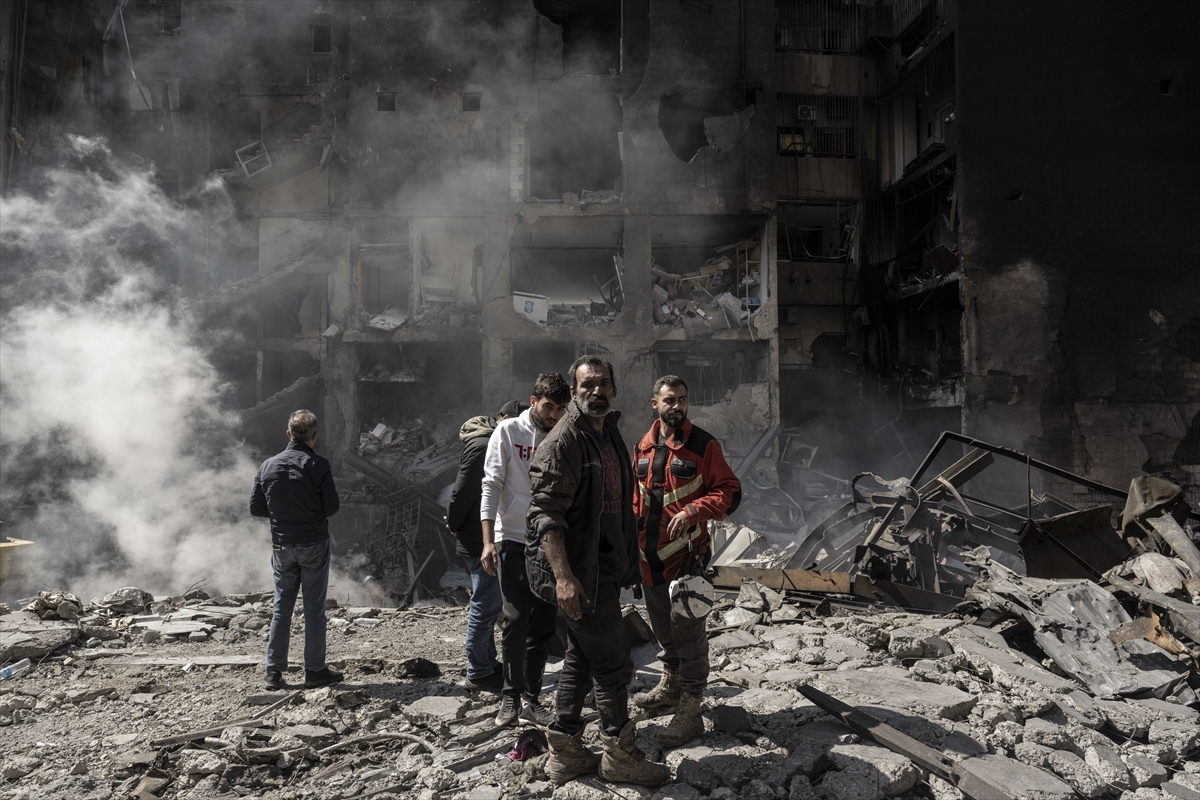
[Photo: Civilians inspect the site as a residential building lies in ruins and surrounding structures show heavy damage after an Israeli strike hits Corniche Al-Mazraa district in Beirut, Lebanon on April 09, 2026. Photojournalist: Murat Şengül/AA]