By Middle East Correspondent
London, (The Muslim News): Five Palestinians, including a nine-year-old girl, were killed in Israeli attacks across Gaza on Sunday as Israel continued military operations despite a ceasefire that has been in force since October 10, 2025.
The latest violence came as a separate regional crisis deepened, with Iran and the United States exchanging fresh military strikes amid escalating tensions over the Strait of Hormuz, a key global oil shipping route.
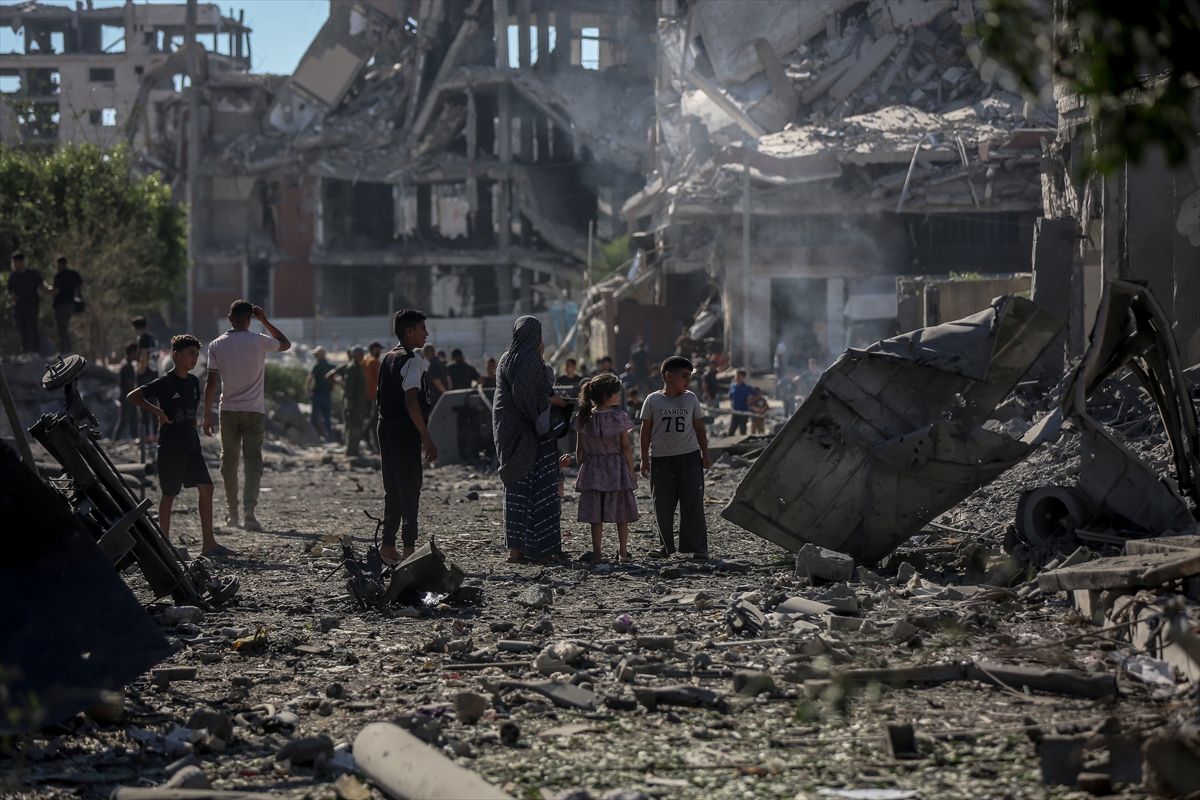
The Palestinian Red Crescent Society said two Palestinians were killed when an Israeli strike hit a workshop in the Sabra district, south of Gaza City. It said the victims’ bodies were torn apart in the attack, which also left a third person wounded.
Witnesses said an Israeli drone fired at least three missiles at a building housing the workshop in the Al-Rayes neighbourhood.
Medical sources said a nine-year-old girl later died from critical injuries she suffered after Israeli gunfire in the Nuseirat refugee camp in central Gaza.
A fourth Palestinian died from wounds sustained during Israeli fire east of the Bureij refugee camp on Friday, while a fifth succumbed to injuries following an earlier Israeli drone strike east of Khan Younis in southern Gaza.
Witnesses also reported that Israeli forces continued demolishing Palestinian homes and other structures in areas under military control south of Khan Younis and east of Gaza City.
Loud explosions were heard during the demolitions, although no injuries were immediately reported.
According to Gaza’s Health Ministry, 1,098 Palestinians have been killed and 3,535 injured since the ceasefire took effect last October.
The ministry says more than 73,000 Palestinians have been killed and over 173,000 wounded since Israel launched its military campaign in October 2023, with around 90 per cent of Gaza’s civilian infrastructure damaged or destroyed.
Strait of Hormuz crisis
Meanwhile, tensions between Iran and the United States intensified over the Strait of Hormuz, through which roughly one-fifth of the world’s oil supplies are transported.
Iranian Foreign Ministry spokesman Esmaeil Baqaei said the future management of shipping through the strategic waterway should be decided through consultations between Iran and Oman.
He said talks during Foreign Minister Abbas Araghchi’s visit to Muscat on Saturday focused on securing navigation through the strait and that both countries had agreed to continue political, technical and legal discussions. A Qatari delegation also took part in part of the talks.
However, Ebrahim Rezaei, spokesman for the Iranian parliament’s Commission on National Security and Foreign Policy, declared that Iran had taken control of the Strait of Hormuz and would maintain that control “with power”.
Earlier on Sunday, Iran’s Revolutionary Guards announced the strait would remain closed until further notice as the confrontation with Washington continued.
The developments came despite a June 16 memorandum of understanding, brokered by Pakistan, under which Tehran and Washington agreed to work towards ending their military confrontation and pursuing a lasting peace agreement.
Iranian army spokesman Brig. Gen. Mohammad Akraminia urged the United States to honour the agreement, accusing Washington of creating insecurity by attempting to establish what he described as an “illegal route” through the waterway.
Speaking to state broadcaster IRIB, he said Iran’s armed forces would firmly defend the country’s rights in the Strait of Hormuz and were continuously updating a list of potential targets.
The latest escalation followed Iranian missile and drone attacks targeting US military facilities in Bahrain, Kuwait, Qatar, Jordan and Oman. The United Arab Emirates said it intercepted and responded to Iranian missile and drone attacks.
The United States said it had launched a third wave of strikes targeting Iranian radar, missile and drone sites across southern Iran.
Iranian officials said US strikes on Sunday hit a communications tower in Kerman province, while overnight airstrikes targeted the outskirts of Veysian in Lorestan province. Officials said there were no casualties in the latter attack.
A military base in the western city of Khondab was also struck by what Iranian state media described as “enemy projectiles”, with authorities assessing damage and any casualties.
Separately, Iran’s Revolutionary Guard Navy reportedly fired a naval cruise missile at a vessel after it allegedly ignored warnings, according to the semi-official Fars News Agency.
The agency did not identify the ship or report any casualties.
The UK Maritime Trade Operations (UKMTO) later reported an incident involving a container ship about nine nautical miles east of Oman. It said the vessel suffered damage to its stern, sparking a fire, and that investigations were under way.
Iranian media also reported explosions in several southern locations, including Bandar Abbas, Sirik, Chabahar, Jask, Qeshm Island and parts of Bushehr province.
The US military’s Central Command (CENTCOM) said its latest operation was launched in response to what it described as an Islamic Revolutionary Guard Corps attack on a Cyprus-flagged container ship in the Strait of Hormuz and was intended to reduce Iran’s ability to target commercial shipping.
[Photo: Palestinians rush as smoke rises among rubble and destruction on Al-Sinaa (Industrial) Street in western Gaza City on July 12, 2026, after the Israeli military targeted several buildings using unmanned aerial vehicles (UAVs). The drone-fired missiles caused significant damage and structural ruin across the residential and commercial area.
Photojournalist: Saeed M. M. T. Jaras/AA]