By Middle East Correspondent
LONDON, (The Muslim News): At least 19 people were killed and several others wounded by Israeli bombing in southern Lebanon on Tuesday, as Israel intensified its military campaign despite ongoing ceasefire talks in Washington, according to Lebanese health authorities and local media.
The state-run National News Agency (NNA) reported a series of airstrikes targeting multiple areas across the south. The Health Ministry confirmed that four people were killed and eight injured in strikes on the city of Tyre and surrounding areas.
Further casualties were reported across the region. An early morning strike near Aishiyeh killed two people, while another attack on a home in Arabsalim left two dead and a woman injured. In the western Bekaa town of Sahmar, three members of the same family were killed in a pre-dawn raid, with one person wounded.
Additional strikes claimed lives in Adloun, where three people were killed, and in Shebriha, where one person died and three others were injured. Two people were also killed when a drone struck a vehicle on the Msayleh–Nabatieh road, while another attack on the Tyre–Abbasiyeh road killed one person. A boy was reported killed in Aba in the Nabatieh district.
Injuries were recorded in several areas, including Mahmoudiyeh, Nabatieh al-Fawqa, Jabal al-Botm, Mansouri, Adloun, and Deir Antar.
Lebanese media also reported that more than 10 homes were targeted by Israel forces in the south, although casualty figures were not immediately available.
Lebanese authorities say at least 2,124 people have been killed and 6,921 injured since then.
Humanitarian conditions are deteriorating rapidly. A senior UN official warned that aid delivery to southern Lebanon is being severely disrupted by ongoing violence and access restrictions.
“Nearly 63% of planned humanitarian convoys to southern Lebanon have not been completed due to negative or absent response or deconfliction requests… Even when convoys are cleared, our teams are being stopped at multiple holding points.
“Last week, one of our convoy missions took 15 hours to complete,” said Samer AbdelJaber, regional director for the Middle East, North Africa, and Eastern Europe at the World Food Programme, speaking at the European Parliament.
He added that more than 80% of markets in the south have been affected, with humanitarian needs rapidly outpacing available resources.
Israel kills 4 Palestinians including a child in Gaza
Meanwhile, in Gaza, four Palestinians, including a child, were killed after an Israeli drone strike targeted a police vehicle in eastern Gaza City. Medical sources said the victims were taken to Al-Shifa Hospital and Al-Ahli Baptist Hospital.
Witnesses reported that the missile struck the vehicle on Al-Nafaq Street, setting it ablaze and wounding several passersby.
The attack marks the latest reported violation of a ceasefire that has been in place since October 10, 2025.
According to local authorities, at least 757 people have been killed and 2,111 injured in Gaza by Israeli forces since the ceasefire began, amid continued shelling, gunfire, and incursions. The United Nations estimates that around 90% of Gaza’s civilian infrastructure has been damaged or destroyed, with reconstruction costs projected at $70 billion.
Wider region still in turmoil
Beyond the immediate conflict zones, tensions are also rising across the wider region.
Maritime traffic continues through the strategically vital Strait of Hormuz despite a US naval blockade imposed in response to Iranian restrictions. Since Monday evening, 25 vessels have passed through the waterway, while congestion has intensified, with around 2,000 ships reportedly trapped on the Gulf side and a further 400 waiting to enter.
Some vessels, including US-sanctioned tankers, have continued transiting the strait, though reports suggest certain ships are broadcasting false identification signals to conceal their identities.
Amid the crisis, former US President Donald Trump signalled the possible resumption of direct talks with Iran, suggesting negotiations could restart in Pakistan within days.
“You should stay there, really, because something could be happening over the next two days, and we’re more inclined to go there,” Trump said during a telephone interview. “It’s more likely, you know why? Because the field marshal is doing a great job.”
Diplomatic activity is also intensifying elsewhere. Senior officials from Pakistan, Saudi Arabia, Türkiye, and Egypt met in Islamabad on Tuesday to coordinate positions ahead of a foreign ministers’ meeting later this week at the Antalya Diplomacy Forum.
In Europe, Italy announced it has suspended the automatic renewal of its defence agreement with Israel. Prime Minister Giorgia Meloni said the decision was taken “in light of the current situation,” reflecting growing international unease.
At the same time, Israel renewed its calls for firm action against Iran’s nuclear programme. Foreign Minister Gideon Saar said Israel “will not allow Iran to obtain nuclear weapons” and urged the international community to take a clear stance against Tehran’s ambitions, claiming recent military actions had “significantly weakened” Iran’s capabilities.
As violence escalates across multiple fronts, the convergence of military operations, humanitarian crises, and diplomatic manoeuvres underscores the growing complexity and volatility of the regional conflict.
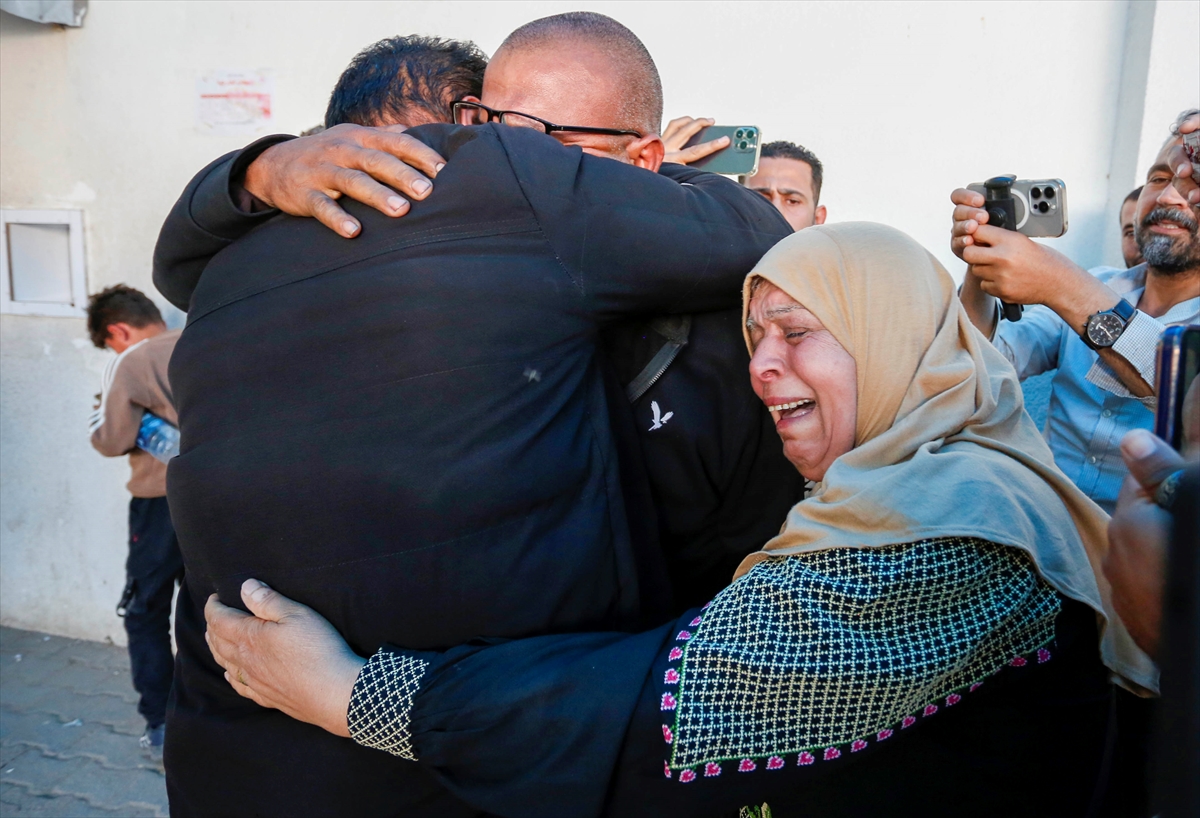
[Photo: Palestinian prisoners released by Israeli forces greeted by their relatives – are transferred to Deir al-Balah through the International Committee of the Red Cross and brought to Al-Aqsa Martyrs Hospital for medical check-ups, on April 15, 2026, in Deir al-Balah, Gaza Strip, Palestine. Photojournalist: Mohammed Eslayeh/AA]