By Middle East Correspondent
LONDON, (The Muslim News): At least 55 people were killed and 40 injured in Israeli airstrikes across eastern Lebanon on Saturday, according to the Lebanese Health Ministry, as fighting linked to the widening confrontation between Israel and Iran continued to intensify across the region.
In one of the deadliest strikes, an Israeli air raid hit the town of Shmustar in the Baalbek district early Saturday, killing six people, including four children and a woman, the ministry said in a statement. Separate Israeli airstrikes on the town of Nabi Chit and nearby areas in Baalbek left 41 people dead, including three soldiers, and 40 others injured, the ministry reported.
These attacks form part of an expanding Israeli military campaign in Lebanon that has intensified in recent days. The escalation has already displaced 112,525 people over the past five days, according to Lebanon’s Disaster Risk Management Unit. The displaced include 26,163 families, and authorities have opened 514 shelters across the country to accommodate those forced to flee their homes.
Israeli commando operation sparks clashes
The airstrikes followed overnight fighting in the mountainous border region between Lebanon and Syria, after what Lebanese media described as an attempted Israeli airborne operation.
According to Lebanon’s National News Agency, Israeli forces attempted an airborne landing near Nabi Chit after four Apache helicopters deployed a commando unit in a rugged area between the towns of Khraibeh, Ma’araboun and Yahfoufa along the eastern mountain range. The Israeli unit advanced under cover of darkness toward a cemetery in the eastern neighbourhood of Nabi Chit but was detected by Hezbollah fighters and local residents, sparking clashes involving light and medium weapons.
Israeli warplanes and helicopters subsequently carried out around 40 airstrikes in the area to cover the withdrawal of the force and prevent reinforcements from reaching the scene, the agency reported.
Hezbollah confirmed the confrontation, saying its fighters engaged the Israeli unit near the village cemetery after spotting the helicopter landing. The group added that Israeli forces launched heavy airstrikes to secure the withdrawal of the special forces.
The Israeli army later acknowledged that its special forces had conducted an overnight operation in Lebanon aimed at locating missing navigator Ron Arad, but said the mission had failed. The military added that no Israeli soldiers were injured.
Escalation linked to wider regional war
The latest developments come amid Israel’s expanding military campaign in Lebanon since Monday, following limited rocket fire by Hezbollah. This escalation is unfolding against the backdrop of broader regional tensions linked to the war launched by Israel and the United States against Iran.
Since the offensive began in October 2023 and escalated into full-scale war in September 2024, more than 4,000 people have been killed and 17,000 wounded in Lebanon, according to Lebanese figures. Despite a ceasefire agreement with Hezbollah reached in November 2024, Israel has continued near-daily strikes that have left hundreds more dead and injured.
In response to these ongoing attacks, Hezbollah said Saturday that it carried out 20 attacks using rockets and drones against Israeli military sites and troop concentrations in northern Israel. The group said the attacks were conducted “in response to Israeli attacks on dozens of Lebanese towns and cities,” including Beirut’s southern suburbs.
Among the targets was Nahariya in northern Israel, where Hezbollah said it launched three rocket barrages and a swarm of loitering drones after warning residents to evacuate. The group also urged residents of Nahariya and Kiryat Shmona to leave immediately and head south, posting maps of the two cities on Telegram.
Hezbollah said it also targeted Iron Dome radar systems at the Kiryat Eliezer site, describing it as a key air defence base in Haifa. Additional strikes reportedly targeted Haifa, Kiryat Shmona, the Stella Maris base, and the Rafael military industries complex near Acre. The group also reported rocket and drone attacks on Israeli troop concentrations near Khiam and Hamamis hill in southern Lebanon, as well as military positions near the Fatima Gate crossing and the Ein Zeitim base northwest of Safed. In a significant escalation, Hezbollah said it also fired a “precision missile” toward the Tel Hashomer base, approximately 120 kilometres from the Lebanese border.
Israel strikes targets in Tehran
As the confrontation widened geographically, Israel launched a new wave of airstrikes in Iran on Saturday evening, targeting oil storage depots and refining facilities in Tehran, according to Israel’s public broadcaster.
The Israeli military said it began a fresh round of strikes targeting infrastructure in the Iranian capital, with more than 80 Israeli warplanes participating in attacks on Tehran and central Iran. Among the sites targeted was Imam Hossein University, which Israel said is affiliated with Iran’s Islamic Revolutionary Guard Corps (IRGC). The military claimed the campus served as a gathering point for IRGC forces and contained military assets. The army also said it struck Iranian military bunkers, missile storage facilities with launch infrastructure and a ballistic missile depot used as a command centre employing hundreds of personnel.
Iranian media reported explosions in Tehran following the strikes. In response to the targeting of the Tehran refinery, the IRGC said missiles struck the Haifa refinery in Israel, according to Iran’s Fars news agency.
The human toll of the broader conflict continues to mount. Authorities in Iran’s Isfahan province said at least 63 people have been killed there since the US and Israeli attacks began on February 28. Akbar Salehi, the province’s deputy governor, said the victims included soldiers, civilians and children. “Since the beginning of the war in Isfahan Province, 63 people — including soldiers, civilians, and children — have lost their lives,” Salehi told journalists, adding that the attacks were ongoing.
Missile interceptions and regional fallout
The escalating confrontation has also triggered incidents across several neighbouring countries, demonstrating how the conflict is drawing in the wider region.
Loud explosions were heard in Jerusalem on Saturday evening after an Iranian cluster missile was seen in the skies above the city, according to an Anadolu correspondent. Sirens sounded across central and southern Israel, and explosions were also reported in Tel Aviv. The Israeli daily Yedioth Ahronoth reported that a “very limited barrage” launched from Iran was fully intercepted by Israeli air defence systems.
Rocket and missile alerts were activated across several regions, including central Israel, Gush Dan, Sharon, Lachish, Beka’a, Samaria and Jerusalem. An alert was also triggered in Moshav Avivim in the Upper Galilee.
The conflict’s reach extended to Iraq, where explosions were reported near Erbil International Airport in the north. Later shelling was heard near the airport for the second time in hours, with air defence systems intercepting the attack, according to local reports. Earlier, blasts were also reported in Baghdad, coinciding with sirens sounding within the compound housing the US Embassy, where air defence systems were reportedly activated.
In northern Iraq, the toll continued to rise as one fighter from the Popular Mobilization Forces (PMF) was killed and three others injured after unidentified aircraft struck the headquarters of the PMF’s 40th Brigade, the Iraqi Joint Operations Command said.
Attacks and interceptions across the Gulf
The regional fallout extended further to Gulf states, where air defence systems were activated to counter incoming threats.
Saudi Arabia’s Defence Ministry said its air defences intercepted and destroyed a drone east of Riyadh before it reached its intended target. Earlier Saturday, Saudi authorities said a ballistic missile launched toward Prince Sultan Air Base in Al-Kharj province fell in an uninhabited area without causing casualties or damage.
In the United Arab Emirates, debris from aerial interceptions caused incidents in Dubai after the country said it had intercepted missiles and drones launched from Iran. Dubai authorities said an Asian driver was killed when debris from an aerial interception struck a vehicle in the Al Barsha district on Saturday evening. Earlier, debris from another interception hit the façade of a tower in Dubai Marina, causing what officials described as a “minor incident” with no reported injuries.
The scale of the aerial threat was underscored by the UAE Defence Ministry, which said the country had detected 229 missiles and 1,305 drones since Iranian attacks began on February 28. On Saturday alone, authorities detected 16 ballistic missiles, 15 of which were destroyed, while 121 drones were detected, with 119 intercepted.
Political reactions and protests
As the military conflict widened, political leaders and international observers began weighing in on the escalating crisis.
Israeli Prime Minister Benjamin Netanyahu said Israel would continue the war against Iran, claiming the country had “a plan full of surprises” to undermine the leadership in Tehran. “Israel has changed the face of the Middle East as promised after the events of Oct. 7, and it has also changed itself,” Netanyahu told reporters. He said he had taken “risk-laden decisions” aimed at eliminating Israel’s enemies.
However, international concern about the escalating conflict has also grown, with some allies expressing reservations. Dutch Prime Minister Rob Jetten said the recent US and Israeli strikes on Iran, as well as Iran’s retaliatory attacks, fall outside the scope of international law. Speaking at a press briefing in The Hague, he said the Netherlands does not support the attacks and noted they were carried out without consultation with other governments. “You see that Iran has also been flouting international law for many years,” he said, adding that “international law has failed to protect the Iranian population.”
In the United Kingdom, London Mayor Sadiq Khan expressed support for Prime Minister Keir Starmer’s decision to resist pressure from US President Donald Trump to join the strikes. “Keir Starmer is right to resist pressure from US President Donald Trump to join strikes on Iran,” Khan said in a statement posted on social media. Khan described the conflict as a “war of choice” that risks causing “needless killing and suffering abroad” while also bringing serious economic consequences for the United Kingdom.
Starmer defended the government’s position earlier in the week, saying the best solution remained “a negotiated settlement with Iran, where they give up their nuclear ambitions.” “My focus is on providing calm, level-headed leadership in the national interest,” the prime minister said.
Anti-War protests in London
The political divisions were mirrored on the streets of London, where thousands of demonstrators marched through the city centre on Saturday calling for an immediate halt to US and Israeli military operations against Iran and an end to arms sales to Israel.
The protest began at Millbank near Victoria Tower Gardens at noon and was organised by a coalition of activist groups including the Campaign for Nuclear Disarmament, the Stop the War Coalition, and the Palestine Solidarity Campaign. Police estimates cited by the Manchester Evening News suggested that between 5,000 and 6,000 people took part.
Protesters marched toward the US Embassy carrying placards reading “Stop Trump’s Wars” and “No War on Iran,” while others waved Iranian and Palestinian flags. Organisers described the military strikes as “illegal” and warned that escalating conflict could place millions of civilians at risk across the Middle East.
Chris Nineham, vice-chair of the Stop the War Coalition, said the situation represented one of “the most dangerous global moments in decades.” “(US President Donald) Trump and (Israeli Prime Minister Benjamin) Netanyahu are creating murder and mayhem across the Middle East. They are risking spreading war across the Middle East, and they are creating the conditions of volatility and instability around the world, and what is disgraceful is that our government is allowing British bases to be used to promote this mayhem,” Nineham said in a video posted from the protest.
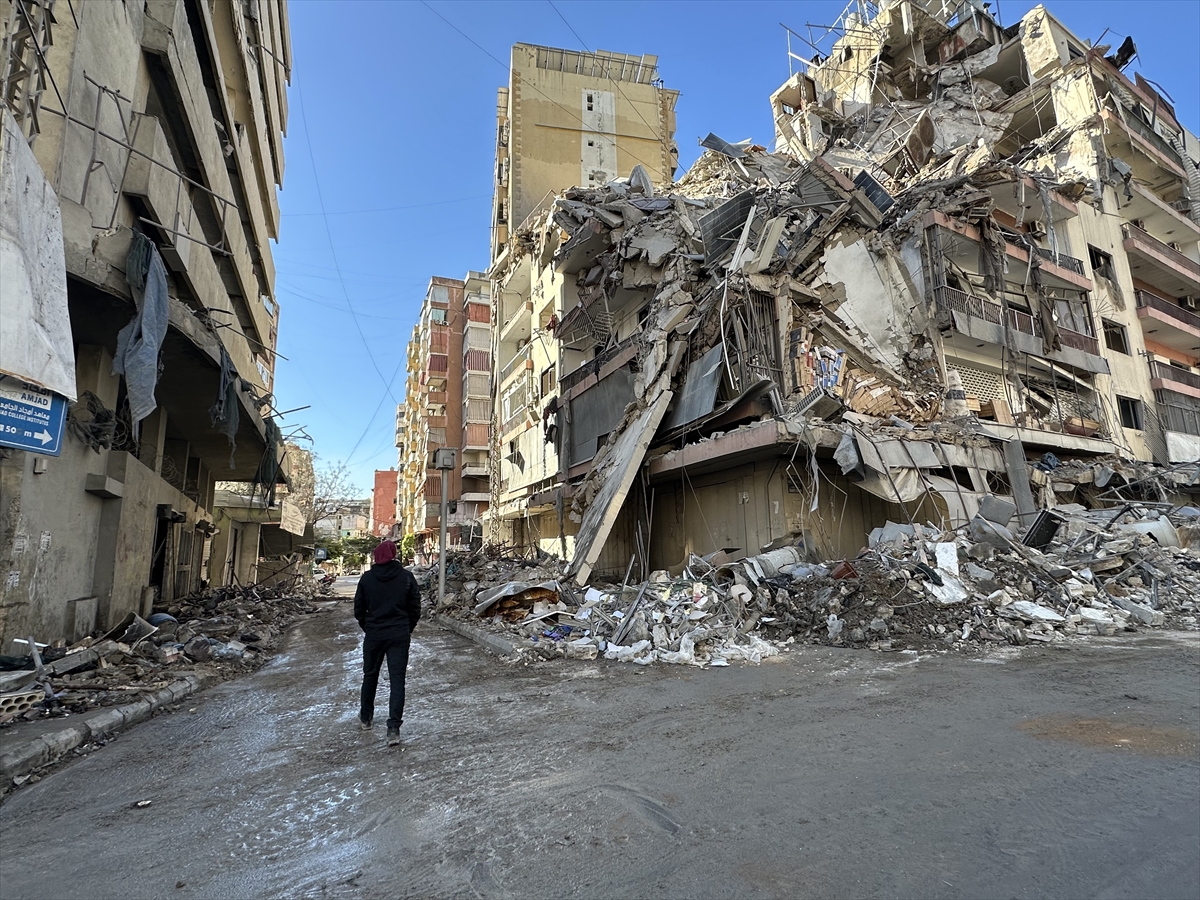
[Photo: A view of destruction following the Israeli military launches airstrikes on the Dahieh district in Beirut, Lebanon on March 5, 2026. Photojournalist: Houssam Shbar/AA]