By Middle East Correspondent
LONDON, (The Muslim News): Israeli airstrikes killed at least 11 civilians across southern Lebanon on Thursday and wounded dozens more, despite an extended ceasefire agreement, as tensions between Iran and the United States escalated in the Strait of Hormuz.
Strikes targeted homes, vehicles, commercial areas and emergency response teams across Tyre, Nabatieh and Marjayoun districts, causing widespread destruction despite the ceasefire agreement reached on April 17 and later extended until May 17.
Lebanon’s National News Agency (NNA) said two people were killed when an Israeli drone struck a car in Ain Baal near Tyre, while another two died in a separate strike on a pickup truck along Habboush Road in Nabatieh. In Harouf, an airstrike on a house killed one person and injured three others.
In Nabatieh, one person was killed and several others wounded as strikes damaged residential buildings and shops. A raid in Deir al-Zahrani destroyed a building and killed another person, while attacks on Doueir left one dead and several injured.
Further attacks killed one person in Ain Baal and another in a strike targeting a motorcycle near the Breqaa junction in Nabatieh. A separate strike on a truck near Safa station on the Meifadoun road also killed one person.
Emergency workers also came under attack. A strike targeting a civil defence team in Toul injured two people and damaged an ambulance, while another raid wounded rescue workers in Majdal Selm. Local reports said civil defence crews in Aadshit were also targeted while evacuating an injured person.
Israeli shelling and drone strikes also hit Habboush, Deir al-Zahrani, Kfour, Deir Kifa and Hannawiyah, as well as the road between Khirbet Selm and Qalawiya. Lebanese media reported Israeli drones flying at low altitude over Beirut and its suburbs.
Hezbollah said in retaliation it carried out eight attacks targeting Israeli military positions in southern Lebanon. The group said the operations struck two tanks, a military bulldozer, a command centre and several gatherings of Israeli soldiers and military vehicles.
Despite the ceasefire, Israel has continued daily strikes and demolitions in southern Lebanon. Since March 2, Israeli attacks have killed at least 2,727 people, wounded 8,438 and displaced more than 1.6 million people, according to official figures.
Israel continues to occupy areas in southern Lebanon, including territory held for decades and areas seized during the 2023-2024 war. Lebanese sources say Israeli forces have advanced around 10 kilometres inside the southern border during the current conflict.
US strikes Iranian targets
As fighting continued in Lebanon, tensions also increased in the Gulf after the United States confirmed strikes on Iranian targets.
Fox News correspondent Jennifer Griffin reported that a senior US official confirmed American strikes on Iran’s Qeshm port and Bandar Abbas on Thursday, although the official said the operation did not represent a return to full-scale war or the end of the ceasefire.
The official also said Saudi Arabia and Kuwait briefly halted US access to their bases and airspace for “Project Freedom” before reversing the decision hours later. However, Saudi-owned Al Arabiya later cited a Saudi official denying reports that Riyadh had authorised the use of its airspace for offensive military operations.
Fox News also reported that US forces struck Iran’s Bandar Kargan naval checkpoint in Minab.
US Central Command (CENTCOM) said American forces intercepted what it described as “unprovoked” Iranian attacks while US Navy destroyers transited the Strait of Hormuz into the Gulf of Oman.
CENTCOM said it targeted Iranian missile and drone launch sites, command centres and surveillance facilities after intercepting attacks on US forces.
Iran presented a different account of events. Early Friday, Iran’s Islamic Revolutionary Guard Corps (IRGC) Navy said it launched a “large-scale and precise combined operation” targeting US destroyers near the Strait of Hormuz using ballistic missiles, anti-ship cruise missiles and explosive drones.
Iranian officials said the attack followed what they described as a US ceasefire violation involving a strike on an Iranian oil tanker near Jask port and the movement of American destroyers towards the waterway.
The IRGC claimed US vessels sustained “significant damage” and that three destroyers withdrew from the area. Iranian state media, including Tasnim News Agency and IRIB, reported that the ships retreated towards the Sea of Oman.
Israeli media later reported that Israel denied any involvement in explosions heard Thursday evening near Bandar Abbas and Qeshm Island in southern Iran.
The developments also prompted criticism in Washington. US Senator Bernie Sanders condemned Israeli military operations in Lebanon and renewed calls for an end to US military assistance to Prime Minister Benjamin Netanyahu’s government.
“The Trump-Netanyahu war is not just about Iran,” Sanders wrote on X, referring to comments attributed to Israeli Defence Minister Israel Katz, who reportedly said: “The fate of southern Lebanon will be the same as that of Gaza.”
Israel continues attacks in occupied West Bank
Meanwhile, Israeli military operations and settler attacks continued across the occupied West Bank.
Several Palestinian students suffered from tear gas inhalation after Israeli forces raided Al-Mughayyir village east of Ramallah. Local sources said Israeli troops entered the village with military vehicles and bulldozers before firing stun grenades and tear gas at the Al-Mughayyir Boys’ School while students were inside.
Israeli forces also set up a checkpoint at the village entrance, restricting movement and firing tear gas at residents.
In Masafer Yatta south of Hebron, Palestinian residents reported further illegal settler attacks on farmers and shepherds. Local activist Osama Makhameh said armed settlers released livestock onto Palestinian farmland in Wadi al-Rakhim, damaging olive saplings and crops.
The Palestinian Red Crescent said three Palestinians were injured after settlers attacked a vehicle near the village of Al-Fakhit.
Israeli forces also demolished agricultural structures in Za’tara east of Bethlehem and in the northern Jordan Valley. Local officials said Israeli bulldozers destroyed greenhouses and water infrastructure, while military checkpoints near Beit Sahour caused traffic disruption.
According to Palestinian figures, around 750,000 Israeli settlers live in illegal settlements and outposts across the occupied West Bank and East Jerusalem. Palestinian authorities said Israeli forces and settlers carried out 1,637 attacks during April alone.
Since October 2023, Israeli attacks in the occupied territories have killed at least 1,155 Palestinians, wounded around 11,750 and resulted in nearly 22,000 arrests.
Erdogan accuses Israel pursuing expansionist policies
Regional leaders also reacted to the escalation. Turkish President Recep Tayyip Erdoğan accused Israel of pursuing expansionist policies that threatened regional stability during a joint press conference in Ankara with Algerian President Abdelmadjid Tebboune.
“Israeli aggression has once again shown that the main security problem for our region is the expansionist, lawless and norm-defying policies of the current government,” Erdoğan said.
He added that Türkiye and Algeria supported efforts to end the violence and advance a two-state solution for Palestine.
Meanwhile, Iranian Foreign Minister Abbas Araghchi held talks with Pakistani Foreign Minister Ishaq Dar following a visit to China, where Tehran said it remained committed to diplomacy while prepared to respond to any “malicious act”.
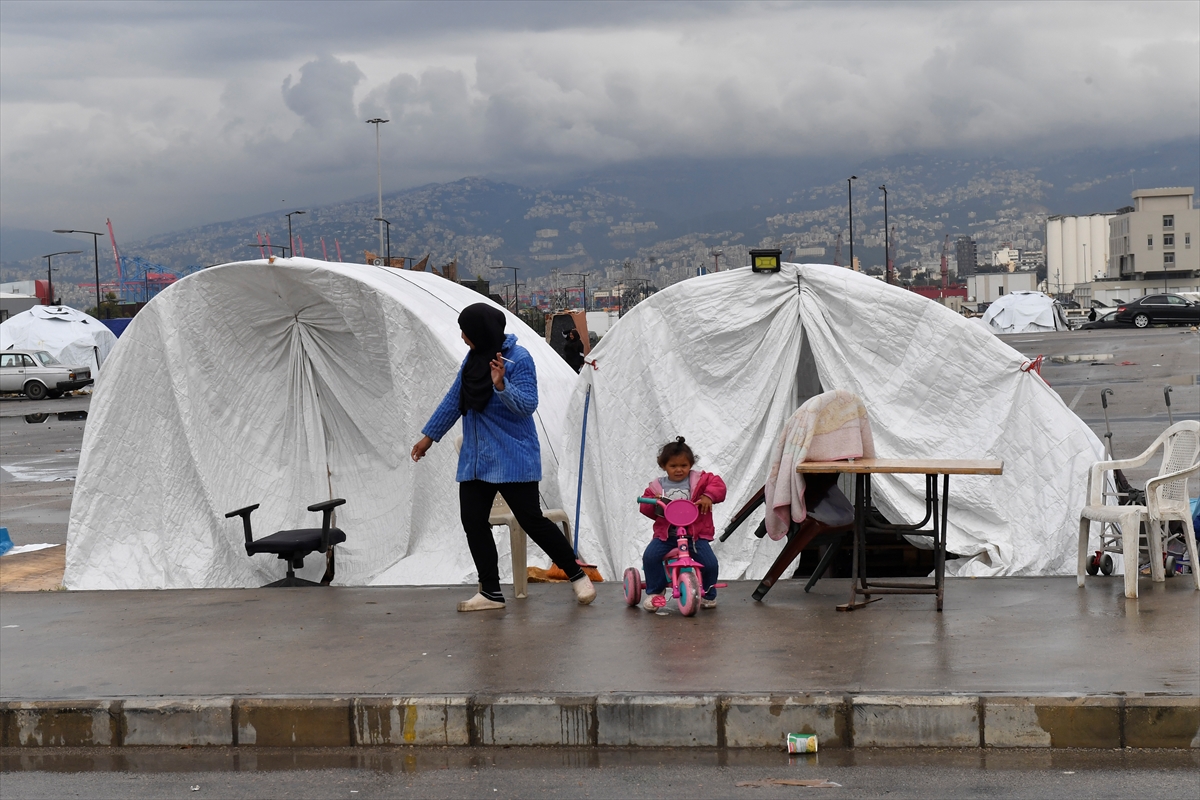
[Photo: Displaced families shelter in makeshift tents as rainfall worsens living conditions in Beirut, capital of Lebanon, on May 05, 2026. Families whose homes were destroyed by Israeli attacks continue to face harsh conditions as rain floods temporary shelters and disrupts daily life. Photojournalist: Houssam Shbaro/AA]