By Abdul Adil
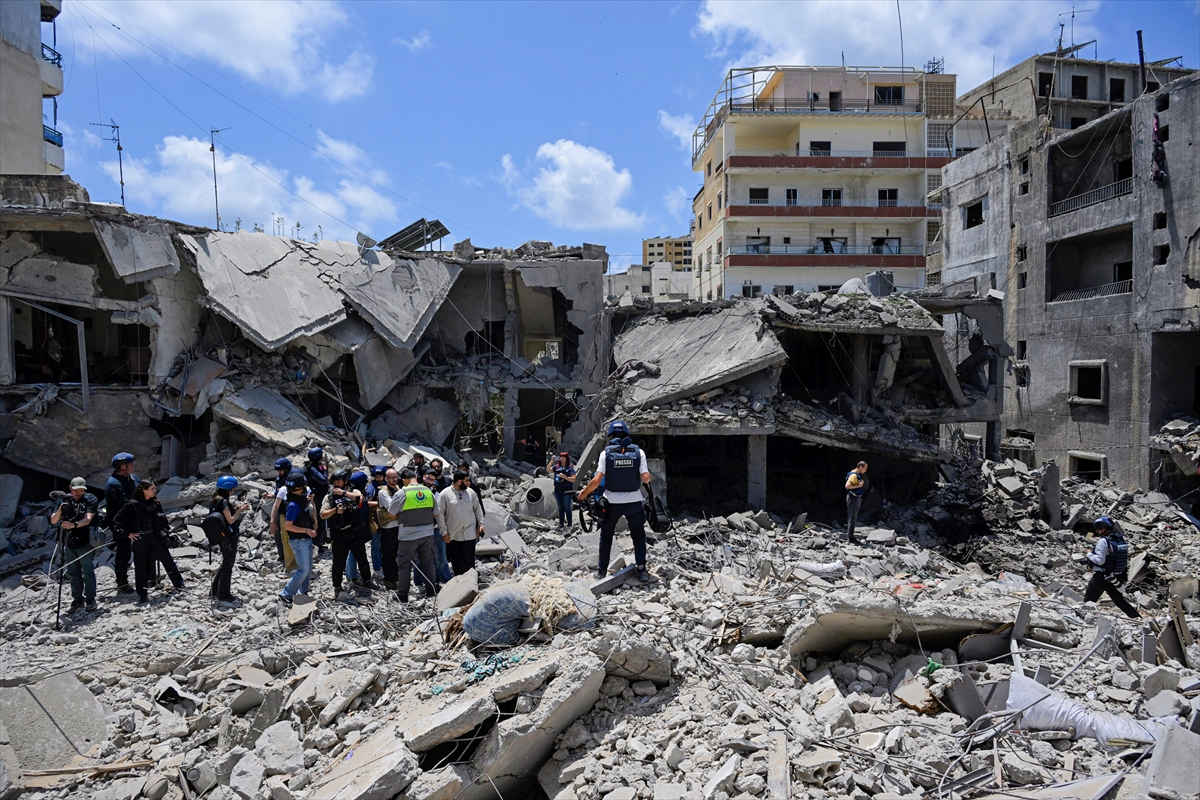
London, (The Muslim News): Residents of the southern Lebanese town of Burj al-Shamali buried victims of an Israeli airstrike that struck a densely populated neighborhood on Thursday. At least 14 civilians were killed in what local authorities described as a massacre carried out by Israeli forces in Lebanon.
According to figures released by Lebanon’s Ministry of Health on Wednesday, 3,371 people have been killed and 9,840 others injured in Israeli attacks since military tensions escalated on March 2.
Fresh Israeli attacks across southern Lebanon
A new wave of Israeli attacks in southern Lebanon on Saturday killed at least six people and injured 16 others, including two Lebanese soldiers.
The soldiers were seriously wounded when an Israeli military drone targeted their vehicle on a public road in Aaiba, in the Nabatieh district, according to a statement from the Lebanese army. Both were transferred to a hospital for treatment.
In the same district, the town of Zibdine was hit by a series of airstrikes, while heavy strikes were reported near the Shqeif Castle area. Another drone strike targeted the town of Abba, injuring two people, according to Lebanon’s National News Agency (NNA).
The agency also reported that the bodies of two victims were recovered from a building struck by Israeli warplanes in Burj al-Shamali, in the Tyre district.
An Israeli airstrike on the town of al-Lubiyah in the Sidon district killed one person and wounded another, NNA reported.
The attacks occurred on the fourth day of the Muslim holiday of Eid al-Adha amid continued Israeli violations of a ceasefire agreement.
Earlier on Saturday, a drone strike in Al-Marj, near the town of Ansar, killed a man and his son and wounded seven other family members. Another Israeli drone strike targeted a pickup truck on the Sharifa–Habboush–Nabatieh road, killing one person and seriously injuring another.
Israeli drones also struck a road leading to the Nabih Berri Governmental University Hospital in Nabatieh, wounding three people.
Early Saturday morning, Israeli warplanes bombed the town of Harouf, destroying a house in the Al-Thaghra neighborhood. The attack coincided with artillery shelling that struck the town and extended to the outskirts of Jibchit and Harouf.
According to Lebanon’s Health Ministry, Israeli strikes across the Tyre district on Friday killed 11 people, including a paramedic, and injured eight others.
Israeli advance in occupation of southern Lebanon
A senior Lebanese military source told Anadolu Agency that Israeli forces have advanced into villages north of the Litani River and reached the outskirts of Nabatieh city.
According to the source, Israeli troops entered villages and towns north of the river, including Zawtar al-Sharqiyah and Shqif Arnoun, while continuing incursions into other areas of southern Lebanon.
The source said the Lebanese army had withdrawn from positions in areas that came under Israeli control to ensure the safety of its personnel, noting that Israeli attacks had caused casualties among Lebanese soldiers.
“There is no presence of the Lebanese army in areas where the occupation is present in southern Lebanon,” the source said.
The source added that the Lebanese army’s current priority is maintaining internal stability and noted that the latest Israeli escalation preceded U.S.-hosted military meetings with Israel on Friday.
Israel has continued military operations in Lebanon despite a ceasefire that took effect on April 17 and was later extended for 45 days beginning May 17 following indirect talks mediated by the United States.
According to Lebanon’s Health Ministry, Israeli attacks since March 2 have killed more than 3,350 people nationwide.
Israeli security concerns and Hezbollah response
Israeli Prime Minister Benjamin Netanyahu held a security meeting on Saturday with senior defense officials to assess the situation in northern Israel following the escalation in southern Lebanon.
Israeli Channel 13 reported that Netanyahu convened an urgent security assessment with Defense Minister Israel Katz, Chief of Staff Eyal Zamir, and senior military commanders.
The report said the Israeli military was surprised by both the scale of Hezbollah’s rocket fire and the group’s decision to alter its response strategy following the expansion of Israeli ground operations in southern Lebanon.
Dozens of rockets were reportedly fired from Lebanon into northern Israel on Saturday. For the first time since the ceasefire began on April 17, rockets reached the cities of Safed and Nahariya.
The report described the situation in northern Israel as “utter chaos” and claimed the government was failing to address growing security concerns.
Israeli Army Radio reported that warning sirens had sounded 1,099 times in northern Israel since the start of the ceasefire.
Hezbollah stated that it launched drone attacks targeting Israeli soldiers near the settlement of Natua and the Galilee Forest military camp in northern Israel.
In recent weeks, Hezbollah’s drone operations have become a growing concern for Israel, with Netanyahu describing them as a “major threat” due to the difficulty of detecting them.
Hezbollah claims attacks on Israeli occupation forces
Hezbollah announced early Saturday that it had carried out 22 attacks against Israeli troops, military vehicles, and positions over the previous 24 hours.
The group said its operations included drone and missile strikes that hit six Israeli Merkava tanks across southern Lebanon.
According to Hezbollah, five tanks were targeted in Yahmar al-Shaqif in Nabatieh province using attack drones, guided missiles, and other weapons, while a sixth tank was struck near Dibbine in the Marjayoun district. The group claimed the tanks were seen burning after the attacks.
Hezbollah also reported attacks on Israeli forces and positions in Naqoura, Haddatha, Rashaf, Bayyada, and Zawtar al-Sharqiya, saying it used attack drones, rockets, and other weapons.
The group said the operations were carried out in response to Israeli violations of the ceasefire and attacks on civilians and villages in southern Lebanon.
U.S. intercepts vessel in Gulf of Oman
The U.S. Central Command (CENTCOM) announced Saturday that American forces had disabled a Gambia-flagged commercial vessel in the Gulf of Oman that was allegedly attempting to sail toward an Iranian port.
According to CENTCOM, U.S. forces observed the vessel, M/V Lian Star, traveling through international waters and issued more than 20 warnings, informing the crew that it was violating a U.S.-imposed blockade.
After the crew failed to comply, a U.S. aircraft fired a Hellfire missile into the vessel’s engine room, disabling the ship and preventing it from reaching Iran.
CENTCOM said U.S. forces have disabled five commercial vessels and redirected 116 others in an effort to enforce the blockade while a ceasefire with Iran remains in effect.
Separately, the Iranian Army said it had shot down what it described as an Israeli-American “Orbiter” drone in the Qeshm region.
Israeli strikes in Gaza continues despite ceasefire
A Palestinian was killed and five others, including a child, were injured on Saturday in Israeli attacks across the Gaza Strip.
The attacks occurred on the fourth day of Eid al-Adha amid what Palestinian sources described as ongoing Israeli violations of a ceasefire announced last October.
Medical sources at Gaza City’s Baptist Hospital reported that two injured Palestinians, one in critical condition, were brought to the facility following an Israeli strike near Firas Market.
Earlier, another Israeli drone strike near Al-Aqsa Martyrs Hospital in Deir al-Balah killed Jamal Abu Aoun and injured three others, including a child.
Israeli artillery shelling also targeted areas east and south of Khan Younis, while additional strikes hit the northeastern part of the al-Bureij refugee camp.
According to Gaza’s Government Media Office, Israeli attacks since the ceasefire took effect have killed 929 Palestinians and injured 2,811 others.
Palestinian sources report that since October 2023, Israeli military operations in Gaza have killed 72,938 Palestinians and injured more than 172,000 people, most of them women and children.
Hamas criticizes international silence on Israeli plans to expand control in Gaza
Hamas on Friday called on the international Board of Peace to take a clear position regarding Israeli plans to expand control over the Gaza Strip.
Hamas spokesperson Hazem Qassem criticized what he described as the silence of the Board and its representative for Gaza, Nickolay Mladenov, regarding Israeli plans to control 70% of the territory and continue efforts to displace Palestinians.
Qassem said the plans constitute a clear violation of the ceasefire framework and existing understandings concerning Gaza.
He warned that the failure to condemn Israeli policies raises serious questions about the willingness of international sponsors to hold Israel accountable for its obligations and alleged violations.
Qassem urged countries represented on the Board of Peace to publicly oppose Israeli expansion and displacement plans and to take practical steps to pressure Israel to halt its policies in Gaza.
Israeli Prime Minister Benjamin Netanyahu acknowledged on Thursday that Israel currently controls 60% of Gaza and indicated plans to increase that figure to 70%.
[Photo: Buildings and structures suffer extensive damage after strikes carried out by Israeli war planes during the second day of Eid al-Adha, in the city of Tyre, southern Lebanon, on May 29, 2026. Photojournalist: Houssam Shbaro/AA]