By Middle East Correspondent
London, (The Muslim News): Israeli attacks killed three Palestinians and wounded several others across the Gaza Strip on Thursday, as the Palestinian Foreign Ministry revealed that more than 22,000 children have been killed since Israel launched its war on the enclave in October 2023.
The latest casualties came amid continued Israeli violations of a ceasefire that took effect on October 10, 2025, with the attacks following a military operation launched by the Israeli army in central Gaza a day earlier.
In Gaza City, a medical source at Al-Ahli Baptist Hospital said a Palestinian man was killed by Israeli artillery shelling in the Zeitoun neighbourhood, south of the city centre. Several others, including a woman, were wounded when an Israeli drone struck a fuel station sheltering displaced Palestinians in the same area.
A separate attack in Zeitoun claimed another life. A medical source at Al-Shifa Hospital told Anadolu that a 38-year-old man was killed by fire from an Israeli quadcopter drone near the Kuwait Roundabout.
The casualties extended into central Gaza, where a Palestinian man died from wounds sustained days earlier in an Israeli drone strike targeting a gathering of Palestinians north of the Bureij refugee camp, according to a medical source at Al-Aqsa Martyrs Hospital.
Another Palestinian was moderately injured by Israeli army fire near the Hosni Al-Masdar Mosque, east of Deir al-Balah.
Further south, in Khan Younis, a child was wounded by Israeli gunfire inside a shelter for displaced people in the Al-Dhahra area, while a woman was injured in the Hamad area, north of the city.
Children bear the brunt of the attacks by Israel
Beyond the latest deaths and injuries, figures released by the Palestinian Foreign Ministry laid bare the mounting toll on children across the occupied Palestinian territories, prompting renewed calls for urgent international intervention.
In a statement issued ahead of World Children’s Day on November 20, the ministry said more than 22,000 Palestinian children had been killed and over 45,000 injured in Gaza since October 2023.
The impact on survivors has also been devastating. More than 11,000 injured children have suffered serious wounds resulting in disabilities, deformities and long-term health effects, the ministry said.
It added that more than 71,000 children had been orphaned after losing one or both parents, while approximately 800,000 remained displaced, many without safe shelter, stability or basic necessities.
“The significance of the figures goes beyond the scale of human losses and affects the ability of Palestinian society to endure and the future of coming generations,” the statement said.
The ministry stressed that protecting Palestinian children was an international legal obligation and called for those responsible for violations against them to be held accountable.
Nor is the crisis confined to Gaza. In the occupied West Bank, including East Jerusalem, Israeli military operations and Israeli settler attacks have killed more than 263 children and injured over 2,186 in the past three years, according to the ministry.
More than 350 children have also been detained, with dozens still held in Israeli prisons under administrative detention orders without charge or trial.
Against this backdrop, the ministry urged the United Nations, its agencies, humanitarian organisations and the High Contracting Parties to the Geneva Conventions to take immediate action to end violations, halt settler attacks and provide effective international protection for Palestinian children.
Israeli operation leaves trail of destruction in central Gaza
The latest casualties also came against the backdrop of an expanding Israeli military operation in central Gaza, where the army announced on Wednesday that it had launched an incursion west of the so-called “yellow line”, before declaring it over on Thursday.
The operation covered three blocks north of the Nuseirat refugee camp and Wadi Gaza, along Salah al-Din Road, leaving widespread destruction to Palestinian homes and infrastructure.
Following the operation, some displaced residents began returning in limited numbers to inspect their properties west of the line.
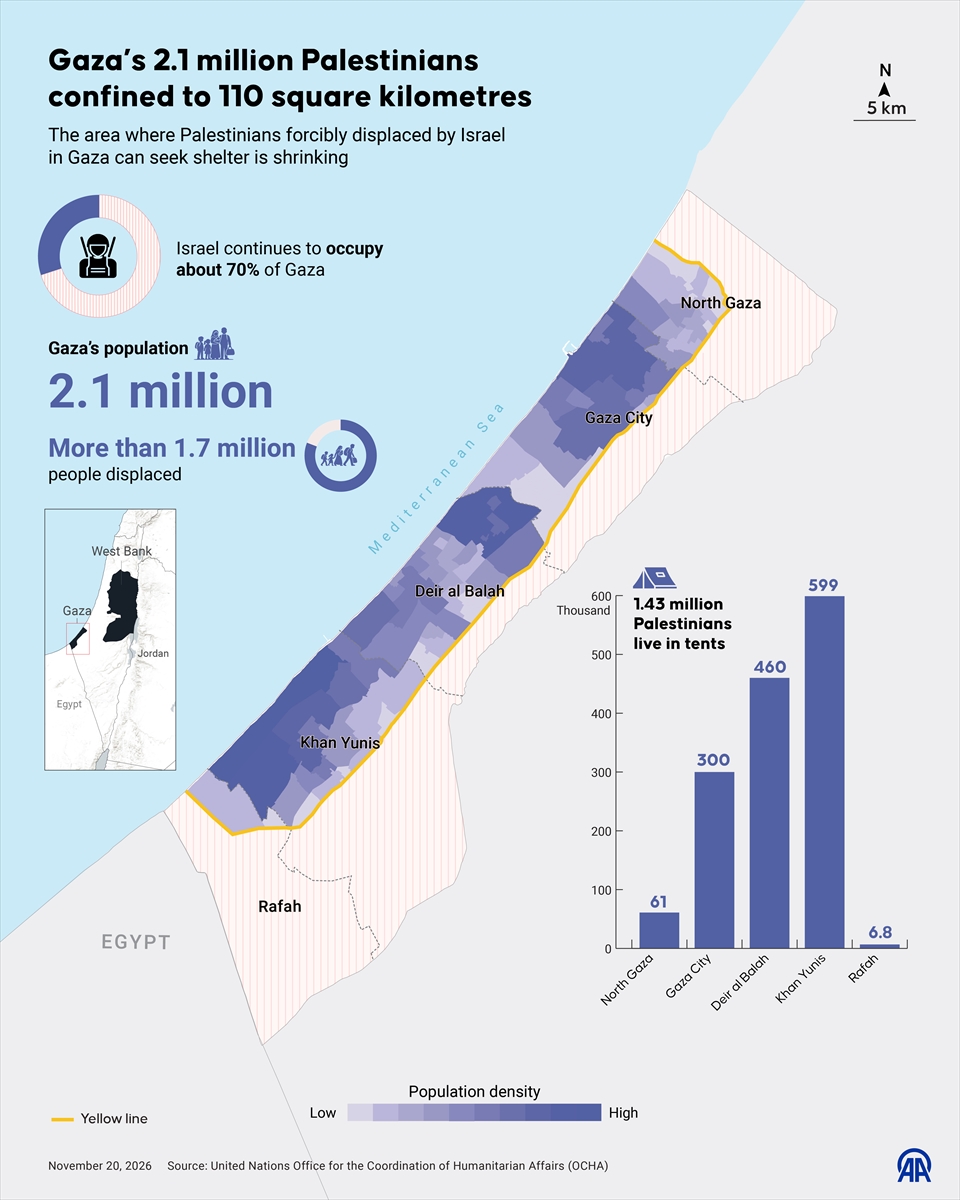
The “yellow line” marks the areas to which Israeli forces withdrew under the first phase of the ceasefire agreement, separating territory under Israeli military control from areas where Palestinians are permitted to move.
Despite the truce, Israeli attacks have continued, alongside efforts to expand the territory under its control, which currently accounts for around 70 per cent of the Gaza Strip.
The ceasefire forms part of US President Donald Trump’s plan to end Israel’s war on Gaza. Its first phase provided for a halt in fighting, a prisoner exchange and a partial Israeli military withdrawal to designated positions.
The continuing attacks come against the backdrop of a war that has devastated the enclave. Since October 2023, Israel, with US support, has killed more than 74,000 Palestinians and injured over 175,000, most of them women and children, while destroying around 90 per cent of Gaza’s infrastructure.
Israeli strikes intensify across Lebanon
The violence has also continued beyond Gaza, with Israeli attacks intensifying across Lebanon on Thursday.
Israeli warplanes carried out five airstrikes on a mountainous area in eastern Lebanon, while further airstrikes, drone attacks and artillery shelling targeted towns across the south.
Lebanon’s National News Agency (NNA) reported that five strikes hit the Al-Shaara area in the Anti-Lebanon mountain range, near the outskirts of Janta village in the eastern Baalbek district. The explosions were heard in Baalbek, but no casualties were reported.
The Israeli military confirmed an attack in the area, saying it had carried out an intelligence-guided strike on a facility in Janta in the Bekaa Valley. It claimed the site had previously been used by Hezbollah to manufacture missiles and store weapons.
The military said it had detected Hezbollah members returning to the facility and targeted its entrances to prevent its restoration. Hezbollah did not comment on the claims.
The attacks were not limited to eastern Lebanon. In the south, NNA reported that two Israeli drones exploded, one striking a house in Shoukin and the other hitting the roof of a building in Nabatieh al-Fawqa.
Israeli warplanes also struck the Ain al-Samahiyah area between Zawtar al-Sharqiyah and Mayfadoun, while two further airstrikes targeted Qantara.
Alongside the aerial attacks, Israeli forces fired eight artillery shells towards Khiam in the Marjayoun district. Further artillery fire and an airstrike targeted the northern outskirts of Kfar Shouba in the Hasbaya district.
Shrapnel landed near residential properties, causing material damage but no reported injuries, according to NNA.
The latest strikes came despite a US-mediated framework agreement signed by Beirut and Tel Aviv on June 26, which provides for an Israeli withdrawal from occupied territory and the deployment of the Lebanese army.
Israel continues to occupy areas of southern Lebanon, including territory held for decades and areas seized during the 2023-2024 war.
Iran warns of readiness as US military costs mount
As Israeli military operations continued across the region, Iran issued a warning about its readiness for a potential confrontation with the United States, while fresh figures emerged on the financial cost of the conflict.
Iran’s Islamic Revolutionary Guard Corps (IRGC) said it had mapped US military deployments across the region, including troop numbers, aircraft, weapons locations and operational plans.
IRGC spokesman Brig Gen Hossein Mohebbi said Iran was fully prepared for any potential confrontation, according to Mehr News Agency.
“We even know the number of US forces in the region, the number of aircraft and the types of aircraft they have brought, the number of US weapons, their locations, the kind of operations these assets might carry out, and the operational plans they have,” he said.
Mohebbi added that Iran treated every hostile possibility as a 100 per cent threat and maintained full readiness.
The warning came as a Pentagon official disclosed the mounting financial burden of the US military campaign against Iran, telling lawmakers that it had cost approximately $48.3 billion since the conflict began in late February.
Arthur Miller, nominated to serve as assistant secretary of the Navy for financial management and comptroller, revealed the estimate during a Senate Armed Services Committee confirmation hearing on Thursday.
“That number includes munitions, equipment replacement costs, and operational cost,” Miller said.
However, the figure did not account for repairs to US military installations in the Middle East damaged by Iranian attacks. Miller acknowledged that these additional expenses had yet to be calculated and said he did not have an estimate for them.
The conflict began with US and Israeli illegal attacks on Iran on February 28, before the sides reached a ceasefire in April. Fighting subsequently resumed as negotiations stalled, despite the signing of a memorandum of understanding in June.
[An infographic titled “Gaza’s 2.1 million Palestinians confined to 110 square kilometres” created in Ankara, Turkiye on November 20, 2026. The area where Palestinians forcibly displaced by Israel in Gaza can seek shelter is shrinking. Photojournalist: Omar Zaghloul/AA]