By Elham Asaad Buaras
LONDON, (The Muslim News): Israeli attacks across the occupied Palestinian territories killed two Palestinians in the Gaza Strip and injured several others on Saturday, as Israeli forces intensified raids, arrests and movement restrictions across the occupied West Bank, targeting residential areas, a wedding celebration and public services.
In northern Gaza, two Palestinians were killed and several others wounded, some critically, when an Israeli drone struck an area near Abu Sharkh Junction, west of Jabalia refugee camp, according to medical sources. The bodies and injured were taken to hospital.
Israeli artillery also shelled areas south of Khan Younis in the southern Gaza Strip, amid continuing military operations across the besieged territory.
Israeli army arrests more Palestinians in raids in occupied West Bank
In the occupied West Bank, Israeli forces arrested at least 10 Palestinians, including a woman, during extensive raids in Nablus and surrounding areas early Saturday, according to local sources cited by Anadolu.
Military vehicles entered Balata and Askar refugee camps east of Nablus, Ein Beit al-Ma’ refugee camp west of the city, and the neighbourhoods of Iskan Rujeib, Al-Masakin Al-Sha’biya, Balata al-Balad and Askar al-Balad.
Soldiers evacuated a house in eastern Nablus and converted it into a military barracks, while conducting field interrogations of residents. Several young men were also injured after being beaten by Israeli soldiers during raids in Balata refugee camp and Balata al-Balad.
Further raids were reported in Tammun, south of Tubas, where soldiers searched homes and tightened restrictions at the Ein Shibli checkpoint in the northern Jordan Valley, disrupting residents’ movement.
In Jenin province, Israeli forces entered homes in Al-Mughayyir village, east of the city, and raided the Wadi Burqin area southwest of Jenin.
Restrictions also affected communities elsewhere in the West Bank. Soldiers closed a side road near the military gate at the entrance to Al-Fawwar refugee camp, south of Hebron, while in the Ramallah area they raided Beitunia and closed the entrance to Al-Mughayyir village, preventing residents from entering or leaving.
The raids extended to private celebrations. On Friday evening, Israeli forces stormed a wedding reception in a hall in Al-Mughayyir, northeast of Ramallah, firing tear gas towards approximately 150 guests, according to the official Palestinian news agency WAFA.
Four Palestinians, including the groom, Hassan Abu Aliya, were detained inside the hall and assaulted before being released several hours later.
Separate accounts from the incident said soldiers also assaulted the bride and other relatives, while female Israeli soldiers searched her wedding dress. The military reportedly justified its intervention by claiming that boys had set off fireworks during the celebrations.
In Jericho, Israeli forces raided a venue on Friday evening prepared to welcome Mohammed Nasser al-Hindi, a Palestinian detainee released from an Israeli prison. Soldiers dispersed those gathered and destroyed the venue’s contents, according to local sources.
The incidents have drawn attention to the disruption of ordinary family and community life under Israeli military operations, with weddings, receptions for released detainees and other gatherings increasingly affected by raids and restrictions.
The Palestinian Prisoners’ Society has also reported attacks on funeral gatherings.
In the latest incident cited by Palestinian accounts, Israeli forces intervened during the funeral in Silwad of a 17-year-old who reportedly died from starvation in an Israeli prison.
Meanwhile, the General Authority for Civil Affairs recorded more than 21 attacks by Israeli settlers against Palestinians and their property over the preceding 24 hours.
The violence has intensified since Israel launched its war on Gaza in October 2023, with Israeli military forces and settlers carrying out killings, arrests, home demolitions, arson and attacks on agricultural land. Settlement expansion and the displacement of Palestinian communities have also continued.
Palestinians have warned that the escalating measures are facilitating the de facto annexation of the occupied West Bank and undermining the prospects of an independent Palestinian state in accordance with relevant United Nations resolutions.
Israel has kept solid waste landfill serving communities near Jerusalem closed
The restrictions have also extended to essential municipal services.
Israeli authorities have kept a solid waste landfill serving communities north and northwest of Jerusalem closed for the tenth consecutive day, leaving local authorities struggling to dispose of mounting rubbish.
The landfill, located in Beit Anan, serves 22 municipalities and villages and is the only available disposal facility for the communities, according to Mohammad Rabie, head of the Joint Services Council for Solid Waste Management in north and northwest Jerusalem.
Speaking to WAFA, Rabie said the council organised a protest on Saturday involving local council heads and members to demand that the facility be reopened.
Israeli forces dispersed the demonstrators, seized a waste collection truck and arrested the landfill’s driver and guard, he said.
Covering approximately 25 dunums (2.5 hectares), the landfill has no readily available alternative, Rabie explained, citing limited residential space and the absence of other suitable land for waste disposal.
He warned that the prolonged closure had disrupted waste collection and disposal services, forcing local authorities to operate under emergency conditions as rubbish accumulated in residential areas, increasing the risk of public health and environmental hazards.
Israel weighs renewed confrontation with Iran
The developments in the occupied Palestinian territories come amid growing uncertainty over Israel’s regional military policy and a political transition following the country’s October 27 elections.
Israeli caretaker Prime Minister Benjamin Netanyahu discussed the possibility of renewed attacks on Iran with Gadi Eisenkot, who has been tasked with forming the next government, Israeli media reported on Friday.
According to Channel 12, the meeting took place on Thursday, with Netanyahu seeking to share intelligence on Iran that an informed source said could influence Eisenkot’s assessment of the reasons for a possible resumption of military action.
Eisenkot had not been informed that Mossad chief Roman Gofman was visiting Washington to discuss the issue, the broadcaster reported, although it did not establish whether this was deliberate.
The meeting followed Netanyahu’s bloc losing its parliamentary majority in the October 27 elections, prompting the transition towards a new government.
Eisenkot had previously cautioned Netanyahu against launching unnecessary military operations before a new administration was formed.
Israel’s public broadcaster KAN reported that military Chief of Staff Eyal Zamir supported the possibility of an operation against Iran but did not consider the current timing appropriate.
Zamir favoured coordination with Washington and selecting what the military considered suitable conditions for any operation, the broadcaster said.
Citing an unnamed security source, KAN reported that the Israeli military did not consider Iran an immediate threat requiring another attack and had warned against entering a prolonged war of attrition. The source also ruled out a renewed war in the coming weeks.
Separately, the Israeli newspaper Haaretz reported that Gofman had met CIA Director John Ratcliffe in Washington and was expected to meet US envoy Steve Witkoff as part of efforts to secure American support for possible renewed attacks against Iran.
Channel 13 reported that Gofman would present intelligence concerning Iran’s nuclear programme and long-range missile development, alongside Israeli allegations that Tehran had breached agreements with Washington.
There was no immediate comment from US or Israeli authorities on the reported meetings.
The diplomatic activity comes amid Israeli concerns, reported by local media, that Washington and Tehran could reach an agreement easing pressure on Iran without addressing its nuclear programme or missile capabilities.
Iran, meanwhile, accused the United States of waging an unlawful war of aggression and warned that any renewed American or Israeli military attack would trigger an immediate response.
Speaking at a UN Security Council meeting on the Middle East on Friday, Iran’s deputy permanent representative to the United Nations, Gholamhossein Darzi, accused Western governments of distorting events and applying double standards in their treatment of regional tensions.
Responding to remarks by the US representative, Darzi said Washington had no legal, political or moral standing to accuse Tehran.
“The United States is the aggressor, not the victim,” he told the council.
He accused Washington of violating the UN Charter through military action against Iran, infringing its sovereignty and territorial integrity, targeting civilian infrastructure and threatening its population.
Darzi rejected suggestions that Iran had abandoned diplomacy, insisting that Tehran remained open to negotiations.
“Iran has never closed the door to diplomacy,” he said.
However, he warned that any renewed military action by Washington or Israel would be met with an immediate and decisive response.
“Any renewed war of aggression by the United States and the Israeli regime will be met with an immediate and decisive response, without hesitation, directed against the source of aggression wherever it may be,” he said.
Tensions spread across the Strait of Hormuz
Maritime security in the Strait of Hormuz also remained a concern after Iran’s Islamic Revolutionary Guard Corps (IRGC) Navy claimed that two oil tankers had struck naval mines and caught fire while attempting to use an unauthorised route through the strategic waterway.
In a statement on Friday, the IRGC Navy said the vessels had attempted to pass through the strait undetected, with their radar and positioning systems switched off. One was described as a supertanker.
The Iranian force warned shipping companies against using the waterway without coordinating with its maritime traffic control centre.
The announcement followed reports of explosions in Iran’s southern port city of Jask. State news agency IRNA, citing local sources, said there had been no reported impact in the city or elsewhere in Hormozgan province.
IRNA had also reported an attack on the southern city of Sirik on Thursday. The IRGC subsequently claimed to have destroyed a US early-warning radar in Bahrain in retaliation for an attack on a telecommunications tower in Sirik.
US Central Command said its forces had intercepted two Iranian attack drones heading towards Bahrain, reporting no injuries or damage.
The Strait of Hormuz connects the Gulf to the Gulf of Oman and is a vital international shipping route for oil and other commodities.
At least 25 seafarers have been killed in and around the waterway since the illegal US-Israeli war on Iran began in February, according to figures presented to the Security Council.
UN Assistant Secretary-General for the Middle East, Asia and the Pacific Khaled Khiari said the toll covered the period up to November 11.
The International Maritime Organization (IMO) recorded 136 security incidents involving vessels in the Strait of Hormuz and the wider Middle East between March 1 and November 11.
Thirty-five incidents were reported in October and a further 10 in November.
Israeli attacks continue across southern Lebanon
Israeli forces also carried out airstrikes, artillery shelling, demolitions and machine-gun fire across southern Lebanon on Friday, while drones flew at low altitude over Beirut, according to Lebanon’s National News Agency.
The attacks affected four districts across the Nabatieh and South Lebanon governorates: Nabatieh, Marjayoun, Bint Jbeil and Tyre.
Israeli warplanes struck Kfar Tebnit in the Nabatieh district, while a tank fired artillery shells towards the outskirts of Zawtar al-Sharqiyah, accompanied by machine-gun fire.
In Marjayoun, aircraft carried out two consecutive strikes near Khiam, while Israeli forces detonated a powerful explosive device towards the Naba Ibl al-Saqi area.
Artillery fire also targeted Haddatha in the Bint Jbeil district, while a drone dropped a stun grenade on Yater. No injuries were reported in that incident.
Further shelling struck Tallousa and Bani Hayyan in Marjayoun, with machine-gun fire directed towards Tallousa.
In the Tyre district, Israeli aircraft dropped illumination flares over the coast of Naqoura, while artillery struck Majdal Zoun and Buyout al-Sayyad. Israeli forces also opened machine-gun fire towards the main road leading to Al-Mansouri.
The National News Agency separately reported that an Israeli tank fired two artillery shells towards a house in the Al-Mashaa area of Mayfadoun, in the Nabatieh district.
Drones were also reported flying at low altitude over Beirut, although no attacks were reported in the capital.
The latest strikes came despite the US-mediated framework agreement signed by Beirut and Tel Aviv on June 26, which provides for an Israeli withdrawal from occupied Lebanese territory alongside the deployment of the Lebanese army.
Israel continues to occupy areas in southern Lebanon, including territory held for decades and areas seized during the 2023-2024 war, when Israeli ground forces advanced approximately 10 kilometres into Lebanese territory.
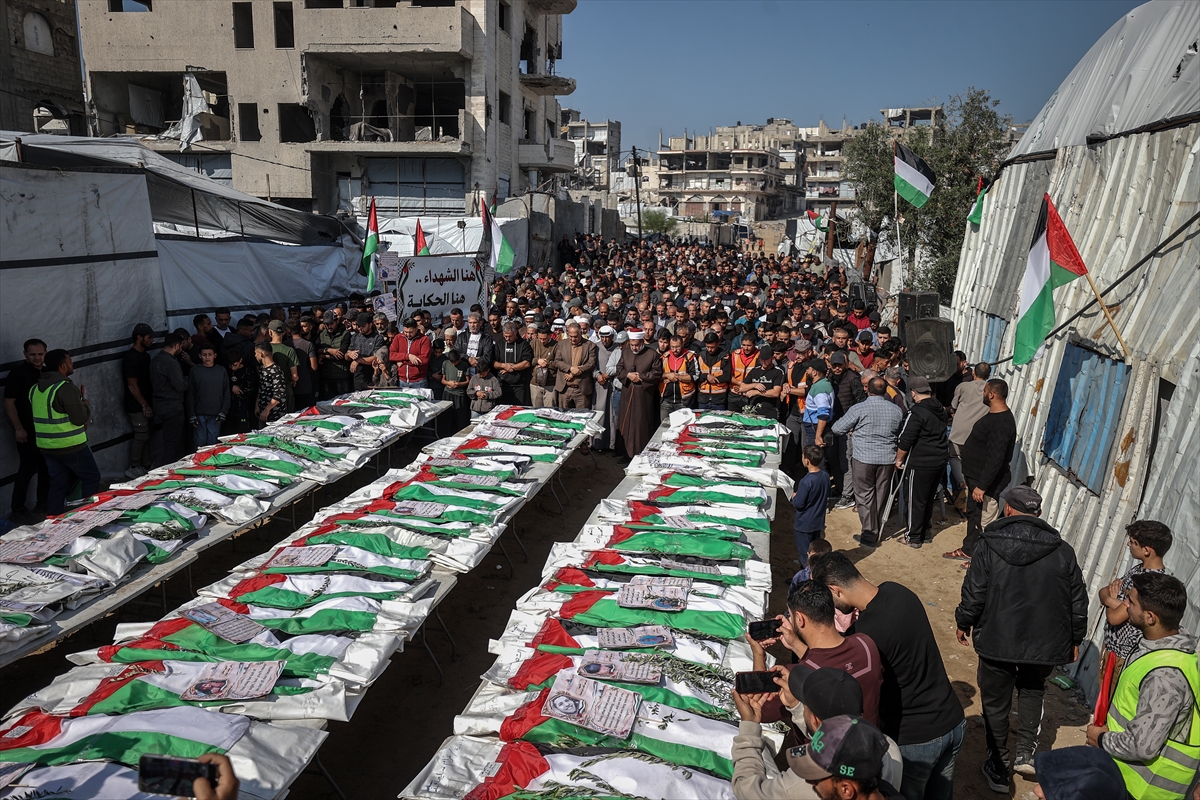
[Photo: Palestinians attend a mass funeral for 70 people whose bodies were recovered from beneath the rubble of homes destroyed in Israeli attacks nearly three years after they were buried, on November 15, 2026 in Gaza City, Palestine. The bodies were recovered during search operations in the northern part of the city and were buried at Faluja Cemetery following the funeral ceremony. Photojournalist: Ali Jadallah/AA]