By Elham Asaad Buaras
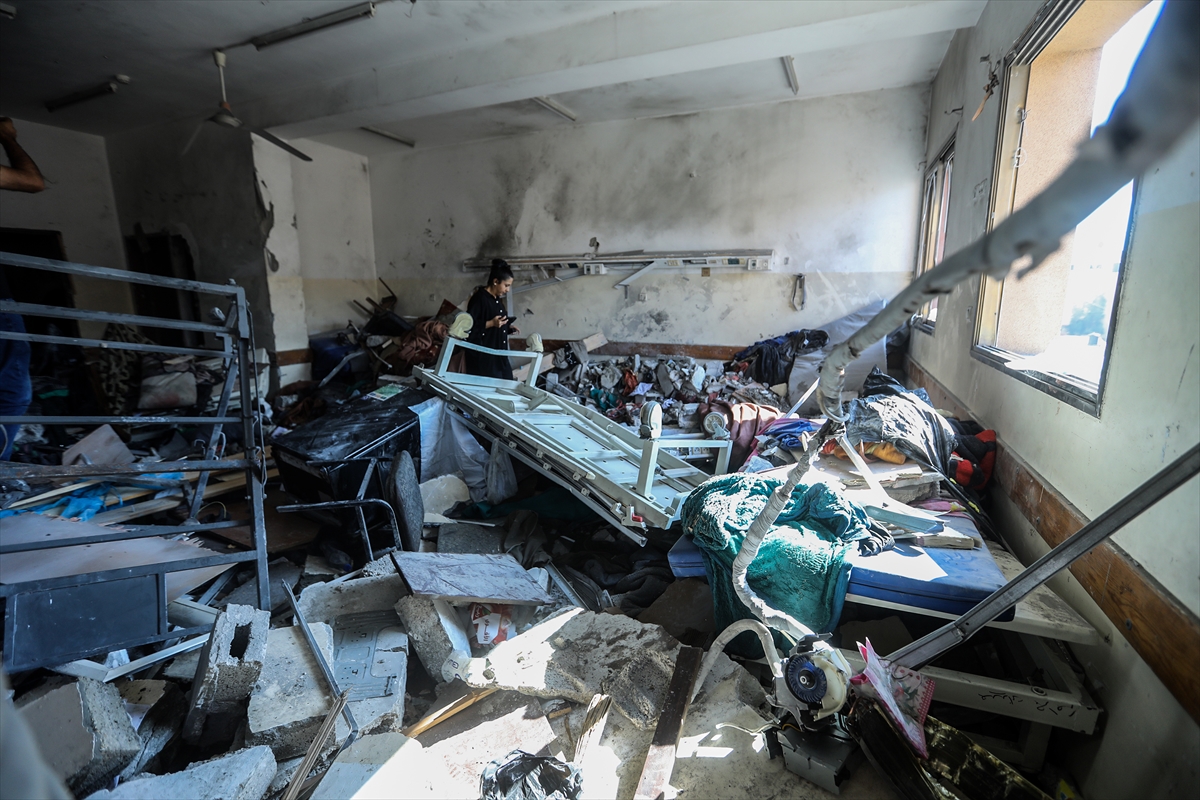
London, (The Muslim News): Nasser Hospital was attacked by an Israeli airstrike in Khan Yunis, southern Gaza Strip, on November 12 killing at least six people and more than 20 others injured according to initial reports.
Palestinian sources and Gaza’s Civil Defense Directorate said Israeli warplanes targeted the hospital’s second floor, causing extensive damage to the building, particularly the men’s and women’s surgical wards and intensive care units.
Meanwhile, three Palestinians were killed and several others injured in two Israeli airstrikes in Gaza City on Wednesday, as Israeli military operations continued despite the ceasefire agreement, while new figures revealed more than 1,100 arson attacks by Israeli forces and settlers against Palestinian property and land in the occupied West Bank since October 2023. Meanwhile Iran warns US and Israel it will retaliate if US and Israel attacks Iran again.
Two Palestinians were killed and several others wounded when an Israeli airstrike struck a tent on al-Jalaa Street in western Gaza City, medical sources told Anadolu. The casualties were taken to Al-Shifa Hospital, although the precise number of injured remained unclear.
In a separate attack, 44-year-old Hani al-Khudari was killed when an Israeli drone struck him with a missile while he was filling water on the rooftop of his home near Sheikh Radwan Cemetery in western Gaza City, according to medical sources and witnesses. His body was also taken to Al-Shifa Hospital.
The latest attacks came amid continuing violations of the ceasefire, which took effect on October 10, 2025. According to figures cited by medical sources, Israeli violations have killed 1,622 Palestinians and injured 5,878 since the agreement came into force.
The wider toll of Israel’s war on Gaza, launched in October 2023, has exceeded 74,600 Palestinians killed and nearly 176,000 wounded, predominantly women and children. Around 90 per cent of the territory’s infrastructure has been destroyed.
Israeli army and settlers continue violence against Palestinian people, property vehicles and agricultural land in West Bank
The continuing violence has also extended across the occupied West Bank, where Israeli forces and settlers carried out 1,182 arson attacks against Palestinian property, vehicles, facilities and land between October 7, 2023, and September 30, 2026, according to the Palestinian Colonization and Wall Resistance Commission.
In figures released on Wednesday, the commission said 809 attacks targeted property, vehicles and facilities, while another 373 affected Palestinian land.
Ramallah and al-Bireh and Nablus governorates accounted for 711 attacks, representing 60.2 per cent of the total. Ramallah and al-Bireh recorded 376 incidents, including 238 targeting property and 138 affecting land, while Nablus documented 335, comprising 207 property attacks and 128 targeting land.
The remaining incidents were recorded across Hebron, with 112; Jenin, 73; Bethlehem, 64; Tulkarem, 61; Salfit, 44; Qalqilya, 39; Jerusalem, 32; Tubas, 29; and Jericho, 17.
The latest figures followed an arson attack early Wednesday in the village of Lubban al-Sharqiya, south of Nablus, where settlers set fire to more than 100 vehicles at a site used to collect old and damaged cars.
According to the Palestinian news agency WAFA, the flames spread to dozens of olive trees, warehouses and streetlights, cutting electricity to the area. Several Palestinians suffered smoke inhalation, while the village council head estimated initial financial losses at more than one million Israeli shekels.
The commission said the village had previously been attacked on April 6, when settlers burned a house, two tents and three vehicles and assaulted residents. Its October report also documented the burning of two vehicles in the Wadi al-Shaer area between the village and Salfit governorate.
The commission said responsibility for the attacks extended beyond Israeli military personnel directly involved, arguing that the army was also responsible for protecting settlers and preventing Palestinian residents and emergency crews from accessing targeted areas.
The scale of the violence was also reflected in figures released by the UN Office for the Coordination of Humanitarian Affairs, which documented 457 settler attacks in the occupied West Bank during October. The figure was the highest monthly total since the UN began recording such incidents in 2006.
The incidents have taken place amid an escalation in Israeli military raids and settler violence across the territory, including killings, arrests, home demolitions, land levelling and seizures, alongside continued settlement expansion.
Iran said it will retaliate against US and Israel if they attack Iran again
Meanwhile, tensions between Iran, the United States and Israel have raised the prospect of a wider regional confrontation, even as diplomatic efforts seek to end the war.
Iran’s deputy chief of the General Staff of the Armed Forces, Amir Kioumars Heydari, warned on Wednesday that US military bases and interests were within range of Iranian missiles and drones, adding that Tehran was prepared to strike targets beyond the region if attacked again.
Speaking to Iranian state broadcaster IRIB, Heydari said the confrontation with Washington had developed into a regional war and claimed Iranian forces could reach all US military bases and interests.
He warned that if aircraft launched from another country’s territory attacked Iran, Tehran could target comparable facilities in the country from which the aircraft departed. He also said Iranian forces had prepared a list of potential targets extending beyond locations involved in previous fighting.
Heydari claimed Iranian forces had driven US troops out of the Gulf and forced American warships to retreat hundreds of kilometres from Iran’s borders.
His remarks followed a warning from Iran’s Supreme National Security Council Secretary Mohsen Rezaei, who said Tehran could target US military installations in distant locations, including Europe.
Rezaei said potential targets included US bases that Iran had not previously attacked and warned that some facilities in European countries could also come within the scope of any future retaliation.
The warnings came as Israel’s security cabinet instructed the military to intensify preparations for a possible new attack on Iran, according to Israeli public broadcaster KAN.
The broadcaster reported on Wednesday evening that the directives could lead to military operations capable of triggering another war.
The instructions became public after Yashar party leader Gadi Eisenkot urged caretaker Prime Minister Benjamin Netanyahu to avoid unnecessary military operations until a new government was formed following the October 27 elections. KAN said the security cabinet had last met on October 5.
US exploring diplomatic solution to military action
At the same time, Washington appears to be exploring a diplomatic route out of the conflict.
US Vice President JD Vance is considering face-to-face talks with a senior Iranian security official, The Wall Street Journal reported on Wednesday, citing US and Middle Eastern officials.
US President Donald Trump has reportedly signalled to aides and foreign counterparts that he would be open to Vance leading renewed negotiations with Tehran.
The discussions remain at an early stage, with no meeting date agreed, although Washington and Tehran have been communicating through mediators and regional allies.
According to the Journal, Vance sent a letter in October to Rezaei requesting a meeting.
The newspaper said the proposed diplomatic initiative carried political risks for Vance, who could become closely associated with any failure to secure an agreement, but could also strengthen his position if negotiations helped end the conflict.
Trump had reportedly questioned aspects of the June framework agreement negotiated with Vance’s involvement, arguing privately that it allowed Iran time to recover and generate oil revenues before a US naval blockade was imposed.
A White House official rejected claims that Trump had reconsidered the agreement, saying US negotiators had acted in good faith.
Vance has also publicly linked the war to Republicans’ poor performance in last week’s midterm elections, highlighting growing domestic pressure on the administration to bring the conflict to an end.
Iranian Parliament Speaker and chief negotiator Mohammad Bagher Qalibaf said on Wednesday that Tehran had already delivered its response to Washington’s proposals but had yet to receive an official reply.
Speaking to Al Jazeera, Qalibaf said Iran had communicated its demands through Qatari mediation.
“We have provided a clear and transparent response to the United States that includes our demands,” he said.
“The ball is now in the Americans’ court. They must make a decision and announce it,” he added.
Qalibaf said Iran preferred peace if Washington accepted its conditions, stressing that Tehran did not want the months-long conflict to continue. However, he warned that any renewed US or Israeli military operation would be met with a response.
He said Iran’s seven conditions for reopening the Strait of Hormuz and resuming substantive negotiations included lifting the US naval blockade and oil sanctions, releasing frozen Iranian assets, ending the war on all fronts, including those involving what Tehran calls the resistance front, formally declaring an end to the war rather than merely agreeing to another ceasefire, and ending interference in Iran’s internal affairs.
The demands also included guarantees for commercial shipping through the Strait of Hormuz and arrangements concerning Iran’s nuclear materials.
Qalibaf said the waterway would not return to its pre-war arrangements, adding that Iran had reached an understanding with Oman on a new transit mechanism in accordance with international law. The proposed arrangement was being discussed through indirect negotiations with Washington.
He accused the US blockade of restricting food supplies and disrupting trade and healthcare services.
The Iranian parliament speaker said Tehran was determined to end the current situation of neither war nor peace, whether through negotiations or what he described as sustainable deterrence.
He added that mediation had reduced the proposed response period from seven days to two, while a six-member committee within Iran’s Supreme National Security Council was managing negotiations, including Foreign Minister Abbas Araghchi.
Qalibaf identified a lack of trust in Washington and what he described as excessive American demands as the principal obstacles to an agreement. He also claimed US officials had travelled to Moscow and asked Russian President Vladimir Putin to facilitate direct negotiations with Iran.
Iranian President Pezeshkian told COP31 in Türkiye environmental consequences of US-Israel military operations
The conflict has also prompted renewed international scrutiny of the environmental consequences of military operations.
Iranian President Masoud Pezeshkian told the COP31 UN climate summit in Türkiye on Wednesday that US and Israeli attacks on Iranian fuel facilities had released an estimated 1.5 million tonnes of carbon dioxide into the atmosphere.
He said strikes on fuel facilities in Asaluyeh released around 500,000 tonnes of carbon dioxide, while attacks on fuel storage tanks near Tehran produced a further one million tonnes.
Israeli strikes hit oil storage facilities near Tehran on March 7 and gas processing facilities in Asaluyeh in southern Iran on March 18.
Pezeshkian accused Washington and Tel Aviv of causing extensive environmental destruction through military operations that damaged infrastructure, triggered fires and released pollutants into the atmosphere.
He also highlighted the environmental consequences of Israel’s military campaign in Gaza, saying the destruction of water resources, infrastructure and ecosystems had created a humanitarian and environmental catastrophe.
The Iranian president said attacks on protected areas and environmental ranger stations in Iran had also damaged natural resources and threatened future generations.
He called on international organisations to document the environmental damage caused by US and Israeli military operations in Iran and Gaza and establish mechanisms to ensure accountability and compensation.
Pezeshkian also cited Iran’s renewable energy development, saying installed capacity had increased from 1,250 megawatts to more than 6,150 megawatts over the previous two years. He said the country generated more than 4.5 billion kilowatt-hours of clean electricity in 2026, preventing an estimated 2.5 million tonnes of carbon dioxide emissions.
The COP31 conference is being held in Antalya, Türkiye, from November 9 to 20, bringing together world leaders and climate negotiators to discuss emissions reductions, climate adaptation and financing.
Maldives reaffirmed prohibition o Israeli passport holders entering the country
Meanwhile, the Maldives has reaffirmed its prohibition on Israeli passport holders entering the country, with President Mohamed Muizzu announcing plans to make the restriction unconditional.
Speaking at a news conference at the President’s Office on Monday, Muizzu said proposed amendments to immigration legislation would establish an outright ban, regardless of future political developments.
Earlier proposals had linked the prohibition to Israel ending its military campaign against Palestinians, which the president described as genocide. The revised legislation would remove that condition.
Muizzu said allowing Israeli passport holders to enter the Indian Ocean nation was unacceptable and reiterated his government’s support for the Palestinian cause through international diplomatic and legal channels.
The Maldives initially prohibited Israeli passport holders from entering in April 2025, after Muizzu ratified amendments to the Immigration Act passed by parliament.
The country has consistently supported the establishment of an independent Palestinian state based on the pre-1967 borders, with East Jerusalem as its capital, in accordance with United Nations resolutions.
The latest announcement places the Maldives among countries that have adopted direct immigration restrictions in response to Israel’s actions against Palestinians, as the humanitarian consequences of the conflict continue to reverberate internationally.
[Photo: A view of the destruction at Nasser Hospital following an Israeli airstrike in Khan Yunis, southern Gaza Strip, on November 12, 2026. At least six people were killed and more than 20 others injured in the attack, according to initial reports. Palestinian sources and Gaza’s Civil Defense Directorate said Israeli warplanes targeted the hospital’s second floor, causing extensive damage to the building, particularly the men’s and women’s surgical wards and intensive care units. Photojournalist: Abed Rahim Khatib/AA]