By Elham Asaad Buaras
London, (The Muslim News): Israeli Prime Minister Benjamin Netanyahu has rejected a 15-point roadmap backed by US President Donald Trump for the second phase of the Gaza plan, insisting that Israeli forces will not withdraw from the territory until Hamas is disarmed.
“Israel rejects the 15-point document,” Netanyahu said at a cabinet meeting on Sunday, adding that the Israeli army “will not carry out any withdrawal until Hamas is genuinely disarmed”.
He said Israel would continue to act against threats to its forces and citizens and confirmed that Israel was discussing the issue with Washington.
“They have ideas, some of which are acceptable to us, and some are not acceptable to us, and we know how to stand firm on these things,” Netanyahu said.
The rejection threatens to derail the sequencing of the second phase of Trump’s plan, which calls for Hamas’ disarmament to take place alongside a phased Israeli withdrawal. It also risks putting Israel at odds with Washington over how the US-backed roadmap should be implemented.
Hamas reaffirmed its commitment to the roadmap on Sunday, calling on mediators and guarantor countries to “assume their responsibilities” and prevent violations that could derail its implementation.
The dispute centres on how disarmament and Israeli withdrawal would take place. Nickolay Mladenov, the Board of Peace’s lead envoy for Gaza, said Israel would withdraw once Hamas’ weapons had been verifiably decommissioned on the ground.
“Nobody is required to do anything – last of all Israel – before we actually have verified steps on the ground,” Mladenov told Israel’s Channel 12.
“If there is verified decommissioning of weapons, that they are taken away from the factions, and stored, and ultimately rendered unusable, Israel then withdraws from Gaza,” he said.
Mladenov said the roadmap was based on three main elements: disarming armed groups in Gaza, transferring day-to-day responsibility for governing the territory to a Palestinian national committee under the Board of Peace, and deploying an international security force to oversee implementation.
Although the roadmap calls for Hamas’ disarmament alongside a gradual Israeli withdrawal, Mladenov said Israeli forces would not be required to withdraw before concrete disarmament measures had been implemented on the ground.
He said the withdrawal would then take place area by area, with Israeli forces pulling back as disarmament was completed in each area, eventually reaching the fence surrounding the Gaza Strip.
Mladenov also said the roadmap did not require Israel to withdraw immediately from its current positions along the “Yellow Line”.
“What we are asking is that the IDF (Israeli army) do not position troops further from the Yellow Line,” he said, adding that Israeli forces should remain in those positions and refrain from firing across the line except when responding to a genuine threat to their soldiers.
The process could be suspended if agreed commitments were not fulfilled or Hamas members continued training or rearming, Mladenov said.
He estimated that destroying Gaza’s tunnel network at the current pace could take “more than a decade”, although the Board of Peace was considering using machinery and contractors to accelerate the process.
Mladenov said Türkiye, Qatar and Egypt had played a “critical” role in securing Hamas’ approval of the roadmap. He said Saudi Arabia, the United Arab Emirates, Kuwait, other Gulf countries and Morocco also supported the plan.
Under the proposed second phase, administration of Gaza would be transferred to a Palestinian technocratic committee, while an international stabilisation force would be deployed and weapons placed under the responsibility of the National Committee for Gaza Administration under international supervision. Reconstruction would proceed alongside the phased Israeli withdrawal.
Israel has continued attacks across Gaza despite a ceasefire that took effect on October 10, 2025 as part of the first phase of Trump’s plan.
Gaza’s Health Ministry says at least 1,258 people have been killed and 4,139 wounded since the ceasefire began.
The overall Palestinian death toll from Israel’s offensive since October 2023 has reached more than 73,000, with more than 174,000 wounded, according to the ministry.
Iran-US talks remain stalled
The dispute over Gaza comes amid continued uncertainty over efforts to ease wider regional tensions.
Iran denies direct negotiations with US taking place
Iranian Foreign Minister Abbas Araghchi said on Sunday that Tehran is not currently holding direct negotiations with Washington and is communicating with the US through mediators.
“Until the violations of the Memorandum of Understanding by the United States are over and the United States does not compensate for what it has violated, it is not possible to restart the negotiations,” Araghchi told reporters, according to Tasnim news agency.
“Mediators are still trying to find new ways to negotiate,” he said.
At the same time, Araghchi said separate talks with Oman on establishing a new maritime route through the Strait of Hormuz had made “good progress” and reached their final stage.
He stressed that this did not mean the Strait of Hormuz would reopen, saying any reopening remained subject to a number of conditions.
Regional tensions escalated after the US and Israel attacked Iran in February. Tehran and Washington subsequently agreed to a ceasefire in April and signed a memorandum of understanding in June aimed at ending their military confrontation and reaching a lasting peace agreement.
The agreement later collapsed, with the two sides exchanging attacks for nearly two weeks before US President Donald Trump halted the bombardment amid reports of efforts to revive negotiations.
Israeli attacks continue in southern Lebanon
Meanwhile, the gap between diplomatic efforts and developments on the ground was also evident in Lebanon, where Israeli artillery struck four villages in the south early Sunday.
The shelling came days after Beirut and Tel Aviv concluded a seventh round of US-sponsored talks aimed at ending Israeli attacks and securing an Israeli withdrawal from Lebanese territory.
Lebanon’s state-run National News Agency reported intermittent shelling between the towns of Mayfadoun and Zawtar al-Sharqiyah in Nabatieh governorate.
The bombardment targeted the Ali al-Taher hill on the outskirts of Nabatieh al-Fawqa, as well as areas around Zawtar, Mayfadoun and Doha Kfar Rumman. No casualties were immediately reported.
The Israeli army also carried out a large explosion in Zawtar al-Sharqiyah.
Israeli warplanes flew over the Bekaa Valley and Mount Lebanon, while drones were reported over the southern suburbs of Beirut, according to Anadolu.
Lebanese President Joseph Aoun said the latest Rome negotiations, which concluded on Thursday, had made “positive progress”.
Lebanon and Israel signed a US-mediated framework agreement on June 26 calling for a phased Israeli withdrawal from Lebanese territory, beginning with pilot zones, in exchange for the deployment of the Lebanese army and the disarmament of armed groups, in an apparent reference to Hezbollah.
Despite the negotiations, Israeli attacks have continued. According to official Lebanese figures, 4,333 people have been killed, 12,250 wounded and more than one million displaced since March 2.
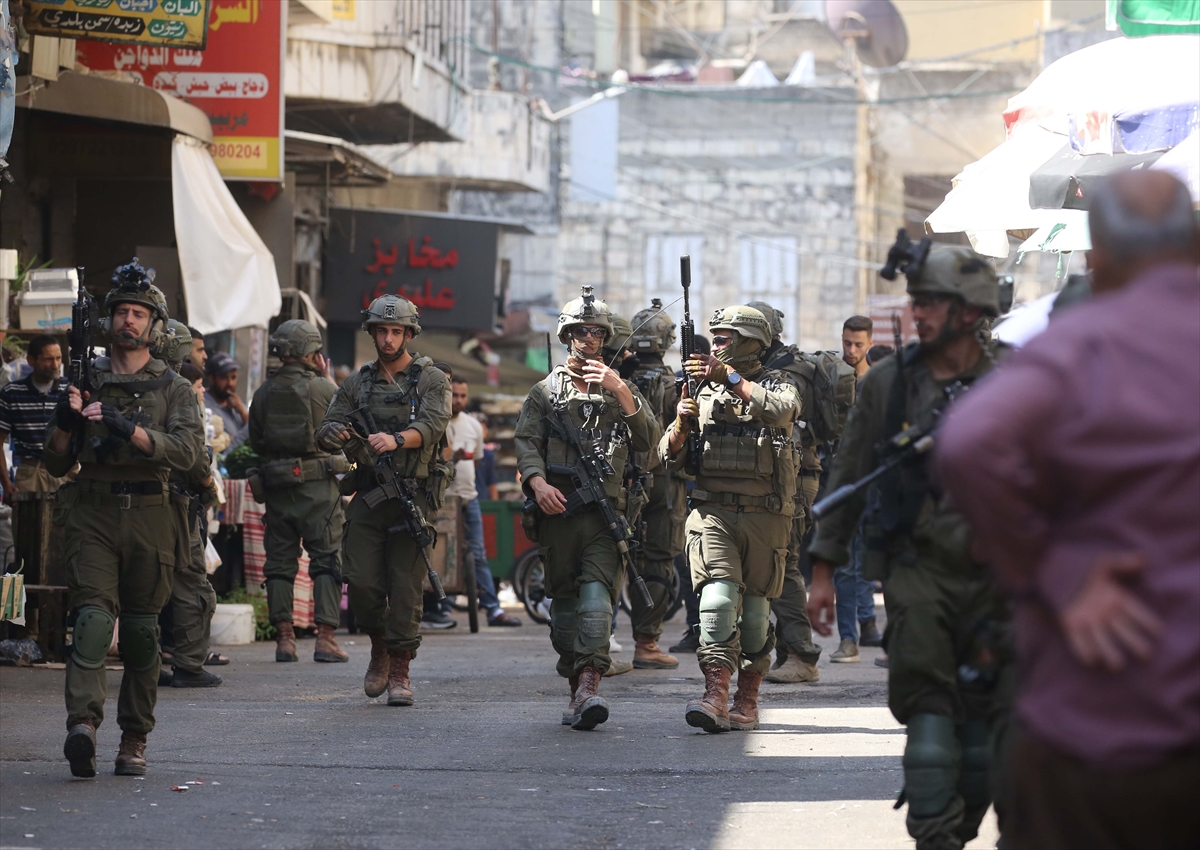
[Photo: Israeli forces conduct a raid, taking extensive security measures on August 09, 2026 in Nablus, West Bank, Palestine. Photojournalist: Nedal Eshtayah/AA]