By Abdul Adil
London, (The Muslim News): Despite a memorandum of understanding (MoU) reportedly signed electronically by U.S. President Donald Trump and Iranian President Masoud Pezeshkian that included provisions aimed at securing a ceasefire in Lebanon, Israel continued military operations across the country on Friday, raising questions about the viability of the broader diplomatic agreement.
According to Lebanon’s Health Ministry, at least 50 civilians were killed and 97 others wounded in a series of Israeli airstrikes that struck southern Lebanon and the eastern Bekaa Valley throughout the day.
Lebanese authorities described the attacks as “intense Israeli airstrikes” conducted from shortly after midnight until Friday afternoon. The highest death tolls were reported in the southern towns of Harouf and Haboush, where nine and seven people were killed respectively. Among the dead were at least two children in the towns of Doueir and Arab Salim.
In eastern Lebanon, Israeli strikes, including one targeting Tal al-Abyad in the Baalbek region, killed three people and injured several others.
The escalation came despite diplomatic efforts to preserve a ceasefire linked to the recently announced U.S.-Iran agreement. Earlier on Friday, Hezbollah said it launched attacks against Israeli troops after detecting what it described as an attempted Israeli advance into southern Lebanon.
According to Hezbollah-affiliated reports, an explosive drone struck a Merkava tank operating near the Ali Taher ridge outside Tibnine shortly after midnight, killing Lt. Col. Dor Gedalia Ben Simhon, commander of the Israeli army’s 52nd Battalion, along with three soldiers. Another drone attack reportedly targeted an Israeli Commando Brigade unit near Beaufort Castle several hours later, injuring five soldiers, one seriously.
The Israeli military responded with extensive airstrikes across southern Lebanon and the Nabatieh region. Reports from the ground indicated continued clashes along the Kfar Tibnit and Ali Taher hill axes, with Hezbollah claiming to have targeted Israeli vehicles and troop concentrations.
Israeli Prime Minister Benjamin Netanyahu later stated that military operations against Hezbollah would continue and reaffirmed Israel’s intention to maintain its presence in parts of southern Lebanon.
His remarks came hours after U.S. Vice President JD Vance urged Israel to support the broader diplomatic process initiated with Iran.
Lebanese Parliament Speaker Nabih Berri reiterated Lebanon’s commitment to the ceasefire framework, saying Hezbollah would continue to respect the agreement provided Israel did the same. However, developments on the ground suggested the truce remained highly fragile.
Meanwhile, Iran announced the suspension of its 60-day negotiation framework with the United States, accusing Washington of failing to uphold the first clause of the recently signed memorandum.
According to Iranian and regional media reports, Tehran views the Israeli strikes in Lebanon less than 24 hours after the signing of the agreement as evidence that Washington has not fulfilled its obligations under the deal. Iranian officials canceled plans to travel to Switzerland for the first round of negotiations and stated that Iran would not proceed with its commitments until Israeli attacks cease and U.S. guarantees are provided.
As a result, the planned first round of U.S.-Iran talks is effectively on hold.
Adding to concerns about the durability of the agreement, a report by The Washington Post cited current and former U.S. officials who said intelligence assessments warned that Israeli actions could undermine President Trump’s efforts to secure a lasting arrangement with Iran.
One U.S. official quoted in the report argued that Israel’s continued military presence in southern Lebanon could jeopardize any ceasefire arrangement.
“Continuing to occupy part of Lebanon is a recipe for disaster,” the official said. “Without a full Israeli withdrawal, the likelihood of resumed hostilities between the Israeli military and Hezbollah is all but certain.”
The ceasefire announcement followed a day of intense fighting that left dozens dead in Lebanon and four Israeli soldiers killed in combat.
The agreement itself traces back to the Islamabad Memorandum of Understanding, signed electronically on Wednesday by Presidents Trump and Pezeshkian, with the stated objective of ending hostilities between the United States, Israel and Iran while halting Israeli attacks on Lebanon.
Tensions were further inflamed by comments from Israeli National Security Minister Itamar Ben-Gvir following reports of Israeli military casualties. Writing on social media platform X, Ben-Gvir called for a significantly expanded military response in Lebanon, remarks that drew criticism from observers who argued they risked escalating the conflict further.
After the announcement that four Israeli soldiers had been killed in combat in southern Lebanon, Ben-Gvir on Friday wrote on US social media platform X: “All of Lebanon must burn.”
“For every tear of an Israeli mother, a thousand Lebanese mothers must weep,” he added, stressing what he called the “need to go berserk. To obliterate. To crush the terror.”
Among those killed during Friday’s fighting was Lt. Col. Dor Gedalia Ben Simhon, commander of the Israeli army’s 52nd Battalion of the 401st Armored Brigade. The battalion has previously drawn international attention over allegations related to the killing of six-year-old Palestinian girl Hind Rajab in Gaza in January 2024.
By Friday evening, Lebanon’s Health Ministry reported that the overall toll from the day’s strikes had risen to 47 killed and 97 wounded. Among the victims was the family of Mohamed and his wife Sahad, who were killed alongside their three young daughters in an airstrike on the town of Harouf.
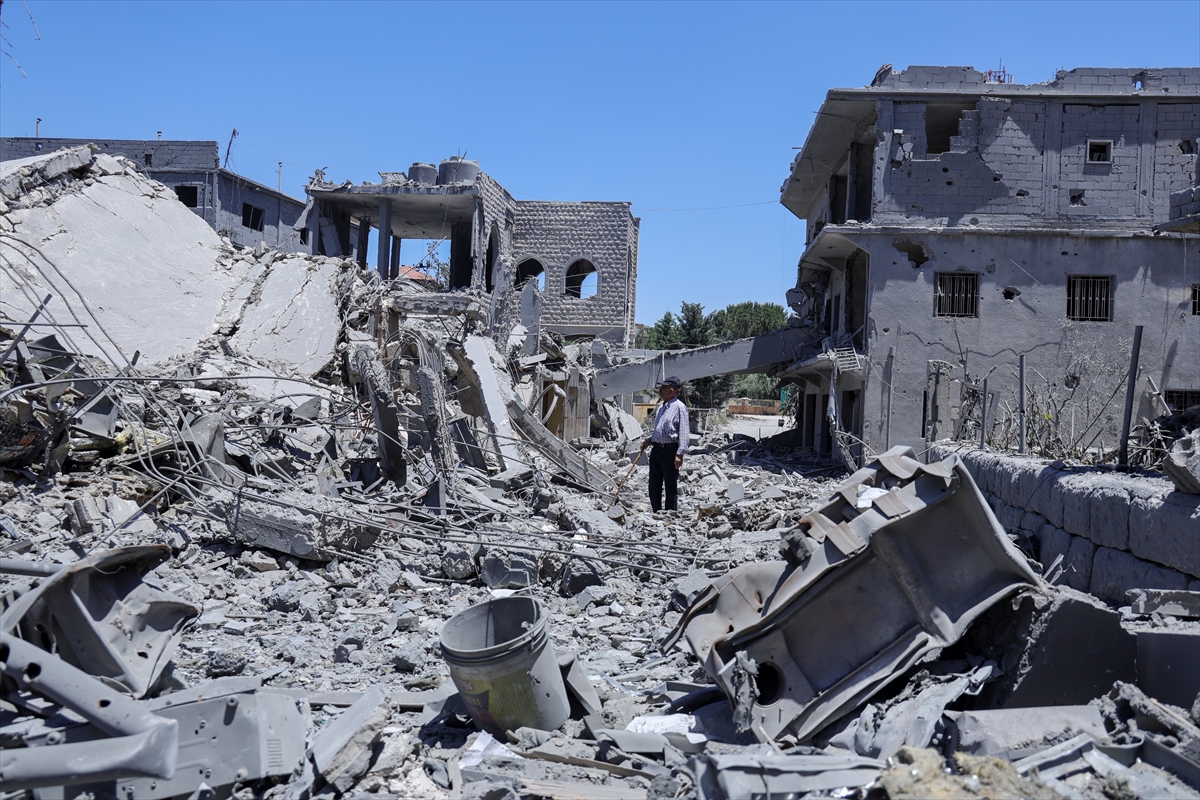
[Photo: Residents inspect damage to a religious building, Husseiniya, and nearby civilian buildings in the town of Sahmar in Lebanon’s Bekaa Valley on June 16, 2026. The destruction caused by Israeli strikes is seen following the agreement reached between the United States and Iran, as residents return to the area. Photojournalist: Ramiz Dallah/AA]