By Middle East Correspondent
LONDON, (The Muslim News): Israel has said it dropped more than 18,000 bombs on Iran during a 40-day war that began on February 28, marking one of the most intense military escalations in the region in recent years.
In a statement posted on X, the Israeli army said it carried out more than 1,000 offensive air sorties against Iran during the conflict. According to previously released military data, dozens of fighter jets took part in each strike, underscoring the scale and coordination of the campaign.
The army added that more than 10,800 airstrikes were conducted, hitting over 6,700 components and 4,000 targets, although it did not provide further details about the nature of these targets.
The financial toll of the war has also begun to emerge. Israel’s Finance Ministry estimated that 40 days of fighting with Iran and Lebanon cost approximately $17.5 billion, according to local media reports.
Meanwhile, rhetoric from Washington has signalled the possibility of further escalation. Donald Trump said the United States is loading warships with the “best weapons ever made” as an American delegation travels to Pakistan for talks with Iran.
“We have a reset going. We’re loading up the ships with the best ammunition, the best weapons ever made,” Trump said, warning that if no agreement is reached, “we will be using them, and we will be using them very effectively.”
On the Iranian side, Mohammad Bagher Qalibaf set clear conditions for negotiations. He said a ceasefire in Lebanon and the release of Iran’s blocked assets which was part of the agreement, must be secured before talks with the US can begin.
“Two of the measures mutually agreed upon between the parties have yet to be implemented,” he wrote on X, adding that both conditions “must be fulfilled before negotiations begin.”
Despite these tensions, Iranian and US delegations are expected to meet in Islamabad on Saturday in rare face to face talks aimed at achieving a permanent ceasefire.
The negotiations follow a 14-day truce brokered by Pakistan earlier this week, temporarily halting weeks of fighting that began with joint US-Israeli strikes on Iran. The conflict has reportedly killed more than 3,000 people, including Iran’s Supreme Leader Ali Khamenei.
US Vice President JD Vance struck a cautiously optimistic tone ahead of the talks, saying Washington would approach negotiations with “open hands”.
“I think it’s going to be positive,” he said, while emphasising that progress would depend on Iran’s position at the negotiating table.
At the same time, tensions have extended beyond the battlefield into diplomatic relations. Israeli Prime Minister Benjamin Netanyahu announced that Spain would be removed from a military coordination centre in Kiryat Gat, accusing Madrid of waging a “diplomatic war” against Israel following its criticism of Israeli illegal military actions.
“I will not allow any country to wage a diplomatic war against us without paying a heavy price,” Netanyahu said, claiming Spain had defamed Israeli soldiers.
The Civil-Military Coordination Centre (CMCC), established by the United States in October, was intended to monitor the implementation of plans to end the war in Gaza.
On the ground in Lebanon, Israeli airstrikes continued to inflict heavy casualties. At least 21 people were killed on Friday alone, including eight Lebanese security personnel, according to Lebanese authorities.
Strikes in Nabatieh targeted areas near a government complex and a State Security office, causing extensive destruction. Additional attacks across southern towns including Deir Qanoun Ras al-Ain, Qana, Hanouiyeh, Kfar Tebnit, Jbaa and Ansar resulted in further civilian deaths and injuries.
In one incident, a municipal official, Ali Abdul Latif Ghaith, was killed alongside other civilians. Elsewhere, drone strikes hit vehicles and residential areas, while emergency infrastructure was also affected.
A strike in Deir Qanoun Ras al-Ain damaged ambulances and firefighting vehicles belonging to the Islamic Health Authority, shortly after Israeli military spokesperson Avichay Adraee warned that ambulances could be targeted over allegations they were being used for military purposes. No evidence was provided by Israel. No casualties were immediately reported in that incident.
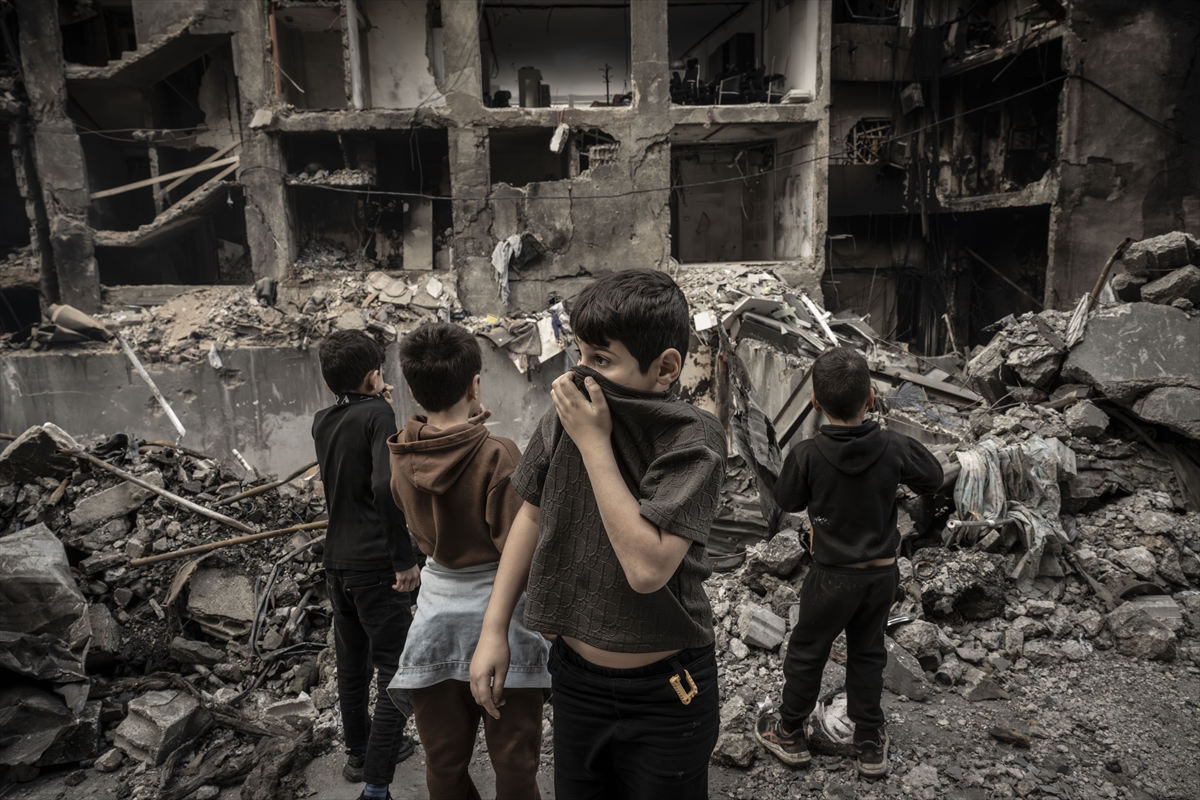
The widening assault has significantly increased the humanitarian toll. Since Wednesday alone, at least 303 people have been killed and more than 1,150 injured in Lebanon, according to civil defence figures.
International concern is growing. The European Union called for an immediate halt to the violence, warning of severe civilian casualties and widespread damage to infrastructure.
“We demand the immediate cessation of attacks in Lebanon,” said European Commission spokesperson Anouar El Anouni in Brussels. “It is clear that all parties must fully comply with international humanitarian law.”
As diplomatic efforts tentatively resume in Islamabad, the scale of destruction across Iran and Lebanon—coupled with escalating rhetoric from global powers—highlights how fragile any path toward de-escalation remains.
[Photo: Children try to protect themselves from dust and smoke rising from the rubble where a large-scale destruction caused by Israeli indiscriminate airstrikes targeting the Corniche al-Mazraa area in the capital Beirut, Lebanon, on April 10, 2026. Photojournalist: Murat Şengül/AA]