By Middle East Correspondent
London, (The Muslim News): Iran said Tuesday that the Strait of Hormuz will remain closed unless Oman accepts Tehran’s proposal giving Iran full control over one shipping lane and partial control over another, as officials also ruled out direct talks with the United States and signalled a tougher stance on the country’s nuclear programme amid continuing regional tensions.
Deputy Foreign Minister Kazem Gharibabadi said on Tuesday that Tehran had rejected Oman’s proposal for a temporary shipping arrangement through the strait, insisting that one navigation lane must remain entirely under Iranian control while part of a second lane should also fall under Tehran’s authority.
“Our proposal is that one shipping lane through the strait must be entirely under Iran’s control, with part of the other lane also under Iranian control. This is our definitive position, and Iran will accept no other formula,” Gharibabadi said on Iranian state television.
He warned that unless Oman accepted the proposal, the Strait of Hormuz would remain closed, adding that Iran was prepared for the possibility of renewed conflict.
The remarks came as Tehran accused Washington of violating last month’s memorandum of understanding by opening an alternative southern shipping route in cooperation with Oman, while insisting that Article 5 of the agreement gives Iran sole responsibility for navigation arrangements, mine-clearing and security in the strategic waterway.
As negotiations over Hormuz continued, Iran also hardened its broader foreign policy position. Gharibabadi said Tehran had no plans to resume negotiations with the United States, was treating its cooperation with the International Atomic Energy Agency as suspended and argued that withdrawing from the Nuclear Non-Proliferation Treaty was “no longer a taboo”, although he said any decision would require careful legal and strategic consideration.
The diplomatic developments unfolded alongside fresh military and political tensions elsewhere in the region. Iranian Foreign Minister Abbas Araghchi said Ukraine had assured Tehran that an attack on an Iranian commercial vessel in the Caspian Sea was unintentional and that Kyiv sought no escalation, while Israeli Defence Minister Israel Katz claimed US aircraft were operating from Israel to carry out strikes on Iran and warned Israel was prepared to act independently if attacked.
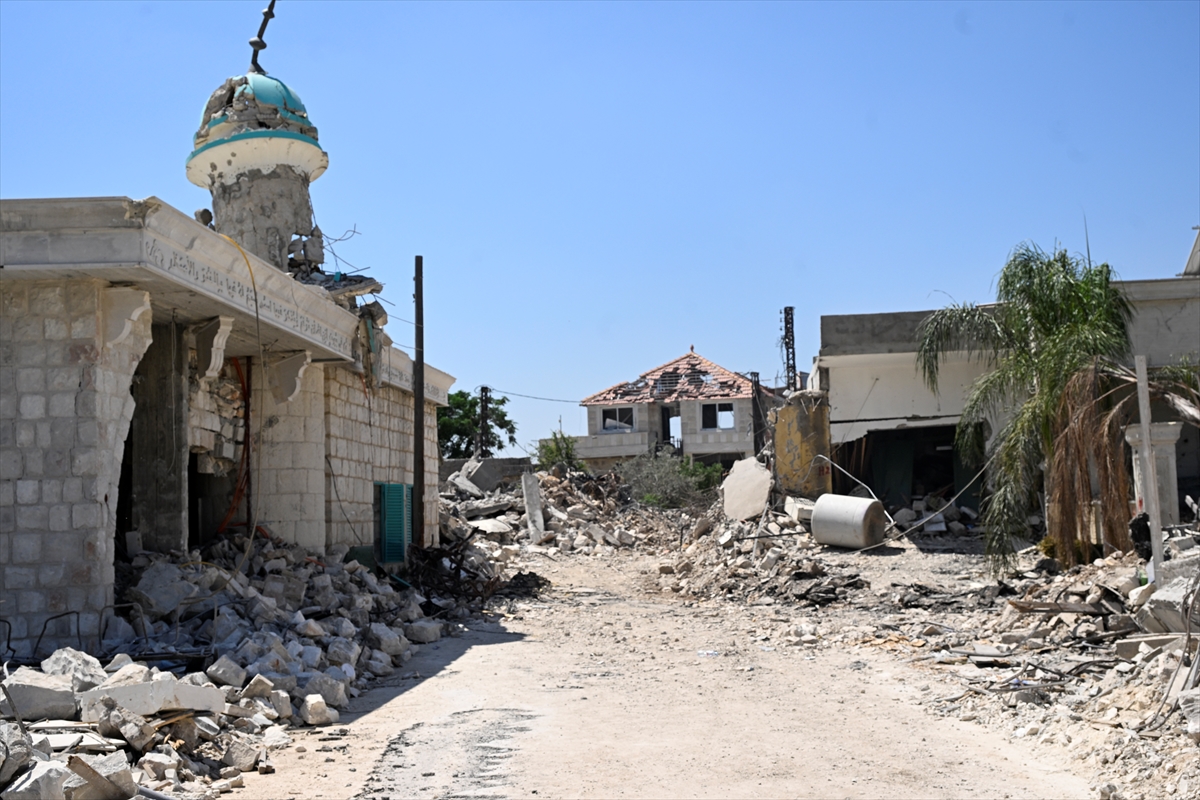
Meanwhile, Israeli military operations continued in Gaza, where an airstrike destroyed the Al-Muttaqin Mosque and tents sheltering displaced families in central Gaza City, leaving hundreds homeless. Palestinian officials also reported the establishment of another Israeli settlement outpost near Yasuf in the occupied West Bank, while Lebanon’s state news agency said the Israeli army carried out a large explosion in the southern town of Majdal Zoun despite the US-mediated framework agreement governing southern Lebanon.
[Photo: A view of heavy destruction at homes, places of worship, roads, and infrastructure, after Israeli troops withdrew from the town of Zawtar al-Gharbiya, following the US State Department’s announcement on July 20 regarding the launch of a pilot project under the Lebanon-US-Israel framework agreement on July 27, 2026 in Zawtar al-Gharbiya, Lebanon.
Photojournalist:Houssam Shbaro/AA]