By Elham Asaad Buaras
LONDON, (The Muslim News): Iran has issued civilians with guidance on surviving a potential nuclear attack by US-Israel as tensions with the United States escalate, following US strikes on Qeshm Island and renewed Iranian threats of retaliation.
Iranian state media published the survival guide on October 29, including an eight-minute instructional video produced by emergency services in Isfahan province and distributed by the IRNA news agency. It outlines measures to take in the event of a nuclear strike.
The advisory followed the US-Israeli military offensive against Iran, launched on February 28.
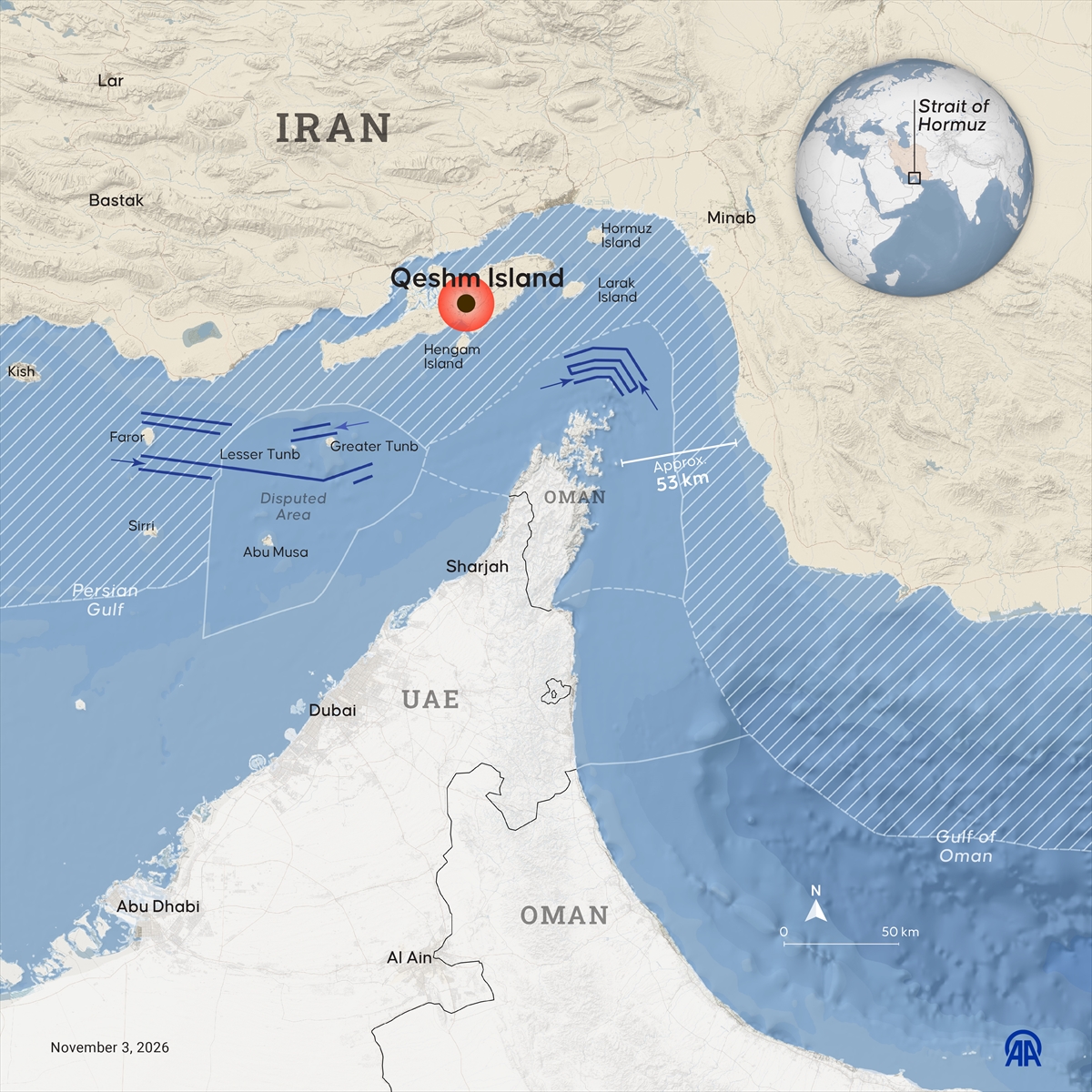
On November 2, US forces struck Iranian military targets on Qeshm Island, near the strategically important Strait of Hormuz. Washington described the operation as a “limited defensive action” against an Iranian missile installation, following an alleged Iranian threat to an American military aircraft over the strait.
Iranian Army spokesman Brigadier General Mohammad Akraminia warned that further US attacks would trigger a wider response, potentially extending beyond West Asia.
He said the armed forces had been ordered to update their target database to include US and Israeli military assets, facilities, personnel and interests within Iran’s reach.
Akraminia also accused Washington of trying to open a ground front along Iran’s western borders by arming separatist groups in Iraq’s Kurdistan Region. He said Iranian deployments and pre-emptive operations had prevented the alleged plan.
Tankers catch fire in Strait of Hormuz
The Strait of Hormuz has become a major flashpoint, with Iran tightening restrictions on shipping and the US maintaining pressure on maritime routes.
Iran’s Islamic Revolutionary Guard Corps (IRGC) Navy said on Tuesday that three oil tankers had struck naval mines and caught fire after entering unauthorised shipping routes.
A statement carried by Tasnim News Agency said the vessels had switched off their navigation and identification systems before entering restricted waters. The tankers were later abandoned near the southern shores of the strait.
The IRGC did not identify the vessels or provide details of casualties, crews or damage. The claims have not been independently verified.
Iranian forces warned that ships ignoring navigation restrictions or cooperating with the US military could face similar incidents.
The announcement followed a separate statement by Iran’s Navy on Monday that another tanker had struck a mine and caught fire east of the strait.
The IRGC also claimed to have shot down two US MQM-170 reconnaissance drones south of Qeshm Island and an MQ-9 drone over the eastern Strait of Hormuz. Iranian sources put the number of MQ-9 drones downed by Iran at 55.
In a separate statement, the force said air defences had destroyed two US LUCAS one-way attack drones over Bandar Khamir in Hormozgan province. There was no immediate US confirmation of the reported losses.
Iran pursues regional security deal through Qatar
Despite the military escalation, Tehran has continued diplomatic contacts with regional governments and Washington.
Foreign Minister Abbas Araghchi said on Tuesday that Iran had no hostility towards Gulf Cooperation Council countries and welcomed mediation efforts by Qatar and Oman, while maintaining dialogue with Saudi Arabia.
Iran wanted regional security arrangements led by countries in the region, without foreign military involvement, he said.
In an interview with Al Jazeera on Monday, Araghchi said recent discussions with Saudi Arabia, Türkiye and Pakistan had focused on cooperation over political, security and economic challenges.
He warned, however, that US military bases and other American targets in the region would be included in any Iranian response to another attack.
Araghchi also outlined a Qatari-mediated proposal to reopen the Strait of Hormuz. Under the plan, Washington would first meet a series of Iranian demands before the waterway reopened the following day.
The demands include lifting sanctions imposed after the Islamabad memorandum, ending the maritime blockade, allowing Iranian oil exports, releasing frozen Iranian assets and reducing the US military presence in the region.
Araghchi said negotiations with Washington could resume once the strait reopened.
He confirmed indirect discussions with US envoys Steve Witkoff and Jared Kushner in New York through Qatari mediation, but denied reports that direct talks had been agreed in Qatar, Türkiye or elsewhere.
He said negotiations over the strait were separate from any future agreement on Iran’s nuclear programme.
Foreign Ministry spokesman Esmaeil Baqaei said Tehran was continuing to exchange messages with Washington through mediators. He added that Iran’s revised seven-stage proposal could be implemented within two days, provided Washington ended its naval blockade and addressed its demands.
Israeli strike kills one Palestinian and injures 11 in Gaza
Meanwhile, Israeli attacks continued in Gaza despite the ceasefire that took effect on October 10, 2025.
One Palestinian was killed and 11 injured in an Israeli strike west of Khan Younis on Tuesday, a medical source at Kuwait Hospital said.
Witnesses told Anadolu Agency that the attack hit a gathering outside the University College in the al-Mawasi area. Gaza’s Interior Ministry said the target was personnel from the Internal Security Service.
It was the second attack on police personnel in three days. An Israeli strike in Khan Younis on Sunday killed six policemen.
Gaza’s Health Ministry said at least 1,599 Palestinians had been killed and 5,774 injured by Israeli fire since the ceasefire began. The overall death toll since October 2023 had reached 74,615, with 175,899 injured.
The ministry said 847 bodies had been recovered, while others remained beneath rubble or in areas inaccessible to rescue teams.
Israel’s attacks have also continued to disrupt education. At least 14 school students and eight education workers were killed during October, according to figures released by the Education Ministry on Tuesday.
The students were aged between six and 16. Those killed among education staff included four teachers, three employees of the Islamic University and a female academic.
The ministry reported further injuries among pupils, university students and education workers, while Israeli gunfire forced schools and educational facilities to suspend or delay classes in several areas.
Restrictions on crossings have also prevented students with overseas scholarships from leaving Gaza, while shortages of fuel and essential supplies have disrupted education.
The ministry said damaged schools could not be adequately repaired because construction materials, temporary classrooms, furniture and specialist equipment remained blocked from entering the territory.
According to Gaza’s Government Media Office, 95% of schools have sustained damage since October 2023. Education Ministry figures released in July put the number of school-age students killed since the start of the war at more than 20,051, alongside more than 532 teachers.
Israel seizes Palestinian land in West Bank for settlement road
In the occupied West Bank, Israeli authorities have ordered the seizure of 26.473 dunams (6.54 acres) of Palestinian land northwest of Ramallah for a road linking Israeli settlements.
The Palestinian Colonization and Wall Resistance Commission said the October 28 military order covers land in Deir Nizam, Umm Safa and Atara, ostensibly for military purposes.
The proposed Ateret–Neve Tzuf emergency route is intended to connect settlement sites. The seizure order remains in force until the end of 2028.
The commission said 20.582 dunams of the affected land were not classified by Israel as state land. It warned that the road would strengthen links between settlements and outposts while further restricting Palestinian landowners’ access to their property.
Elsewhere, Israeli forces demolished five Palestinian-owned shops northwest of Hebron, while five families in Ras al-Ahmar, southeast of Tubas, were ordered to evacuate their tents during military exercises.
Israeli settlers set fire to Palestinian vehicles
In Majdal Bani Fadil, south of Nablus, Israeli settlers set fire to two Palestinian vehicles parked outside their owners’ homes, local sources said.
The incidents came amid a sharp increase in settler violence. The commission recorded 1,369 attacks by Israeli settlers in October, up from 647 in September – an increase of 111.6%.
Including attacks by Israeli forces, it documented 3,133 incidents against Palestinians, their land and property during October, compared with 2,051 the previous month.
The incidents included assaults, property and crop destruction, restrictions on access to agricultural land, closures, settlement outposts and demolitions.
The UN considers Israeli settlements in the occupied West Bank, including East Jerusalem, illegal under international law. Security Council Resolution 2334 states that they have no legal validity.
In a July 2024 advisory opinion, the International Court of Justice also ruled that Israel’s continued presence in the occupied Palestinian territory is unlawful and must end as rapidly as possible.
[An infographic titled “Qeshm Island” created in Ankara, Turkiye on November 3, 2026. Photojournalist: Omar Zaghloul/AA}