By Elham Asaad Buaras
London, (The Muslim News): Gulf Arab states have sharply condemned Israel’s strike on a village in southern Syria that killed 13 people, including children, branding the attack a blatant breach of Syrian sovereignty and international law.
Syria’s representative to the UN, Ibrahim Olabi, criticised Israel’s attack on the town of Beit Jinn, saying it further underscored what he described as Israel’s disregard for international norms and its anxiety over Syria’s growing strength. “The incident is yet another indication to the world of which country in the region is the one abiding by international law and which isn’t,” Olabi told Al Jazeera. It also shows “who really wants a peace deal, a security agreement – who wants to be able to get the region into stability – and who doesn’t,” he said.
Olabi added that Israel was acting out of fear of Syria’s “regional and international prominence”. “Israel is terrified by a strong and prosperous and stable Syria. We are heading in that direction no matter what.”
The condemnation came as violence escalated across the occupied Palestinian territories. In the northern occupied West Bank, 130 Palestinians have been injured since the Israeli army launched a military offensive in the Tubas governorate last Wednesday, according to Nedal Odeh, director of ambulance and emergency services in Tubas. Odeh told Anadolu Agency that the injuries resulted from Palestinians being beaten by Israeli forces during raids.
The Israeli army has conducted extensive operations in Tubas and nearby towns, raiding numerous homes, converting some into military posts, and causing widespread property damage. The Palestinian Prisoner Society reported that 162 people were arrested during the raids, most of whom were later released after field interrogations and what it described as mistreatment. Dozens of homes were vandalised, their contents destroyed, and several were turned into military outposts after residents were forced to leave.
While the Israeli military says the operation aims at “eliminating militants,” Palestinian analysts warn of covert objectives, including illegal settlement expansion and efforts to displace Palestinian communities.
In Jenin, two young Palestinians were shot dead by Israeli soldiers on Thursday after surrendering, according to video footage showing them emerging from a building with their hands raised before being fired upon at close range. The army said it is conducting a field investigation, asserting the men were wanted and had been surrounded for hours before the shooting.
The violence unfolds against the backdrop of a devastating two-year war in Gaza, which has killed nearly 70,000 people, according to official Palestinian figures.
In the West Bank, the conflict has also taken a heavy toll, with at least 1,085 Palestinians killed and 11,000 injured in army and settler attacks, and more than 20,500 detained.
The International Court of Justice ruled last July that Israel’s occupation of Palestinian territory is illegal and called for the evacuation of all settlements in the West Bank and East Jerusalem.
Ongoing Israeli attacks across Gaza intensified on Friday, with a Palestinian man, Abdullah Hammad, killed in a drone strike in Bani Suhaila, east of Khan Younis, according to medical sources who spoke to Anadolu. The strike took place in areas of southern Gaza that Israel continues to occupy under the ceasefire agreement, where its forces still control roughly 53 per cent of the enclave.
Separately, a young girl was moderately wounded when Israeli military vehicles fired heavily towards tents housing displaced families in Al-Mawasi, northwest of Rafah. Tens of thousands of Palestinians displaced from across Gaza are sheltering in the area.
In the early hours of Friday, Israeli warplanes launched intense strikes east of Khan Younis and northeast of Rafah. Off the Khan Younis coast, naval forces opened heavy fire and fired incendiary rounds towards fishermen and tents along the shoreline, while also shelling areas near Gaza City. Artillery fire was reported near Khan Younis.
Phase one of the ceasefire deal, agreed in October, includes the release of Israeli hostages in exchange for Palestinian prisoners, as well as commitments to rebuild Gaza and establish a new governing framework excluding Hamas.
Regional tensions intensified further as Hezbollah’s Secretary-General, Naim Qassem, on Friday condemned Israel’s killing of senior commander Haitham Ali al-Tabtabai, calling it a “deliberate crime” and asserting that the group reserves the right to retaliate. It was Qassem’s first public response since Israel announced the killing on Sunday in an airstrike targeting Beirut’s southern suburb.
Speaking at a memorial for Tabtabai, Qassem said: “What happened is a blatant attack and a deliberate crime, and we have the right to respond – we will determine the timing ourselves.” The strike killed five people and wounded 25. Hezbollah confirmed Tabtabai’s death in the attack.
Qassem said the ceasefire agreement reached on 27 November 2024 “represents a new phase in which the state has decided to assume responsibility for expelling the occupation and deploying the Lebanese army.” He criticised domestic opponents he described as “servants of Israel”, accusing them of seeking instability and following American directives.
He added that Hezbollah is prepared “to discuss the defensive strategy, but not under pressure, not in pursuit of a new agreement, not to give up our strength as part of any other arrangement, and not to evade the current agreement.” He accused Israel of wanting Lebanon as a subservient state. “We will not accept that the enemy decides how we live. We, our people, our allies, and our army will not accept being subservient to Israel,” he said.
Qassem also condemned Israel’s attack on Beit Jinn, saying it “proves that the Syrian people will not accept surrendering to Israel.”
A ceasefire between Israel and Lebanon came into effect on 27 November 2024 following more than a year of cross-border attacks linked to the Gaza war, which left more than 4,000 people dead and 17,000 wounded. Under the deal, Israel was expected to withdraw from southern Lebanon in January, but it has only partially pulled back and maintains a presence at five border outposts.
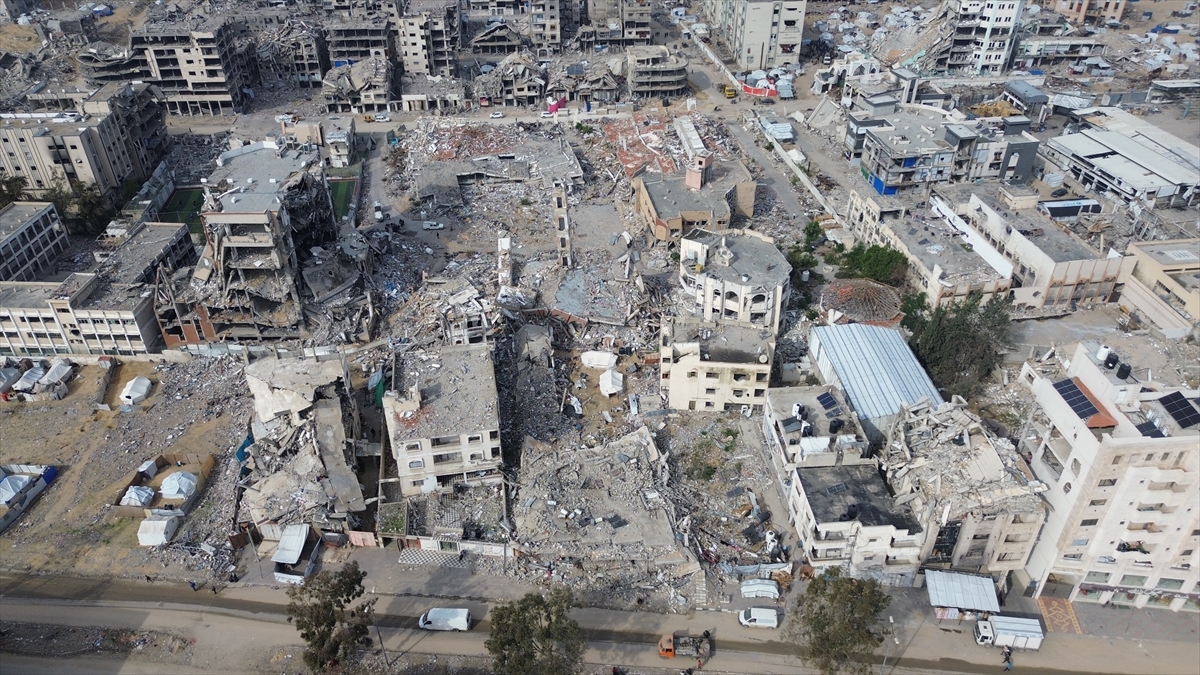
[Photo: An aerial view of demolished Al-Aqsa University, after the Israeli army’s direct target, forcing thousands of students to suspend their studies in Gaza City, Gaza on November 29, 2025. Al-Aqsa University is Gaza’s most prominent institutions, the university had provided education to more than 25,000 students across 15 faculties. Photojournalist: Mohammed Eslayeh/AA]