By Middle East Correspondent
London, (The Muslim News): Heavy rain and strong winds have flooded or damaged tens of thousands of tents sheltering displaced Palestinians in Gaza, leaving hundreds of thousands exposed. Israeli attacks continued across the occupied Palestinian territories and southern Lebanon as the United States escalated military attacks against Iran.
Storm floods 70,000 tents as Gaza families face freezing conditions
The Government Media Office estimated that 70,000 tents flooded in the first 12 hours of a storm that began late Friday. Gaza’s Health Ministry said 350,000 displaced Palestinians were sleeping in the open.
Gaza Municipality spokesman Hosni Muhanna told Anadolu Agency that families with destroyed or damaged tents had nowhere else to go. About 1 million residents and displaced people are crowded into roughly 30% of Gaza City, straining infrastructure devastated by Israel’s genocidal war.
The city received 60 millimetres of rain in 12 hours, about 15% of its annual rainfall. Strong winds tore through makeshift shelters, and municipal crews took around 250 emergency calls reporting flooded streets, soil erosion and blocked drains.
Crews responded to most incidents, but Muhanna warned that 270 camps and shelter sites in Gaza City remained at risk. War damage has cut the drainage network to 20% capacity, leaving low-lying neighbourhoods especially vulnerable.
The Government Media Office put initial losses at about $3 million. Dozens of walls collapsed, including some weakened by Israeli bombardment. Medical sources told Anadolu that five Palestinians were injured when two damaged walls collapsed and a sheet of corrugated metal fell.
Abdullah al-Majdalawi, director of public relations for Gaza’s Civil Defense, said crews had received hundreds of distress calls about flooded camps and buildings at risk of collapse. He said workers lacked the equipment and resources to provide alternative accommodation.
“We go to people and find an entire camp flooded, with its tents, people, furniture and bedding,” al-Majdalawi said. “We stand helpless before this tragic and difficult reality in Gaza.”
Civil Defense said water had reached 1.5 metres in some areas, forcing families to stay outdoors.
Gaza Health Ministry Director-General Munir al-Bursh appealed for urgent international intervention to protect displaced families, particularly children.
“Is the world waiting for our children to freeze?” he asked, urging the opening of crossings to admit tents, winter supplies and reconstruction materials. He said thousands of tents were waiting at the crossings but the Israeli army was refusing them entry.
On Sunday, a landslide in Deir al-Balah in central Gaza struck tents sheltering displaced families, killing a woman and four children and injuring several others, according to Civil Defense. Rescue teams continued searching for missing people.
Hamas said Israel bore “full responsibility” for the deaths, arguing that its blockade and restrictions on aid and shelter materials had left displaced families without safe accommodation.
The group said more than 2 million people had been forced from their homes into overcrowded camps lacking basic protection. It called for the blockade to be lifted and reconstruction to be facilitated so families could return to safe homes.
UNRWA, the UN agency for Palestinian refugees, said Thursday that 1.98 million people, about 94% of Gaza’s population, needed shelter and other essential supplies, citing June surveys. Around 58% faced critical or catastrophic shelter needs.
In October, the UN Office for the Coordination of Humanitarian Affairs warned that about 950,000 Palestinians were living at displacement sites at moderate or high risk of flooding, including more than 400,000 in high-risk areas.
Israel’s war, launched in October 2023, has destroyed homes and civilian infrastructure across Gaza, forcing hundreds of thousands into makeshift accommodation. More than a year after the ceasefire took effect on October 10, 2025, shelter and reconstruction needs still far exceed available aid. Israeli restrictions on tents, mobile homes, building materials and heavy equipment have further hampered recovery.
Israeli attacks kill Palestinians despite Gaza ceasefire
The humanitarian crisis has unfolded alongside repeated Israeli ceasefire violations. Medical sources said attacks across Gaza on Sunday killed two Palestinians, including a woman, and wounded 12 others.
A source at Nasser Medical Complex said an Israeli strike on civilians in al-Mawasi, Khan Younis, killed two and wounded seven. In northern Gaza, four others were wounded, one seriously, when eyewitnesses said a drone fired a missile at a gathering in Bir al-Naaja, west of Jabalia.
Israeli forces also shot a woman in the back in the Qatari Camp, east of the Hamad residential complex in Khan Younis. Israeli military vehicles fired towards southern Khan Younis and the al-Shakoush area west of Rafah, while artillery shelled areas east of Gaza City, local sources told Anadolu.
Gaza’s Health Ministry said at least 1,610 Palestinians had been killed and 5,819 wounded by Israeli fire since the October 10 ceasefire. It put the war’s overall death toll at more than 74,000, with over 175,000 injured and about 90% of civilian infrastructure damaged or destroyed.
West Bank raids and settler attacks intensify
Israeli military operations and illegal Israeli settler attacks have also intensified across the occupied West Bank, including East Jerusalem.
Palestinian media reported that Israeli forces shot and wounded a child and detained two men during raids late Saturday. Palestine TV said the child was shot in the foot near the Kafr Saba neighbourhood in Qalqilya.
Wafa News Agency reported that troops detained a man at his home in Hebron and another in Taybeh, east of Ramallah, seizing the latter’s vehicle. In Hebron, soldiers confined a family to one room while searching their home. Hundreds of settlers then entered the Old City under army protection, forcing shopkeepers to close, and others attacked a Palestinian home on al-Shuhada Street, smashing its windows.
Elsewhere, settlers attacked Palestinians harvesting olives west of Jenin, seizing a tractor and olives. In Kisan, east of Bethlehem, a settler assaulted a Palestinian and stole his belongings.
Israeli forces also raided Dura al-Qara and Ni’lin in the Ramallah area, and four towns in Tulkarem province, where troops disrupted traffic and fired stun grenades. Voice of Palestine radio reported further raids across Bethlehem, Nablus, Tubas, Jenin and Ramallah. No injuries or arrests were reported in the Tulkarem operations.
Palestinians report that raids and attacks have intensified since October 2023, with killings, arrests, home demolitions, arson, land destruction and the displacement of entire communities.
Iran-US confrontation widens as shipping comes under attack and US bombs Qeshm Island
The escalation has coincided with a widening Iran-US confrontation, marked by military activity around the Strait of Hormuz, attacks on commercial shipping and continuing bombing by US on Qeshm Island.
Iranian military sources and state media said air defences engaged US aircraft over the Strait and the southern island of Qeshm.
Iran’s army said it destroyed a US-made MQ-9 Reaper drone with a new air-defence system. The Islamic Revolutionary Guard Corps (IRGC) separately claimed it intercepted an MQ-1 drone, reportedly the 16th of that model destroyed since the war began.
Iranian military sources also said surface-to-air missiles were fired at a US Navy F/A-18 Super Hornet over the Strait. None of these claims could be independently verified.
The reported engagements came days after US carrier aircraft struck Iranian air-defence launchers on Qeshm. Reports of further explosions around Qeshm and the port of Jask were followed by Iranian claims of missile launches at ships accused of violating restrictions in the waterway. The circumstances remain unclear.
At least 11 vessels were attacked in and around the Strait in the week ending November 6, according to the United Kingdom Maritime Trade Operations (UKMTO), which said three ships sank.
Western military intelligence has recorded 88 projectile strikes since hostilities resumed in early July, but cautioned that most attacks go unreported.
The US Central Command (CENTCOM) said Saturday that American forces disabled a commercial cargo vessel in the Gulf of Oman after its crew allegedly ignored repeated warnings and tried to breach Washington’s naval blockade of Iran.
CENTCOM said the St Kitts-flagged M/V Huda, which had been leaving regional waters after a port call in Iran, was struck in the stern by precision munitions from a US military aircraft. The command did not disclose the crew’s condition.
“US forces continue to strictly enforce America’s naval blockade against Iran,” CENTCOM said, adding that 147 commercial vessels had been redirected after complying with military orders since enforcement began in July. Five merchant ships that refused to comply were disabled.
CENTCOM also claimed US forces destroyed 10 Iranian commercial oil tankers allegedly tied to a multibillion-dollar IRGC shadow network.
Washington has also extended its pressure beyond the sea. CENTCOM announced a new task force to disrupt Iranian ground routes allegedly used to transport advanced weapons and other materials.
Washington presses Iraq as Tehran warns of retaliation
Iraqi Foreign Minister Fuad Hussein said Sunday that the US Treasury had formally asked Baghdad to close all but two of its border crossings with Iran to increase economic pressure on Tehran.
Speaking to Qatar-based Al Jazeera, Hussein said Washington proposed keeping one crossing in Iraq’s Kurdish Region and another elsewhere, with locations yet to be identified.
“Closing the border crossings could be a punishment for Iran, but it would also hurt Iraq,” Hussein said. “Trade would stop, movement would stop, and that would affect us economically.”
He said it was unclear whether the restrictions would apply to visitors, commercial traffic or all cross-border movement.
Hussein estimated that Iraq lost about $60 billion because it could not export oil through the Strait of Hormuz for around four months at the start of the war. Before the disruption, Iraq exported roughly 3.3 million to 3.4 million barrels a day.
He warned that military operations could resume across the region and reiterated Baghdad’s opposition to the use of Iraqi territory to attack neighbouring countries.
Iraq and Iran are jointly investigating an attack on Saudi Arabia that, according to information Baghdad received, was launched from inside Iraq near the Iranian border.
On bringing armed factions under government authority, he said the Iraqi Prime Minister had reached understandings with four groups to place their weapons under state control, with talks continuing with two others.
“We hope to bring weapons under state control through dialogue and negotiations,” he said.
Tehran, meanwhile, warned Washington against further escalation.
Mohsen Rezaei, secretary of Iran’s Supreme National Security Council, warned Saturday that the US would face a “devastating response” if it launched another war against Iran.
“You lost the war and the election,” Rezaei wrote on X, adding: “Start a war, and you’ll face a devastating response.”
His remarks followed the November 3 US midterm elections, in which Democrats won both the House and the Senate, ending President Donald Trump’s Republican congressional majorities.
Rezaei reportedly restated Tehran’s conditions on a visit to Moscow on Thursday, where he met Russian President Vladimir Putin and delivered a message from Iran’s Supreme Leader Mojtaba Khamenei.
The warning came as Iran announced a change to its self-imposed limit on ballistic missile range. According to the Associated Press, Tehran has lifted its 2,000-kilometre cap, potentially putting European capitals and distant US bases within reach.
IRGC spokesman Brigadier General Hossein Mohebbi said the restriction had been “removed for us,” following a directive from Khamenei calling for responses “without geographical limitations.”
Iran’s Khorramshahr missile could reach about 3,000 kilometres with a lighter payload. A reported 2026 missile launch towards the US-UK base at Diego Garcia suggested a possible range of up to 4,000 kilometres, though Iran’s operational capabilities remain unclear.
Iranian Foreign Minister Abbas Araghchi has sought diplomatic support. He said Saturday that he had spoken with 12 foreign ministers in the previous 48 hours, including senior diplomats from Oman, Qatar, Saudi Arabia and Pakistan.
Araghchi said he had explained Tehran’s “fundamental positions,” including seven demands for reopening the Strait of Hormuz, and stressed the need for “regional security arrangements without the interference of superregional powers.”
He rejected suggestions that Iran refuses a ceasefire because it wants to keep fighting.
“We are not rejecting a ceasefire because we seek war,” Araghchi said. “Rather, this war must end in a way that ensures our enemies never again consider repeating such attacks.”
Israeli occupation and attacks continue across southern Lebanon
As Washington and Tehran traded warnings and the Gulf confrontation intensified, Israeli forces continued attacks in southern Lebanon despite a US-brokered framework agreement between Lebanon and Israel in June.
Lebanon’s National News Agency reported that Israeli forces carried out a demolition operation in Bani Hayyan and search operations in Khiam, in the Marjayoun district.
Israeli artillery shelled the outskirts of Wadi al-Hujair in the Jabal Amel region, as well as areas around Baraachit, Wadi Zibqin and al-Arayesh. Israeli forces also fired heavy machine guns towards the outskirts of Mansouri and Bayut al-Sayyad, south of Tyre.
The June agreement provides for a gradual Israeli withdrawal from occupied Lebanese territory in exchange for deployment of the Lebanese army and its assumption of security responsibilities.
Israel still occupies parts of southern Lebanon, including positions held for decades and others seized in the 2023-2024 war, when its ground forces advanced about 10 kilometres into Lebanese territory.
Lebanon’s Health Ministry said Thursday that Israeli attacks since March 2 had killed 4,390 people and wounded 12,429 as of November 5.
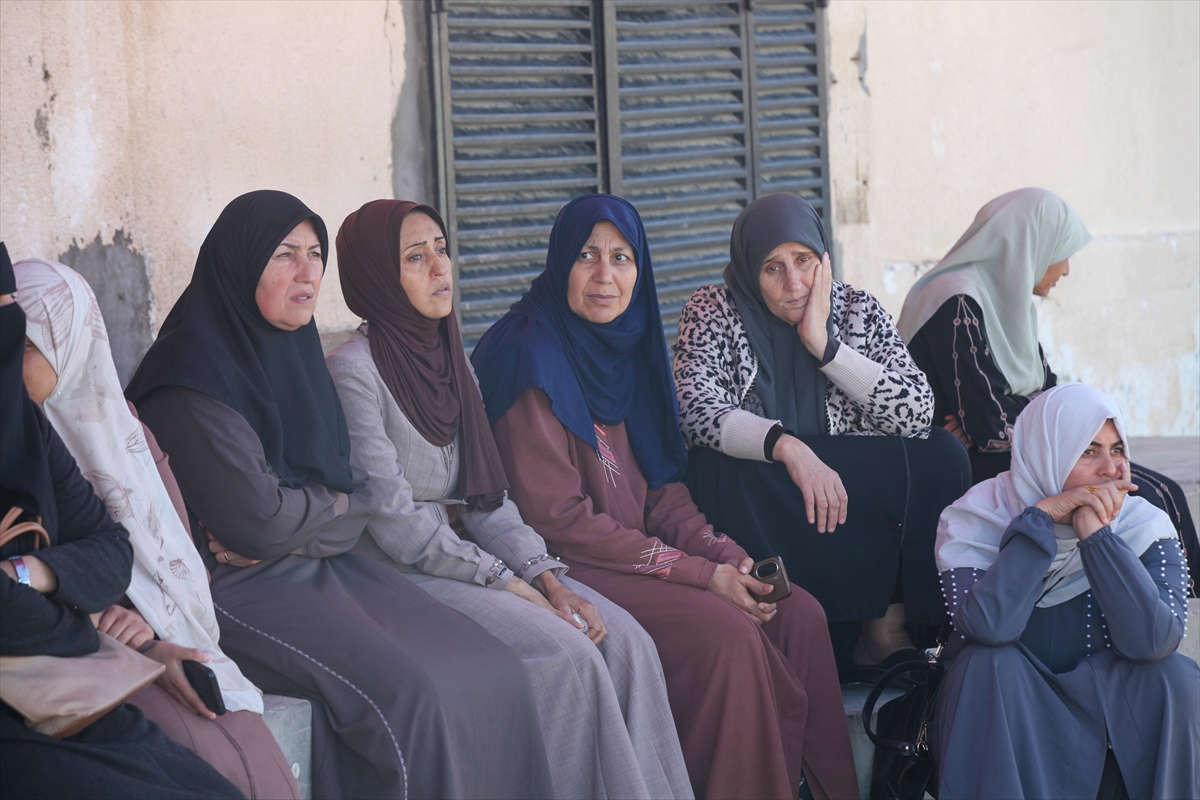
[Photo: Family members of five Palestinians, including three children, killed when a sand dune collapsed onto tents sheltering displaced families following heavy rainfall, attend funeral ceremony as bodies are taken from Al-Aqsa Martyrs Hospital and buried in Gaza City, Gaza, Palestine on November 9, 2026. Photojournalist: Moiz Salhi/AA]