By Middle East Correspondent
LONDON, (The Muslim News): Israeli attacks killed Palestinians in Gaza, while an Israeli rabbi issued a religious ruling permitting the seizure of Palestinian olive crops as violence against farmers intensified across the occupied West Bank. Israel also continued strikes in southern Lebanon, while fighting escalated in Yemen.
Gaza’s Health Ministry said on Friday that at least 466 Palestinians, including 157 children, had died from malnutrition and starvation since 2024, as food shortages continued to threaten the enclave’s most vulnerable residents.
In Gaza, an Israeli quadcopter drone opened fire on Palestinians in the Al-Tawam area, northwest of Gaza City, killing a man after shooting him in the head, local sources told Anadolu.
A young man also died on Friday morning from serious injuries sustained when an Israeli drone struck a gathering of civilians in the Sheikh Radwan neighbourhood of northern Gaza City on Thursday evening, a medical source said.
Four Palestinians, including a woman and a girl, were injured early on Friday when an Israeli helicopter struck a residential building near Bahloul Junction in northern Gaza City, according to medical sources and eyewitnesses.
Gaza’s Health Ministry said Israeli violations of the ceasefire had killed 1,505 Palestinians and injured 5,332 as of Thursday.
Since October 2023, Israel’s war on Gaza has killed more than 74,000 Palestinians and injured over 175,000, according to Palestinian figures, while destroying about 90 per cent of the enclave’s infrastructure.
Starvation and malnutrition
The Health Ministry released its latest hunger-related death toll on World Food Day, October 16, reporting that 189 of those who died were elderly people, representing 40.5 per cent of the total.
The UN declared famine in Gaza in August 2025. More than 1.4 million Palestinians, around 67 per cent of the population, are expected to face crisis-level food insecurity or worse through the end of 2026, the ministry said.
More than 158,000 cases of acute malnutrition were recorded among children under five between 2024 and August 2026. Of these children, 18 per cent suffered from severe acute malnutrition and 12.2 per cent experienced stunted growth.
The ministry estimated that 74,200 children would need treatment for acute malnutrition through April 2027. The mortality rate among children under five rose from 13.6 to 33.4 deaths per 1,000 live births between 2022 and 2025, it added.
Anaemia among pregnant women reached 61 per cent in 2026, compared with 41 per cent before the war. Around 4,000 pregnancy losses were recorded in the first half of 2026, more than three times the number in the preceding six months.
“One in three pregnancies in Gaza is now classified as high-risk,” the ministry said.
Israeli restrictions on crossings tightened in March 2025, leaving thousands of aid trucks waiting to enter Gaza. The government media office said Israel had allowed in only about 34 per cent of the humanitarian aid trucks agreed upon.
After 81 days, Israel permitted 87 aid trucks to enter in late May 2025, according to the office. Deliveries subsequently remained limited and intermittent until February 2026, when a limited increase was allowed under a ceasefire agreement. Palestinian officials said supplies remained insufficient.
The Health Ministry called for the safe, sustained and unrestricted entry of food, nutritional supplements and medicines, prioritising children, pregnant and breastfeeding women, and elderly people. It also urged international support to restore local food production.
Israeli rabbi sanctions seizure of Palestinian olives
Prominent Israeli rabbi Dov Lior issued a religious ruling permitting Israeli settlers to take olives from Palestinian land in the occupied West Bank, claiming that harvesting the crop “demonstrates Jewish ownership of the land”.
The ruling was published by Israeli Channel 13 amid escalating attacks on Palestinian farmers during the annual olive harvest.
Lior argued that Palestinians did not own their land because they had not purchased it from the “people of Israel” or a Jewish person, describing it as “stolen property”.
Citing Jewish religious law, he claimed that ownership could not be transferred through theft and that planting olive trees did not confer ownership of either the land or its produce.
He further argued that Palestinians had already received sufficient compensation by consuming the fruit in previous years, and that the land and harvest should return to what he called their “rightful owners”.
The ruling also permitted the seizure of olive crops from Palestinian areas farther from illegal settlements.
Palestinian, Israeli and international rights organisations have accused Israeli authorities of failing to prevent attacks by settlers or hold perpetrators accountable. Israeli settlements built on occupied Palestinian land are considered illegal under international law.
West Bank attacks injure Palestinians and journalists
At least 12 Palestinians and two foreign journalists were injured in attacks by Israeli settlers across the occupied West Bank on Friday. Four vehicles, including one belonging to the Palestinian Civil Defense, were also set ablaze.
The Palestinian Red Crescent Society, Civil Defense and Palestinian rights group Al-Baydar reported injuries in Abu Falah, Burham, Deir Jarir, Burqa and Turmus Ayya in the Ramallah and Al-Bireh governorate.
In Burham, north of Ramallah, a 70-year-old man was injured in an assault. Three other Palestinians were injured in Deir Jarir, east of Ramallah, and taken to a medical centre, the Red Crescent said.
In Abu Falah, a 63-year-old woman and a 40-year-old man were injured during an attack on farmers harvesting olives and taken to hospital.
Four people were injured in Burqa after occupiers attacked farmers, according to the Red Crescent. Al-Baydar said victims sustained injuries to their heads, backs and hands, while a foreign journalist was pepper-sprayed.
In Turmus Ayya, north of Ramallah, settlers attacked olive pickers and torched three Palestinian vehicles in the Al-Nabaat area, local sources told Anadolu. Warning sirens sounded to alert residents.
American journalist and international solidarity activist Heidi Levine was injured when settlers assaulted her in the presence of Israeli troops, Al-Baydar said. She was taken to Al-Istishari Hospital for treatment.
The Palestinian Civil Defense said one of its members sustained bruises when settlers attacked an emergency crew responding to the fires. Firefighters were assaulted and a Civil Defense vehicle was set alight, the agency added. Volunteers from Abu Falah and Turmus Ayya helped extinguish the fires.
The agency warned that attacks on emergency crews and vehicles threatened efforts to protect lives and property.
Elsewhere, settlers assaulted farmers and forced them off their land in Rammun, east of Ramallah, Al-Baydar said. In Qabalan, south of Nablus, a Palestinian woman was physically assaulted before her olive harvest was stolen.
Similar attacks targeted farmers in eastern Burin and Majdal Bani Fadil, south of Nablus. In Arraba, southwest of Jenin, settlers attacked homes belonging to the Al-Rahhal family, the group reported.
The Palestinian Colonization and Wall Resistance Commission said on Monday that it had documented 136 attacks linked to the olive harvest since the beginning of October. The incidents included beatings, expulsions, intimidation, gunfire, tear gas, arrests, theft of olives and harvesting equipment, and damage to trees.
The October harvest is a vital source of income for thousands of Palestinian families, who face increasing violence and restrictions on access to their land.
Fighting escalates in Yemen
Yemen’s army said on Friday that it had repelled a large-scale Ansar Allah[Houthi] attack south of Taiz after nearly eight hours of fighting, killing at least 16 fighters.
The army’s 22nd Mechanised Brigade said in a Facebook statement that its troops, backed by local resistance fighters, had thwarted an offensive against the eastern and western sectors of the Al-Shaqab front, a key southern approach to Taiz.
Preliminary information indicated that 16 Ansar Allah fighters had been killed and several others injured, the brigade said, adding that the group had made no territorial gains.
The Ansar Allah had not immediately commented.
On Wednesday, the army said more than 200 Ansar Allah fighters had been killed or injured in clashes across Taiz province, including at Al-Shaqab, Al-Aqrud and Dhubab.
Separately, reports from Yemen said three children were killed and at least 17 civilians, including seven children and three women, one of them pregnant, were wounded when a Saudi-led coalition bombardment struck civilian homes in the Dawran Anis district of Dhamar province. The reports said cluster bombs were used.
Israeli attacks continue in southern Lebanon
Israeli forces carried out airstrikes, artillery shelling and demolitions across southern Lebanon on Friday as military vehicles advanced towards the outskirts of Kfar Shuba, according to Lebanon’s National News Agency.
Israeli warplanes struck Mansouri in the Tyre district, while artillery targeted the outskirts of Bint Jbeil and the valleys of Srebbine and Zibqin. Israeli forces also fired towards valleys and wooded areas in Srebbine, the agency said.
In the Nabatieh district, Israeli forces carried out two large, simultaneous explosions in Kfar Tebnit, near a school, and in Zawtar al-Sharqiya towards Nabatieh al-Fawqa.
Artillery also shelled the Jarmaq area in the Jezzine district and the outskirts of Kfar Shuba, where a military bulldozer accompanied by two tanks and several other vehicles advanced towards the town’s southern outskirts.
Separately, an Israeli drone dropped a stun grenade on the outskirts of Khiam. No immediate casualties or damage were reported.
According to Lebanese government figures released on Monday, Israeli attacks had killed 4,389 people and injured 12,424 since March 2.
The attacks have continued despite a US-sponsored framework agreement signed by Beirut and Tel Aviv on June 26, which calls for a gradual Israeli withdrawal from Lebanese territory and the deployment of the Lebanese army.
Israel continues to attack southern Lebanon and occupying many Lebanese areas, some occupied for decades and others seized during more recent military operations.
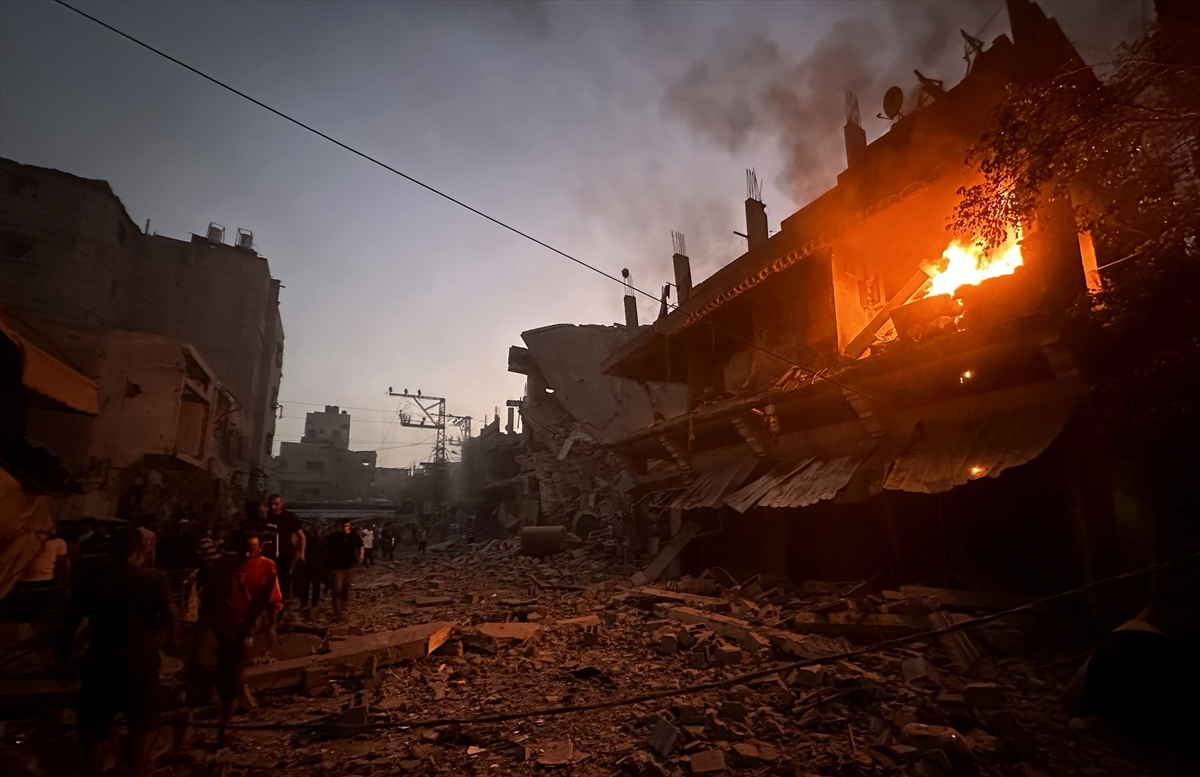
[Photo: Israeli warplanes target two houses despite the ceasefire, causing widespread destruction and a fire at Maghazi Refugee Camp in the central Gaza Strip, Palestine on October 15, 2026. Numerous Palestinians were injured by shrapnel in the attack. Photojournalist: Ahmed Maqadema/AA]