By Home Affairs Correspondent
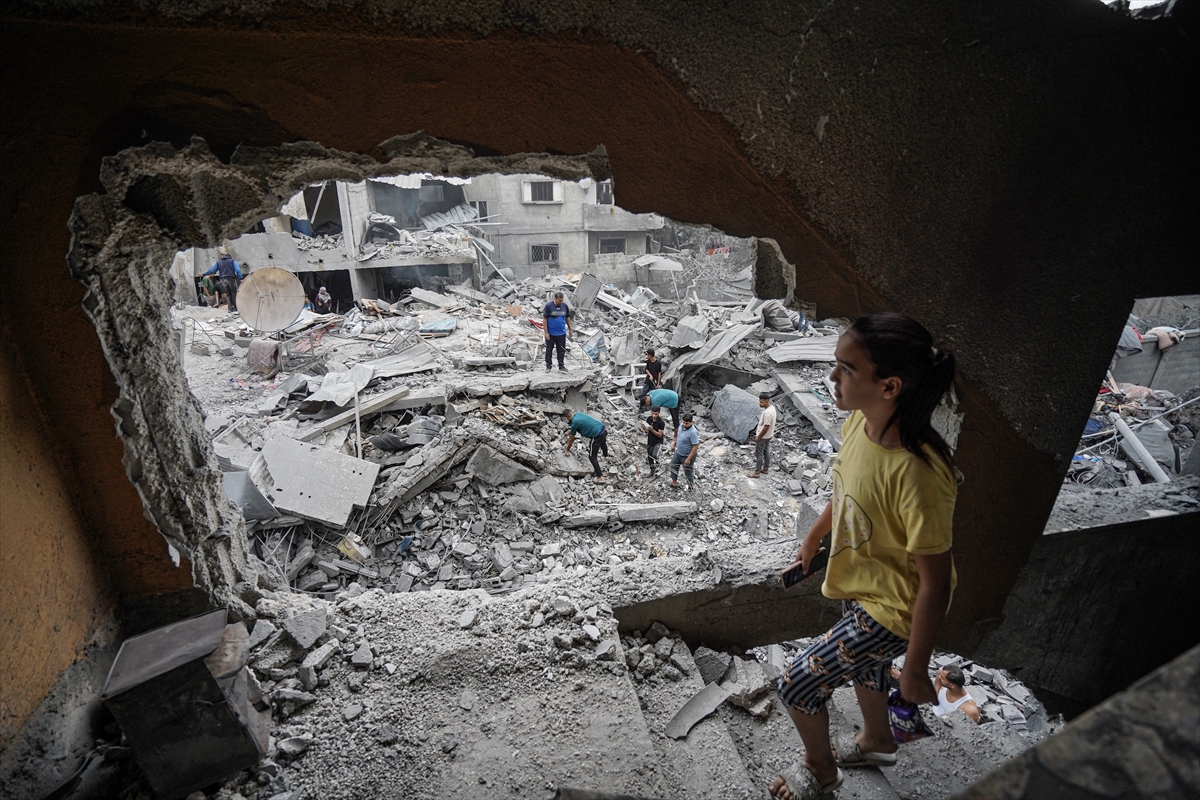
LONDON, (The Muslim News): Three Palestinians were killed and several others injured in an Israeli drone strike on a tent in southern Gaza on Sunday, as Israeli forces continued military operations across the besieged territory despite a ceasefire. Meanwhile, Saudi Arabia reported attacks on two major airports, Yemen’s army launched strikes against Ansar Allah [Houthi] positions and Iran said Washington’s response to its conditions for reopening the Strait of Hormuz was insufficient.
A medical source at Nasser Hospital said the bodies of three Palestinians and several wounded people were brought to the facility after an Israeli drone strike near the hospital in the al-Buraq area of Khan Younis.
Witnesses told Anadolu that the drone fired at least one missile at a tent being used as a mobile phone charging point.
Earlier on Sunday, a medical source at al-Shifa Hospital said six-year-old Jihad Iyad al-Ghandour had died from serious wounds sustained on Saturday when Israeli soldiers opened fire in Jabalia refugee camp in northern Gaza.
Separately, Israeli forces expanded their area of control in eastern Gaza City, injuring two Palestinians, including a pregnant woman, and forcing dozens of families to flee their homes, according to local Palestinian sources.
The sources told Anadolu that Israeli military vehicles advanced tens of metres beyond their existing positions in the Shujaiya neighbourhood overnight from Saturday into Sunday, under cover of heavy gunfire and artillery shelling.
The troops were accompanied by armed Palestinian militias cooperating with and supported by the Israeli army, while quadcopter drones provided cover, the sources said.
Israeli forces fired heavily across the area stretching from the vegetable market in the east to the Shujaiya intersection on Salah al-Din Street in the west.
For about a week, eastern areas of Gaza, particularly parts of the Tuffah and Shujaiya neighbourhoods, have experienced nighttime demolitions, gunfire, heavy artillery shelling and military vehicle movements near the so-called yellow line.
The line separates areas occupied by Israeli forces in the east from areas where Palestinians are permitted to remain in the west.
The latest incidents came amid continuing violations of the ceasefire agreement that took effect on 10 October 2025, days after the third anniversary of the start of Israel’s war on Gaza.
Israeli ceasefire violations have killed 1,488 Palestinians and injured 5,281 as of Sunday, according to the latest figures from Gaza’s Health Ministry.
Since the war began in October 2023, more than 74,000 Palestinians have been killed and over 175,000 injured, while around 90 per cent of Gaza’s infrastructure has been destroyed, the ministry said.
Saudi Arabia reports attacks on two airports and oil facilities
Saudi Arabia said on Sunday evening that King Fahd International Airport in Dammam, in the kingdom’s Eastern Province, had come under attack as Yemen’s Ansar Allah group claimed responsibility for strikes targeting two Saudi airports and major oil facilities.
The Saudi General Authority of Civil Aviation said damage assessments and safety inspections were under way at King Fahd International Airport in coordination with the relevant authorities.
It provided no immediate details about casualties or the extent of the damage, saying the incident came amid continued attacks on civilian aviation facilities in the kingdom.
The Saudi-led coalition separately said on X, the US social media platform, that air defences had intercepted and destroyed a drone in the Eastern Province.
Earlier on Sunday, the aviation authority reported another attack on King Khalid International Airport in Riyadh, saying it had caused injuries without specifying their number or severity.
Ansar Allah military spokesman Yahya Saree claimed responsibility for the attack on King Fahd International Airport in a televised statement, saying the strike had directly hit its target and disrupted air traffic.
Saree also claimed attacks on King Khalid International Airport, Saudi oil giant Aramco’s Shedgum gas plant and its Tanajib oil facility in the Eastern Province.
He said the operations were carried out in retaliation for Saudi airstrikes on Yemen and threatened further attacks on the kingdom.
The claims concerning the targets and the extent of the damage were not independently verified in the reports provided.
Yemeni army launches strikes against Ansar Allah positions
Meanwhile, Yemen’s army said it had launched a series of airstrikes against Ansar Allah positions and military vehicles in several areas of Taiz province in southwestern Yemen and Marib province in the centre of the country, inflicting casualties, and destroying vehicles.
State-run Saba TV reported that the army carried out concentrated strikes against Ansar Allah positions and military vehicles on fronts south and southwest of Marib.
The strikes destroyed or disabled several combat vehicles and inflicted losses in personnel and equipment, the channel said, without providing figures.
In Taiz, the army’s media centre for the al-Aqroud front said government forces had regained full control of Mahyoub Thabet and Watheeb hills in al-Dhunayb village, in the southern part of the province.
The advance inflicted heavy losses on Ansar Allah forces, the centre said, without providing further details.
In a separate statement, it said army forces and allied Popular Resistance fighters had also recaptured al-Furqan school in al-Dhunayb village on the same front.
September Net, a website affiliated with Yemen’s Defence Ministry, reported that army warplanes had carried out several airstrikes against Ansar Allah positions, deployments and vehicles west, east and north of Taiz city.
The reported targets included Ansar Allah gatherings in the al-Siyahi area west of the city, positions in al-Hawban and on Sixty Street to the north, and a position on Sofitel hill to the east containing a tank and artillery pieces.
The strikes also hit Ansar Allah positions on al-Jaasha hill and in the al-Maqrami area east of the city, the website said.
It reported casualties among Ansar Allah fighters and the destruction of several vehicles but did not specify the number of people killed or injured or the number of vehicles destroyed.
Taiz Governor Nabil Shamsan called for urgent national and international action to address the humanitarian consequences of the military escalation and end the siege imposed by the Houthis on the province for nearly 12 years.
Separately, Yemen’s Information Ministry accused the Houthis of firing missiles at al-Saeed Mosque in central Taiz while worshippers were inside.
In a statement posted on X, the ministry described the reported attack as a “flagrant violation of the sanctity of mosques and a direct threat to civilian lives”.
The Ansar Allah had not commented on the reported developments at the time of publication.
Iran rejects US response to seven conditions for reopening Strait of Hormuz
Iran considers Washington’s response to its seven conditions for reopening the Strait of Hormuz “insufficient”, a senior Iranian official said, according to the semi-official Tasnim News Agency.
Mohsen Rezaei, secretary of Iran’s Supreme National Security Council, said the US had accepted some of Tehran’s conditions but left others unclear.
He said Washington had approached Tehran over the previous two months through three channels — Pakistan, Qatar and Iraq — asking Iran to submit its proposals.
About two weeks ago, Iran conveyed seven conditions to the US, explicitly stating that the Strait of Hormuz would not reopen to Washington and negotiations would not take place until those conditions were met, Rezaei said.
He added that Tehran was no longer waiting to respond to Washington because the US had already submitted its response, which Iran considered insufficient.
“They must clarify the issues that remain ambiguous to us,” he said.
The report did not detail all seven conditions or specify which ones Washington had accepted.
Rezaei said the Gulf could not be secure without Iran’s management of the Strait of Hormuz, describing control over the strategic waterway as an “immense source of national wealth and a major national asset”.
He said Iran’s interests extended beyond closing the passage and collecting transit fees.
Iranian Foreign Minister Abbas Araghchi said in late September that Tehran could reopen the strategic waterway within seven days if Washington accepted a proposal conveyed through Qatari mediation.
Under the plan, the US would take agreed steps during the first four or five days, allowing normal navigation through the strait to resume on the sixth day and negotiations on a final agreement to begin on the seventh.
Tehran’s demands include an end to hostilities, the release of frozen Iranian assets, the lifting of restrictions on Iranian oil exports and an end to the US naval blockade on Iranian ports.
Iran has kept the Strait of Hormuz restricted while demanding that Washington fulfil commitments under a June memorandum of understanding. Tehran has said the waterway will not fully reopen until its conditions are met and US commitments are implemented.
The US and Israel launched a war against Iran on 28 February. Tehran responded with missile and drone attacks across the region and effectively closed the Strait of Hormuz, while Washington later imposed a naval blockade on Iranian ports.
Washington and Tehran subsequently signed a memorandum of understanding in June concerning freedom of navigation through the strait, but implementation stalled amid disagreements over security in the strategic waterway.
[Photo: People search through the rubble of a building belonging to the Buheysi family following an Israeli airstrike in the town of Az-Zawayda, near Deir al-Balah in the central Gaza Strip, on October 11, 2026. Israeli forces carried out the strike despite the ceasefire, destroying the building and damaging surrounding structures. Photojournalist: Adam Bilal/AA]