By Abdul Adil
London, (The Muslim News): Four Palestinians, including two women and a child, were killed and eight others wounded in Israeli attacks across the Gaza Strip on Saturday, medical sources told Anadolu, as violence continued despite a ceasefire agreement that took effect on October 10, 2025.
The attacks came amid renewed concerns over the humanitarian situation in Gaza and escalating Israeli military operations in the occupied West Bank, where thousands of Palestinians face the threat of displacement.
A Palestinian child died from wounds sustained in Israeli army gunfire in Deir al-Balah, in central Gaza. In the south, a Palestinian woman was killed by Israeli gunfire west of Khan Younis.
In northern Gaza, Fatima Abu Laban was killed by Israeli gunfire in the Tal al-Dhahab area of Beit Lahia. Another woman was wounded in the neck by gunfire in the same area.
Mohammad Anan al-Rawagh, a young Palestinian, was killed in an Israeli strike on the al-Rimal neighbourhood west of Gaza City. Three other people were wounded, one seriously.
Three Palestinians were also injured when Israeli military vehicles opened fire east of Deir al-Balah and al-Maghazi refugee camp. Two others sustained shrapnel wounds from a bomb dropped by an Israeli drone east of al-Musaddar village.
Witnesses reported that an Israeli drone fired at least one missile near Palestine Stadium in al-Rimal. Early Saturday, Israeli drones dropped explosive boxes on homes evacuated by residents in the al-Tuffah neighbourhood east of Gaza City, while military vehicles opened heavy fire in the surrounding area.
Israeli naval vessels also fired gunshots and shells towards Gaza City’s coastline. No injuries were reported in that incident.
Since October 2023, Israel’s war on Gaza has killed more than 74,000 Palestinians and wounded over 175,000, according to figures cited in the report. The conflict has caused widespread destruction, affecting approximately 90% of the territory’s civilian infrastructure. More than 1,500 people have reportedly been killed since the ceasefire began.
Israeli offensive in Hebron forces families from their homes
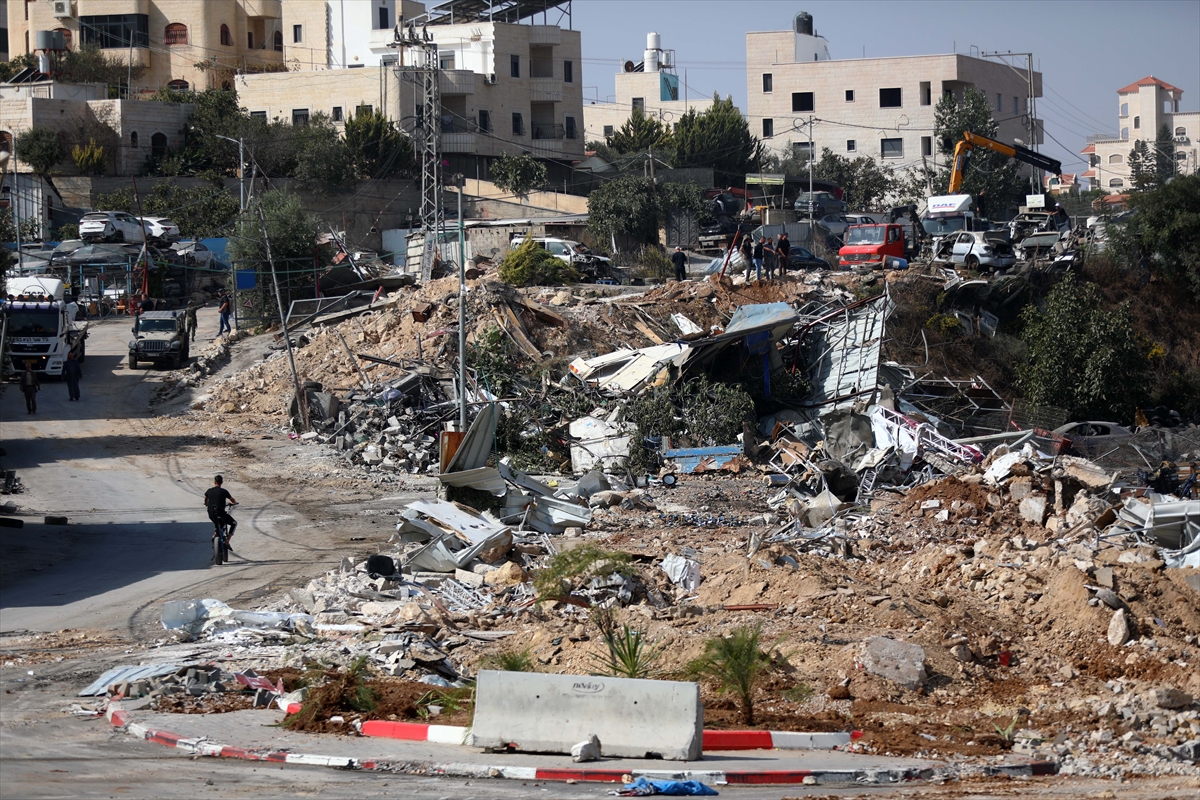
Meanwhile, Israeli forces have forced approximately 1,500 Palestinians from 250 families to leave their homes in Hebron, in the southern occupied West Bank, since Friday, with another 2,500 people reportedly facing displacement in the coming hours, the municipality said Saturday.
The displaced families lived in the Deir Bahha and al-Jilda neighbourhoods, which together are home to approximately 500 families, according to the municipality.
Israeli forces marked evacuated homes and distributed notices instructing remaining residents to leave without taking their vehicles, the municipality said.
The Israeli army continued its siege of Hebron for a second consecutive day on Saturday, following a military operation launched on Friday. The measures included closing main entrances and roads connecting the city to surrounding areas, deploying military vehicles and bulldozers, and conducting raids and searches of homes.
The closure followed an incident in which two Palestinians opened fire at an Israeli checkpoint. Both attackers and two Israeli soldiers were killed, while three other Israeli soldiers were wounded, according to Israeli figures.
Israeli Prime Minister Benjamin Netanyahu said Friday, during an incursion into Hebron, that the army was preparing a large-scale military offensive in the occupied West Bank that would involve displacing Palestinians from neighbourhoods and raiding their homes.
Netanyahu said Israel would apply a military model previously used during operations in refugee camps in the northern West Bank.
The Palestinian Foreign Ministry condemned the threats, warning that plans to evacuate and demolish neighbourhoods could amount to an attempt to repeat the Nakba and carry out ethnic cleansing. The ministry urged Palestinian diplomatic missions to press governments internationally to take firm action against Israeli measures.
The occupied West Bank, including East Jerusalem, has witnessed escalating military operations, settler violence, demolitions and displacement since the war on Gaza began in October 2023. Palestinians warn that these measures could pave the way for the annexation of further territory and undermine prospects for an independent Palestinian state.
Illegal Israeli settler attacks target Palestinian workers and farmers
In separate incidents, Israeli settlers attacked Palestinian workers at a cactus farm in Khirbet Soba, west of Hebron, early Saturday, injuring several people, local sources said.
The sources added that Israeli forces prevented an ambulance from reaching the injured workers.
Settlers also attacked Palestinian farmers harvesting olives in Wadi al-Ahmar, east of Marda village, north of Salfit.
According to local sources, dozens of settlers damaged a farmer’s vehicle, forced farmers off their land and prevented them from continuing the harvest.
The incidents come amid continuing reports of settler attacks on Palestinian communities, agricultural land and property across the occupied West Bank.
Trump says US could strike Iran as Tehran warns of retaliation
Regional tensions also intensified after US President Donald Trump said Washington could launch another attack on Iran as soon as Sunday, October 25, or reach an agreement with Tehran.
Asked about the possibility of military action, Trump told reporters that the United States was considering it, adding that Iran could still avoid further strikes by reaching what he described as a major agreement.
Trump said his objective was to prevent Iran from developing a nuclear weapon and argued that previous US military operations had not guaranteed a permanent outcome.
He also claimed that oil shipments through the Strait of Hormuz had increased compared with levels before the war, without providing figures.
Trump did not announce a final decision, saying that either further military action or a negotiated agreement remained possible.
Iran’s Islamic Revolutionary Guard Corps warned Saturday that even a limited attack would trigger a response several times greater than the initial action, according to the Fars news agency.
IRGC spokesman Hossein Mohebbi dismissed what he described as hostile rhetoric, arguing that those threatening Iran would be unable to achieve their objectives under current circumstances.
He said Iran’s armed forces were prepared to respond and that any renewed military operation against the country would end in defeat for its adversaries.
The warnings followed remarks by US Ambassador to Türkiye Tom Barrack, who said Washington could strike Iran as soon as the weekend. Trump subsequently said he was unaware of his ambassador’s comments.
US media reports have also indicated that Washington and Israel have developed plans for possible strikes on Iran following the November 3 US midterm elections.
The conflict, which began with US-Israeli illegal strikes in February, remains unresolved despite a ceasefire and efforts to finalise a peace agreement. Disagreements over navigation through the Strait of Hormuz remain among the reported obstacles to a settlement.
Washington warns citizens against travel to Iraq
Against the backdrop of heightened regional tensions, the US State Department renewed its warning against travel to Iraq, advising American citizens not to visit the country for any reason.
The advisory, updated on Friday and published by the US Embassy in Iraq on Saturday, cited risks including armed conflict, terrorism and kidnapping.
The department warned that the Iraqi government could not guarantee the safety of US citizens during sudden outbreaks of violence and said Washington’s ability to provide emergency assistance was limited by security conditions.
The advisory cited attacks involving explosive devices, projectiles and drones, including incidents targeting hotels, universities, energy infrastructure, airports and diplomatic facilities.
It also highlighted restrictions and warnings issued by the US Federal Aviation Administration concerning flights in or near Iraqi airspace.
The warning comes amid reports of possible further US-Israeli military action against Iran and uncertainty over the timing of any escalation.
Ansar Allah claim attacks on Saudi Airports and oil facilities
Meanwhile, Yemen’s Ansar Allah [Houthi] group claimed Saturday that it had carried out seven military operations involving ballistic missiles and drones against airports, oil facilities and a military air base in Saudi Arabia.
The group said the operations targeted King Khalid International Airport in Riyadh, facilities belonging to Saudi oil giant Aramco in Yanbu and the Rabigh oil refinery.
It also claimed to have targeted crude oil pumping stations and the East-West oil pipeline, which transports oil from eastern Saudi Arabia to the Red Sea coast.
Other claimed targets included King Fahd International Airport in Dammam, Najran airport and the Khamis Mushait air base.
Ansar Allah said the attacks were retaliation for Saudi airstrikes in Yemen, alleging that approximately 100 strikes had hit civilian sites in Sana’a and other areas under their control over the preceding 24 hours, killing and injuring dozens. These claims were not independently verified in the report.
Saudi Civil Defense, meanwhile, said two Ansar Allah ballistic missiles targeting the Makkah and Madinah regions had been intercepted, with debris falling in four locations.
The agency claimed that fragments fell in Wadi al-Mughammas in Makkah, while interception debris landed in Jeddah’s al-Nuzha district, Wadi Jalil in Taif and Masturah in Rabigh.
Saudi media reported that fragments from one missile fell near the Arafat holy site, approximately 23 kilometres from the Grand Mosque in Makkah.
Ansar Allah military spokesman Yahya Saree denied that the group had targeted holy sites in Makkah or Madinah, saying its operations were directed at oil facilities and military bases.
Earlier Saturday, the Saudi-led coalition in Yemen said it had intercepted and destroyed two Ansar Allah ballistic missiles targeting Taif and Yanbu.
Ansar Allah has controlled Sana’a and other parts of Yemen since 2014. Saudi Arabia has led a military coalition supporting Yemen’s government against the group since 2015.
The latest escalation began in July following the collapse of a ceasefire that had been in place since 2022.
[Photo: A general view of the rubble of Palestinian homes and structures demolished by Israeli army heavy machinery in the Farsh Al Hawa area of Hebron, West Bank, Palestine on Saturday, October 24, 2026. The demolitions followed a deadly shootout at the local checkpoint involving two Palestinians and two Israeli soldiers, leading to a total lockdown of Hebron and surrounding communities. Photojournalist: Wisam Hashlamoun/AA]