By Middle East Correspondent
LONDON, (The Muslim News): Israeli strikes and gunfire killed four Palestinians, including a girl, and injured at least 19 others across the Gaza Strip on Thursday, according to medical sources and the Palestinian Red Crescent Society, despite a ceasefire agreement.
In the occupied West Bank, Israeli settlers set fire to olive trees and Israeli soldiers forced Palestinian farmers off their land as the UN warned that attacks and access restrictions were preventing families from harvesting their crops.
Meanwhile, US President Donald Trump threatened further military action against Iran, saying Washington had already inflicted heavy damage and “may do it a little bit further”.
The New York Times reported that US and Israeli militaries had drawn up plans for renewed strikes after the US midterm elections.
In the latest violence in Gaza, a Palestinian was killed when an Israeli drone struck an electric bicycle west of the Nuseirat refugee camp in the central Gaza Strip, a medical source said.
Another Palestinian was killed and others injured, one seriously, when an Israeli drone struck a civilian vehicle in the Tel al-Hawa neighbourhood southwest of Gaza City.
In the northern Gaza Strip, Israeli forces shot and killed a Palestinian girl in the head in Jabalia, according to a medical source cited by Anadolu. In southern Gaza, another Palestinian was killed and two others injured when an Israeli drone struck a motorcycle in Khan Younis.
Four members of a displaced family were injured when Israeli artillery fire hit Mustafa Hafez School, which was sheltering displaced Palestinians.
A medical source at Nasser Hospital said a man, his wife and their two children arrived with injuries of varying severity after an artillery shell struck their tent in the school’s courtyard.
The Palestinian Red Crescent Society said 13 Palestinians were injured in a separate Israeli strike targeting a gathering in the Ard al-Shanti area north of Gaza City.
Witnesses reported heavy fire from Israeli military vehicles towards homes and tents sheltering displaced people east of Hamad City in Khan Younis.
In Gaza City, an Israeli helicopter struck an empty apartment in the Rimal neighbourhood, while a drone targeted an evacuated house in the Nasr neighbourhood that had previously been damaged by Israeli bombardment, witnesses said.
Israeli forces also continued demolishing residential buildings in the eastern Gaza City neighbourhoods of Tuffah and Shujaiya. Residents reported two powerful explosions from demolition operations overnight and early Thursday, while Israeli artillery shelled the area around the Al-Sanafour junction east of Tuffah amid heavy gunfire from nearby military vehicles.
The attacks came despite a ceasefire agreement that took effect on October 10, 2025. Gaza’s Health Ministry said Israeli violations since the agreement began had killed 1,538 Palestinians and injured 5,498 others.
Since October 2023, Israeli attacks have killed more than 74,000 Palestinians and injured over 175,000 in Gaza, according to figures cited in the report. Around 90 per cent of the enclave’s civilian infrastructure has been destroyed.
UN warns over West Bank olive harvest attacks
In the occupied West Bank, Israeli settlers set fire to olive trees in the Al-Shabaat area on land belonging to the village of Imatin, east of Qalqilya, on Thursday, according to local sources cited by Anadolu.
In the same area, Israeli soldiers forced Palestinian farmers harvesting olives in Al-Jabal to leave their land and detained a landowner and his workers, the sources said.
The Palestinian Colonization and Wall Resistance Commission documented 409 attacks targeting olive farmers, trees, farmland and agricultural equipment across the West Bank between October 1 and 21. It attributed 317 incidents to Israeli occupiers and 92 to the Israeli army.
The UN warned on Thursday that recurring attacks and Israeli access restrictions were preventing Palestinians from safely harvesting their olives, undermining food security and threatening the livelihoods of farming families.
UN spokesperson Stéphane Dujarric said Acting Special Coordinator Ramiz Alakbarov had travelled to Jenin with diplomats from 13 member states to examine the challenges facing Palestinian farmers and the prolonged displacement of Palestinian communities.
In the village of Arraba, the delegation heard from farmers about repeated attacks by Israeli settlers and restrictions on access to their land.
“In the village of Arraba, they heard from farmers growing olives about recurrent settler attacks, which, combined with Israeli access restrictions, are undermining food security,” Dujarric told reporters.
Humanitarian partners briefed the delegation on efforts to protect olive pickers, including accompanying them to groves and providing legal assistance to challenge Israeli-imposed access restrictions.
Dujarric said Alakbarov had stressed that the harvest season should be a time of celebration, noting that up to 100,000 Palestinian households depend on olives for their livelihoods. Many families, however, were being prevented from collecting their crops safely.
“He said that crimes committed against them must stop, and the perpetrators must be held to account by the Israeli authorities,” Dujarric said.
The delegation also visited a clinic in Qabatiya, where diplomats met Palestinians who have been prevented by Israeli authorities from returning to Jenin refugee camp since early 2025. Many of their homes have been destroyed.
Alakbarov called for additional funding to help humanitarian organisations support displaced Palestinians and urged Israeli authorities to allow their safe and dignified return, according to Dujarric.
The visit followed an attack on a delegation that included European diplomats and Catholic Church officials near Taybeh, east of Ramallah, according to the Palestinian Foreign Ministry.
Israeli Army Radio reported that seven masked attackers surrounded a diplomatic vehicle and smashed a window of a Belgian consular car. Israeli troops and police reportedly took three hours to arrive.
The Israeli military described the incident as a “serious violent incident”, while saying the delegation had not coordinated its visit in advance and that no troops were present at the scene.
The Palestinian Colonization and Wall Resistance Commission also reported 40 attacks and violations against farmers, farmland and olive crops in a single day the previous weekend.
Since Israel’s war on Gaza began in October 2023, Israeli forces and settlers have intensified attacks on Palestinians and their property across the occupied West Bank, including East Jerusalem.
Trump threatens further strikes on Iran
Trump signalled the possibility of further US military action against Iran on Thursday, saying previous presidents should have acted sooner.
“This should have been done a long time ago by other presidents, the Iran war, and we’ve knocked the hell out of them, and we may do it a little bit further,” Trump told reporters at the White House before departing for a campaign rally in Iowa.
Asked about public reaction to the war, Trump said: “Well, in one way they love it because I’m doing what should have been done by other presidents. In another way, maybe they don’t.”
“There’s a price to pay, which I knew immediately when I did it. But we can’t let Iran have a nuclear weapon,” he added.
On Wednesday, Trump said Washington was not negotiating with Tehran and that “something one way or the other” would happen “fairly soon”.
The New York Times reported that US and Israeli militaries had developed plans for renewed strikes on Iran after the US midterm elections, although it said it remained uncertain whether Trump would approve them.
The United States and Israel launched their war against Iran on February 28. Tehran responded with missile and drone attacks across the region and effectively closed the Strait of Hormuz, a key route for global energy supplies.
A memorandum of understanding was signed in June to pave the way for a final peace deal, but it collapsed amid disagreements, including over navigation through the strait.
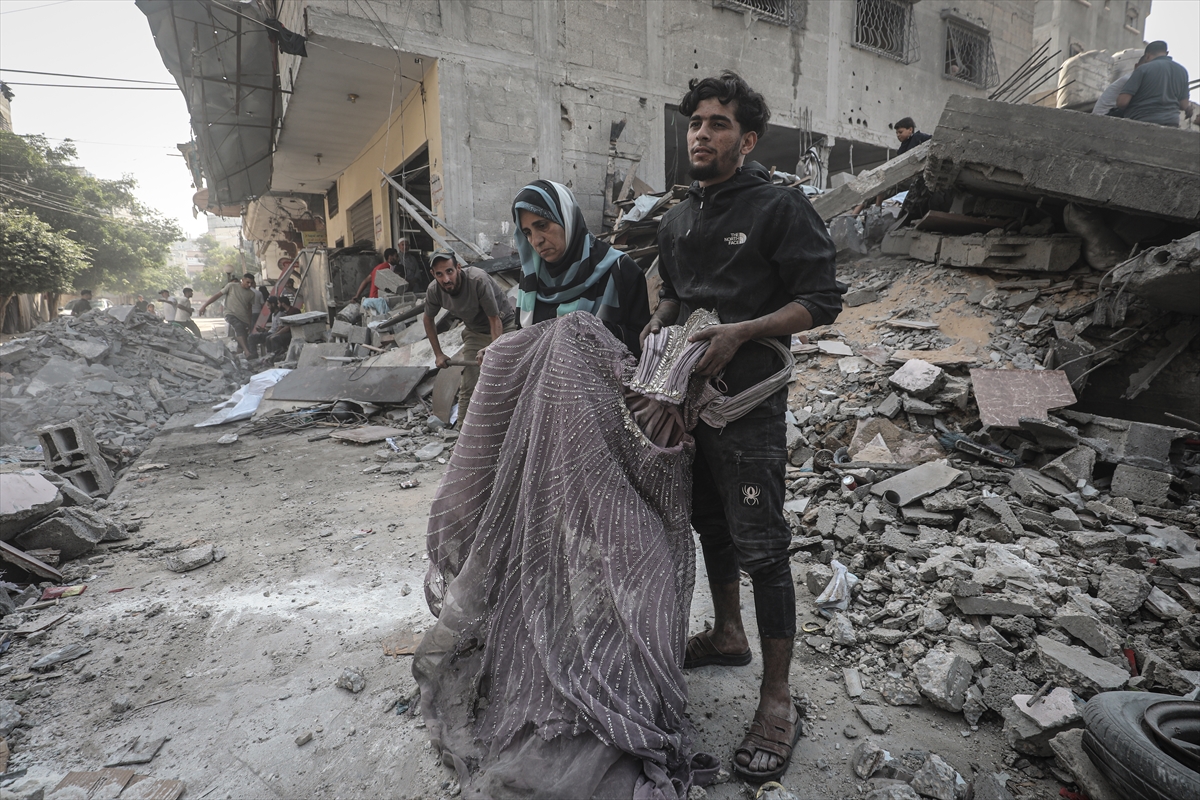
[Photo: The home of Ibrahim Muhammad Hamad, who was preparing to get married next month in Gaza, is reduced to rubble by an Israeli attack in Nuseritat camp, near Deir al Balah, Gaza, Palestine on October 23, 2026. Hamad, who lives in the Nuseirat camp in the central Gaza Strip, had built the home by himself, hoping to move in after getting married.
Photojournalist: Moiz Salhi/AA]