By Ahmed J Versi and Middle East Staff
Whitehall, (The Muslim News): The British government has formally shut the door on the prospect of sanctions against Israel, despite a sharp escalation in regional violence and a documented surge in breaches of the current ceasefire agreement.
Number 10 is sticking fast to its policy of “quiet diplomacy” following a bloody 48-hour window in which more than 40 Palestinians were killed. When challenged by The Muslim News regarding near-daily military incursions and the rising death toll, a spokesperson for the Prime Minister insisted the government’s position remains unchanged.
“The prime minister’s position hasn’t changed, which is that he wants the ceasefire to hold and peace, a lasting peace, to be achieved,” the spokesperson said, adding that the UK would continue to work alongside international partners, including the United States.
When pressed on whether the UK would introduce any punitive measures in response to repeated killings of Palestinians and violations of the truce, the spokesperson declined to do so, reiterating: “Our focus is very much on securing a lasting peace in the region… working with international partners, including the US.”
These comments from Whitehall come as Israeli attacks continue across the Gaza Strip in the face of the agreed-upon cessation of hostilities. Medical sources confirmed that four Palestinians, including a three-year-old child, were killed on Monday, with several others wounded in strikes targeting displacement tents and shelters.
The toddler was killed when Israeli naval gunboats shelled tents housing displaced civilians along the coast of the al-Iqlimi area of al-Mawasi, west of Khan Younis.
The violence has extended into northern Gaza, where an Israeli quadcopter drone struck a school sheltering displaced families in Jabalia, killing one Palestinian and critically wounding another, while a young man was shot dead by Israeli forces in the same town.
Another Palestinian was killed by gunfire southwest of Khan Younis, in an area outside Israeli military control, as witnesses reported heavy gunfire from military vehicles positioned east of the so-called “Yellow Line.”
This boundary was intended to be temporary under the first phase of the October 10 ceasefire agreement, yet Israeli forces have since been observed carrying out demolition operations in Rafah and central Gaza.
Estimates suggest hundreds of ceasefire violations have occurred since the agreement, resulting in the deaths and wounding of hundreds of Palestinian civilians. These breaches persist despite a US announcement in January that the second phase of the ceasefire had commenced, a phase that was to include further Israeli withdrawals and the launch of reconstruction efforts estimated by the UN to cost approximately $70 billion.
Since October 2023, the offensive has killed more than 71,000 Palestinians and destroyed around 90% of Gaza’s infrastructure.
The humanitarian crisis is further compounded by reports from Palestinian prisoners’ rights groups regarding the death of 67-year-old Khaled al-Saifi. Al-Saifi, a prominent cultural figure from Bethlehem, died just a week after being released from four months of administrative detention in critical condition.
Groups allege he was released only after his health severely deteriorated due to abuse and medical neglect, describing his death as a “slow execution.” His passing adds to a toll of more than 100 Palestinian detainees who have died in Israeli custody since the start of the war amid reports of torture and starvation.
Simultaneously, the occupied West Bank has seen armed Israeli settlers attack homes in Khirbet al-Kharaba under military protection, while in Bethlehem’s al-Khader town, Israeli bulldozers uprooted around 200 mature grapevines in what local officials’ term systematic colonial expansion.
UNIFIL denounces Israel for dropping chemical substance in southern Lebanon
This regional volatility has also drawn condemnation from the UN peacekeeping mission in Lebanon (UNIFIL), which recently denounced the Israeli army for dropping a chemical substance in southern Lebanon. The mission called the action “unacceptable” and a violation of UN Security Council Resolution 1701, noting that the incident forced a nine-hour suspension of peacekeeping activities while further strikes in the area claimed another life.
Despite Israel being required to withdraw under the ceasefire that ended more than a year of fighting, it continues to occupy five Lebanese hilltops.
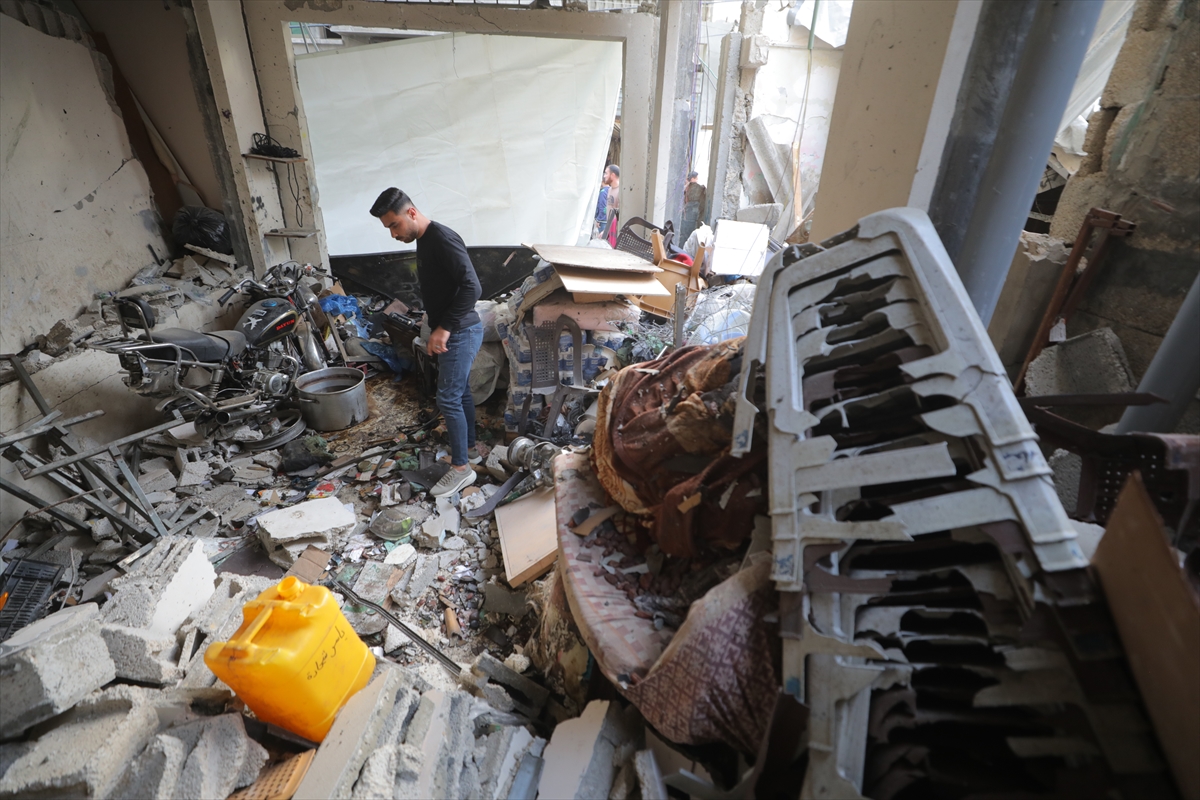
[Photo: Palestinians inspect the damaged area for their belongings from the rubble after the Israeli strikes hit a makeshift tent at the Nuseirat Refugee Camp, killing at least two people and wounding many others, including children, on February 2, 2026, in Gaza City, Gaza. Photojournalist: Hassan Jedi/AA]