By Middle East Correspondent
LONDON, (The Muslim News): At least 51 people were killed on Friday amid a wave of deadly attacks across the Middle East, as Israel intensified strikes in Lebanon, US-Israeli air raids targeted Iran, and Iran launched missile attacks on Israeli territory. Total number of Iranians killed by US-Israel bombings have increased to 1,230 and 217 killed, 798 injured in Lebanon by Israel bombings. Incidents across Iraq and the Gulf underscore the rapid escalation and growing risk of a wider regional conflict.
DEADLY STRIKES IN LEBANON
Lebanon bore some of the heaviest casualties. According to the Lebanese National News Agency (NNA), nine people—mostly women and children—were killed in an Israeli airstrike on a home in Majdal Selm, southern Lebanon. The victims were members of the Saleh family, with several others injured.
Earlier on Friday, 19 more people were killed in separate Israeli strikes across Lebanon, which also destroyed residential and religious buildings. The bombardments have triggered widespread displacement, including in Beirut and southern towns, as air raids continue across the country.
In a related incident, members of the Ghanaian contingent serving with the UN Interim Force in Lebanon (UNIFIL) were injured after an Israeli strike hit their position in Qouzah, in the Bint Jbeil district. The exact number of injured peacekeepers has not been confirmed, and UNIFIL had not yet issued a statement.
Established in 1978 following Israel’s invasion of southern Lebanon, UNIFIL was significantly expanded after the 2006 war under UN Security Council Resolution 1701. More than 10,000 peacekeepers are currently deployed to monitor the cessation of hostilities and assist the Lebanese army in extending its authority south of the Litani River.
Despite a ceasefire agreement with Hezbollah since November 2024, Israel’s offensive in Lebanon — which began in October 2023 and escalated into full-scale war in September 2024 — has already killed over 4,000 people and wounded approximately 17,000, with near-daily Israeli violations continuing to claim lives.
HEZBOLLAH COUNTERATTACKS
Hezbollah responded to the intensifying Israeli campaign with a series of coordinated attacks on Friday. The group reported 18 drone and rocket strikes on Israeli military sites in northern Israel and on Israeli forces operating in southern Lebanon, describing the operations as “in response to Israeli aggression targeting dozens of Lebanese towns and cities, including Beirut’s southern suburbs.”
Among the attacks, Hezbollah launched a swarm of suicide drones at the Ktsavia base in the occupied Syrian Golan, targeted the Ammiad base south of Safed, and fired a guided missile at Israeli soldiers at the newly established Blat site in southern Lebanon, claiming a “direct hit.” Rocket barrages also struck Israeli army positions at the Markaba site in southern Lebanon and the Malkia military site in northern Israel.
Additional attacks targeted five Israeli settlements in northern Israel — Shomera, Kiryat Shmona, Ramot Naftali, Malkia, and Sasa—as well as Israeli military vehicle concentrations in southern Lebanon and the Wadi al-Asafir area near Khiam. Hezbollah claimed direct hits on advancing Israeli forces in Wadi al-Asafir, forcing them to retreat.
Further operations included rocket strikes on the Haifa naval base and Israeli troop concentrations in Metula, Manara, Marj, and Tellet al-Ajl. The group also targeted positions in Wadi al-Asafir, Talat al-Hamamis, the Kfar Kila gate, Markaba, and the Ruwaysat al-Alam site in the occupied Lebanese hills of Kfar Shouba.
Hezbollah issued a warning for Israelis to evacuate 23 settlements near the Lebanese border and move at least five kilometres south, responding to Israeli evacuation orders for Lebanese residents in recent days. The Israeli military reported eight soldiers wounded by rocket fire from southern Lebanon, several seriously.
ESCALATION BETWEEN IRAN AND ISRAEL
The conflict has widened into direct exchanges between Iran and Israel. Iranian state media reported that the Islamic Revolutionary Guard Corps (IRGC) launched a new wave of missile attacks on Israeli territory. Israel confirmed detecting the launches, with air defence systems reportedly intercepting the projectiles, while sirens warning of missile and rocket fire were activated in Samaria, Sharon, and the Jordan Valley.
Meanwhile, US-Israeli airstrikes inside Iran killed at least 23 civilians. Bombings in a residential neighbourhood of Zibashahr, Shiraz killed 20 and injured 30, including two paramedics. In Qazvin, a teenage boy was killed when bombs struck near his school. Media infrastructure was also hit, with the Tehran headquarters of the reformist daily Sazandegi heavily damaged, though no casualties were reported in that strike.
US-Israel bombed commercial Mehrabad airport Satruday destroying commercial airlines like Boeing-747.
Iranian authorities have warned European nations against joining the US and Israel in military actions. Deputy Foreign Minister Majid Takht-Ravanchi told France 24 that governments had already been cautioned: “We have already informed the Europeans and everybody else that they should be careful not to be involved in this war of aggression against Iran,” adding that any state participating “will also be legitimate targets for Iran’s retaliation.”
WESTERN MILITARY REINFORCEMENTS
Amid escalating hostilities, France is deploying the amphibious helicopter carrier Tonnerre to the Mediterranean to join the aircraft carrier Charles de Gaulle. The UK is reinforcing its military presence in the Gulf, with Prime Minister Keir Starmer offering fighter jets to Bahrain for defensive cover and sending four additional Typhoon jets to Qatar.
INCIDENTS IN IRAQ
Security incidents in Iraq reflect the spread of regional instability. Drones and rockets struck the Azadi camp in northern Iraq, affiliated with the Kurdistan Democratic Party of Iran. Iraqi forces intercepted two drones near a vital facility in Basra, with no casualties reported. Additional rockets launched from Abu Ghraib, west of Baghdad, landed in empty areas near the airport without causing damage.
INTERNATIONAL REPERCUSSIONS
Germany announced plans to withdraw troops from the Middle East amid deteriorating security. Bundeswehr personnel have already left Bahrain, with further withdrawals from Lebanon, Kuwait, and relocations from Baghdad to Jordan underway.
Political pressure is also rising in the Muslim world. In Indonesia, religious organisations and academics have urged the government to withdraw from the US-led Board of Peace for Gaza reconstruction, citing ongoing US-Israeli attacks and the initiative’s failure to achieve meaningful Palestinian independence.
With violence spreading across multiple fronts — from Lebanon and Israel to Iran and Iraq — diplomats and analysts warn that the region faces one of its most dangerous escalations in decades, with the risk of further international involvement and a broader conflict.
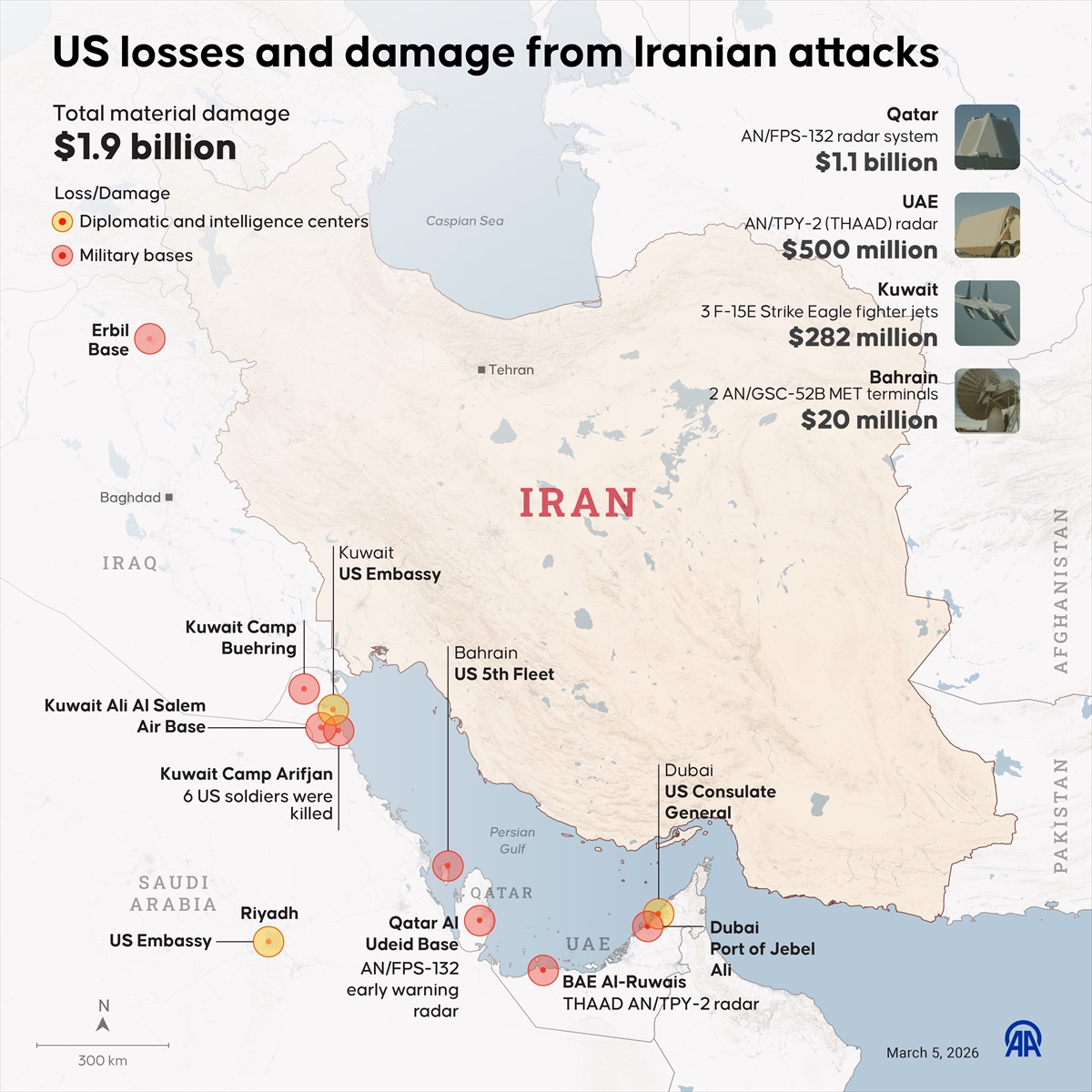
[An infographic titled “US losses and damage from Iranian attacks” created in Ankara, Turkiye on March 5, 2026. Photojournalist: Murat Usubali/AA]