By Ahmed J Versi
London, (The Muslim News): At least 15 civilians, including six paramedics, were killed on Friday in a series of Israeli airstrikes across southern Lebanon, according to Lebanon’s National News Agency (NNA).
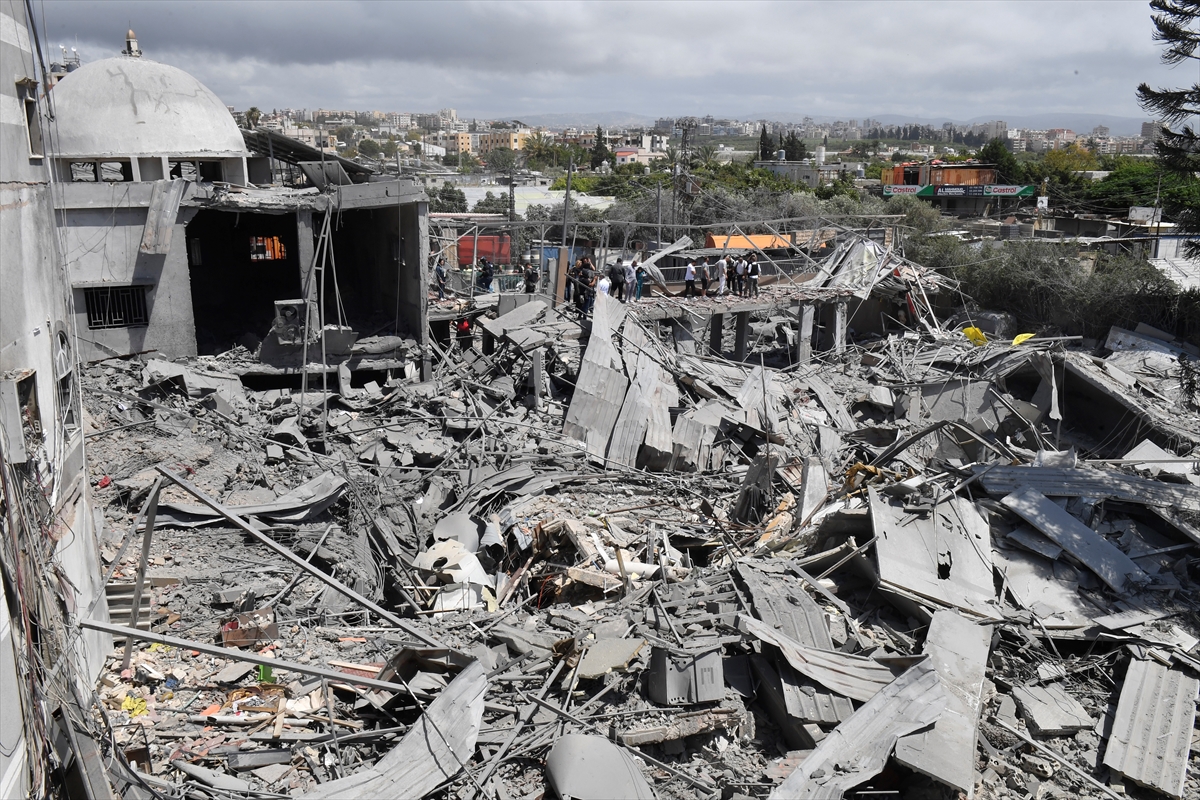
In Deir Qanoun al-Nahr, in the Tyre district, two paramedics were among 10 people killed while carrying out what officials described as their “humanitarian duty.” Elsewhere in Tyre, an Israeli warplane struck a position belonging to the Islamic Health Authority in Hanouiyeh, killing four additional paramedics.
In Nabatieh, one person was killed and two others wounded after an Israeli drone strike targeted a vehicle. Three more civilians were injured in a separate strike near the Hafour area between Siddiqine and Qana.
Among those killed was Ahmad Hariri, a photographer and paramedic with the Risala Civil Defence.
Only a day earlier, Hariri had been documenting the aftermath of Israel’s attack on the Al-Deebo family, capturing images of funerals, grieving relatives, destroyed homes, and civilians killed in the bombardment.
Today, while attempting to save others, he became one of the victims himself.
Hariri was killed alongside fellow paramedic Ali Ghassani. Hours earlier, four other paramedics had already been killed in overnight strikes on Hanawiya in the Tyre district.
The attacks came a day after an Israeli airstrike caused major damage to Tebnine Hospital in southern Lebanon. According to the NNA, two people were killed and another injured after an Israeli fighter jet struck near the hospital.
Figures released by Lebanon’s Health Ministry show that at least 16 hospitals have been damaged in Israeli attacks since March 2.
The ministry also reported that 116 medics and ambulance workers have been killed and 263 wounded during the same period.
Lebanese officials say that since the start of the Israeli assault in March, at least 3,089 people have been killed, 9,397 injured, and more than 1.6 million displaced.
Israeli attacks have continued across Lebanon despite a US-mediated ceasefire that formally took effect on April 17 and was later extended until early July.
Meanwhile, reports indicate that the United States is sanctioning senior Lebanese military officers who refused to attend meetings with Israeli military officials at the Pentagon.
Washington is also reportedly imposing additional sanctions on Hezbollah MPs, former Lebanese ministers, and figures associated with the AMAL movement — widely viewed as a message directed at parliamentary speaker Nabih Berri.
The developments underscore two realities simultaneously.
First, they expose deep divisions within Lebanon’s military establishment, where some officers refuse to legitimise direct engagement with Israel.
Second, they raise serious questions about the extent to which elements within Lebanon’s political leadership may be cooperating with foreign powers against officials from their own institutions.
Qatar now joins in mediating between Iran and US
At the same time, regional diplomatic efforts to contain the widening conflict continue.
According to Iran’s semi-official Tasnim news agency, a Qatari delegation is currently in Tehran holding talks with Iranian Foreign Minister Abbas Araghchi in an effort to end the war that began on Feb. 28, when Israel and the United States launched military strikes on Iran.
Tasnim reported that Pakistan remains the principal mediator between Washington and Tehran.
Earlier on Friday, Pakistan’s army chief, Field Marshal Asim Munir, arrived in Tehran for his second visit as part of ongoing mediation efforts. Pakistan’s military said he was welcomed by Iranian Interior Minister Eskandar Momeni, with Pakistani Interior Minister Mohsin Naqvi also present.
Pakistani sources said the discussions would focus on Iran-US negotiations, regional stability, and broader security concerns, though details regarding the duration of the visit were not disclosed.
Iran meanwhile reiterated that it is not seeking “any concessions” from the United States.
“We do not want any concessions from the United States; we are only seeking our rights,” Iranian Foreign Ministry spokesman Esmaeil Baghaei said, according to Tasnim.
Baghaei said Tehran was demanding an end to what he described as “America’s criminal actions against the Iranian people,” including the lifting of sanctions and the release of frozen Iranian assets.
“For the past five decades, we have been subjected to what they themselves call ‘crippling sanctions,’” he added.
Three Palestinians killed in Gaza by Israel
In Gaza, the Israeli army acknowledged on Friday that it had killed three Palestinians in the northern and southern parts of the enclave, marking the latest reported violations of a ceasefire officially in place since last fall.
The military claimed the individuals had crossed the so-called “Yellow Line” — the boundary separating areas under full Israeli military control following phase two of a US-backed plan announced by President Donald Trump.
Israeli forces said one of the Palestinians had been “moving suspiciously” near troops before an airstrike was carried out.
Despite the ceasefire that took effect on Oct. 10, 2025, Israeli attacks across Gaza have continued on an almost daily basis.
According to Gaza’s Health Ministry, at least 883 people have been killed and 2,648 wounded since the truce was announced.
The ceasefire agreement was intended to halt Israel’s two-year war on Gaza, which has killed more than 72,000 people — most of them women and children — wounded over 172,000, and devastated roughly 90 percent of the enclave’s civilian infrastructure.
Israeli settlers storm Al-Aqsa Mosque compound
In occupied East Jerusalem, Palestinian authorities said nine Israeli settlers stormed the Al-Aqsa Mosque compound on Friday after assaulting two mosque guards.
The Palestinian Jerusalem Governorate said the settlers entered carrying a bread offering associated with the Jewish holiday of Shavuot and managed to reach the Dome of the Rock courtyard.
Officials described the incident as “a dangerous precedent” and the first such occurrence since Israel occupied East Jerusalem in 1967.
The Islamic Waqf Department also condemned the incident, calling it “a dangerous escalation” and warning that it formed part of ongoing attempts to impose new religious realities inside the Al-Aqsa compound.
The incursion coincided with increased mobilisation by extremist Temple Mount groups during Shavuot.
Despite Israeli restrictions, more than 70,000 Palestinians performed Friday prayers at Al-Aqsa, according to the Waqf Department.
Palestinians accuse Israel of intensifying efforts to Judaize East Jerusalem, including the Al-Aqsa Mosque compound, and erase its Arab and Islamic identity.
They regard East Jerusalem as the capital of a future Palestinian state, in line with international resolutions that reject Israel’s occupation of the city in 1967 and its subsequent annexation in 1980.
[Photo: A general view of the heavy destruction following an Israeli airstrike on a health center belonging to the Islamic Health Authority (Hayaa) in the Al-Mashouk area near the southern city of Tyre, Lebanon, on May 20, 2026. Photojournalist: Houssam Shbaro/AA]