By Abdul Adil
London, (The Muslim News): Regional tensions continued to intensify on Sunday as diplomatic efforts to resolve the Iran-US conflict remained stalled, Ansar Allah (Houthi) attacks threatened Saudi Arabia’s aviation infrastructure, and Israeli military operations in the occupied West Bank displaced thousands of Palestinians. Meanwhile, Sri Lanka repatriated 40 Iranian sailors who had required medical treatment after being rescued from merchant vessels off its southern coast.
Sri Lanka repatriates 40 Iranian sailors amid maritime tensions
Sri Lanka has repatriated 40 Iranian sailors who were brought ashore for medical treatment after authorities received distress calls from merchant vessels stranded approximately 24 nautical miles off the southern port city of Galle, according to local media reports.
Foreign Minister Vijitha Herath told the Daily Mirror that all 40 sailors received medical attention before returning to Iran on Saturday morning. The Iranian Embassy in Colombo arranged their evacuation, while Sri Lankan authorities coordinated their transfer through Galle port.
Sri Lankan Foreign Ministry spokesman Thushara Rodrigo said the authorities had coordinated the transfer and fulfilled their humanitarian obligations.
The incident comes amid growing maritime tensions linked to the conflict between Iran and the United States. Nearly a dozen empty Iranian oil tankers reportedly remain anchored off Galle, unable to return home because of the US blockade of Iranian ports and shipping.
Sri Lankan authorities have stated that the vessels are located in international waters, beyond the country’s 12-nautical-mile territorial limit. Naval patrol boats and reconnaissance aircraft have been deployed to monitor their movements.
The situation follows a deadly incident in March, when the Iranian warship IRIS Dena was attacked by a US submarine off Sri Lanka. Iran’s army said 104 crew members were killed and 32 were injured in the March 4 attack, which occurred as the vessel was returning from the Milan Peace 2026 naval exercises in India.
Washington confirmed that an American submarine carried out a torpedo attack on the ship. Sri Lanka subsequently launched a rescue operation after receiving a distress call, taking the 32 wounded sailors to a local hospital.
The latest repatriation underscores the humanitarian consequences of the wider confrontation and the challenges facing countries seeking to provide assistance while navigating increasingly sensitive maritime and diplomatic circumstances.
Trump rules out immediate strike but keeps military options open
US President Donald Trump said Sunday that Washington had no immediate plans to launch another military strike against Iran, even as his administration continued to weigh diplomatic and military options.
Asked by reporters as he departed the White House for a campaign rally in Michigan whether an attack could occur as soon as Sunday, Trump replied that there would be no strike. He also said the United States was doing well in its dealings with Iran, while describing intelligence assessments available to his administration as advanced and divided.
His remarks followed a more confrontational message earlier Sunday, when Trump presented the choice facing Washington as either reaching a diplomatic agreement with Tehran or pursuing a devastating military campaign.
In an interview with Fox News, he questioned whether the United States should make a deal or finish off Iran, framing the decision as a choice between negotiations and intensified military action.
Trump also claimed that American forces controlled maritime traffic through the Strait of Hormuz and praised the enforcement of the US blockade on Iranian ports and shipping.
However, an unnamed US official told Israeli broadcaster i24NEWS that Trump was prepared to change course on Iran, suggesting that the possibility of military strikes was increasingly being viewed as a question of timing rather than whether they would occur.
The conflicting messages have added uncertainty to an already fragile situation, with the threat of renewed hostilities persisting despite a ceasefire and earlier efforts to establish a lasting peace agreement.
The conflict began in late February with joint US-Israeli illegal strikes against Iran, followed by Iranian attacks on Israel and American assets across the region. Although an interim agreement was reached in June with the aim of concluding a final peace deal within 60 days, negotiations have stalled amid continuing disagreements over security and maritime access.
The Strait of Hormuz remains at the centre of the confrontation because of its strategic importance to global energy supplies and commercial shipping. Washington insists that navigation must remain unrestricted, while Tehran argues that the conduct of the United States and Israel has undermined regional security.
Tehran says it has not abandoned diplomacy
Iran has insisted that it remains committed to negotiations, blaming Washington for the diplomatic impasse and accusing the United States of attempting to impose unilateral conditions.
Foreign Ministry spokesman Esmaeil Baqaei told German broadcaster ARD on Sunday that Iran had never left the negotiating table. He argued that the principal obstacle was Washington’s insistence on demands that Tehran considers unacceptable.
Baqaei also rejected allegations linking Iran to operations reportedly targeting air bases in Britain, saying Tehran had no connection to the incidents.
Addressing the Strait of Hormuz, the Iranian spokesman said the waterway was unsafe and held the United States and Israel responsible. He accused both countries of using the wider region as a platform for military operations against Iran and warned that Tehran would take necessary measures to defend its territorial integrity, national security and population.
Iran has reportedly offered to reopen the strait within seven days if Washington lifts its blockade, eases restrictions on Iranian oil exports, releases frozen Iranian assets and ends hostilities on all fronts, including in Lebanon.
The proposal highlights the central role of economic restrictions and maritime access in any potential settlement. However, the two sides remain divided over the conditions under which shipping can resume and the extent of Iran’s authority over the strategic waterway.
Iranian Foreign Minister Abbas Araghchi separately warned that the regional order had fundamentally changed as a result of the war with the United States and Israel.
Speaking at the Foreign Ministry, Araghchi said new realities had emerged and that shipping routes through the Strait of Hormuz would not operate as they had before the conflict. He added that Iran would welcome security arrangements developed by countries within the region.
His comments signal that Tehran is seeking a revised regional security framework in which neighbouring states play a greater role, rather than returning to the previous arrangements.
Washington and Tehran nevertheless remain at odds over the management of the strait, with Iran asserting its right to regulate passage and the United States demanding unrestricted navigation.
The stalled negotiations, continued blockade and competing claims over maritime security leave the prospect of a durable settlement uncertain.
Ansar Allah attacks raise security concerns as Riyadh airport partially reopens
Security concerns intensified in Saudi Arabia on Sunday as Yemen’s Ansar Allah [Houthi] movement claimed responsibility for a series of missile attacks targeting Riyadh’s main airport and two military installations, coinciding with the partial resumption of flights at King Khalid International Airport.
The US Embassy in Saudi Arabia issued an updated security alert warning of escalating threats from the Iran-supported group. It said the US State Department had ordered non-emergency government employees and their families to leave the kingdom, effective October 23, because of growing security risks.
The embassy said Ansar Allah attacks against civilian airports and critical infrastructure had caused casualties and severe travel disruption. It warned that hostilities could rapidly expand beyond the immediate areas affected and urged American citizens to exercise extreme caution when travelling through Saudi airports.
According to the embassy, King Khalid International Airport partially reopened Sunday, allowing domestic flights and some international services operated by Saudi carriers to resume.
The airport had suspended operations following an October 10 Ansar Allah attack that reportedly killed 13 people and wounded hundreds. Saudi authorities have not announced a complete restoration of airport operations.
Ansar Allah military spokesman Yahya Saree said the group had conducted three operations involving dozens of ballistic missiles.
The first allegedly targeted King Khalid International Airport and, according to Saree, achieved its objective. The second targeted aircraft parking areas, ammunition depots, drone control centres and other facilities at King Khalid Air Base in Khamis Mushait, in southern Saudi Arabia.
The third operation reportedly targeted a Border Guard naval base in Jizan, southwestern Saudi Arabia. Saree claimed that the attack caused deaths and injuries but did not provide figures or further details.
The group also warned airlines, airport employees and passengers against using Riyadh’s airport, describing it as unsafe and threatening further attacks deep inside Saudi territory.
Saudi authorities had not immediately commented on the latest Ansar Allah claims. However, Saudi Arabia reported intercepting additional missiles and drones on Sunday as fighting continued.
The embassy also warned that further attacks could lead to airspace closures, flight cancellations and additional disruptions. US government personnel now require special authorisation to use any airport in the kingdom.
The renewed attacks reflect the vulnerability of civilian aviation and critical infrastructure to the expanding regional conflict. They also threaten to complicate efforts to restore normal air travel and increase pressure on Saudi authorities to strengthen air defence and airport security.
Ansar Allah has controlled Yemen’s capital, Sana’a, and other parts of the country since 2014. Fighting with Saudi-backed government forces resumed in July after a truce that had largely held since 2022 broke down. The group has also targeted Saudi energy facilities, extending the security threat beyond aviation.
Israeli military operation in Hebron displaces around 2,000 Palestinians
In the occupied West Bank, Israeli forces continued a military operation in Hebron on Sunday, taking over Palestinian homes and using them as military barracks and observation posts after forcing residents to leave.
The official Palestinian news agency Wafa reported that Israeli troops occupied homes in the Khallat Manna and Dahiyat al-Zaytoun areas of southern Hebron. Residents in other neighbourhoods were also reportedly forced from their properties, which were subsequently used as observation positions.
The latest developments followed extensive raids, road closures and movement restrictions that have displaced hundreds of families since Friday.
Israeli Defence Minister Israel Katz acknowledged Saturday that approximately 2,000 Palestinians had been forcibly displaced from their homes in Hebron. Speaking to Israeli public broadcaster KAN, Katz said residents would not be permitted to return until what he described as Hamas infrastructure in the city had been dismantled.
The operation began after two Palestinians attacked an Israeli checkpoint on Friday, killing two Israeli soldiers and wounding three others, according to Israeli figures. Israeli forces killed both attackers.
The Israeli military said the operation could continue for several days and would involve house searches, interrogations and efforts to locate weapons and what it termed terrorist infrastructure. Shin Bet and Border Police personnel are also involved.
The operation has disrupted essential services and daily life throughout Hebron. The city’s education directorate suspended classes for Sunday and Monday, while Hebron University and Al-Quds Open University moved Sunday’s classes online.
Municipal services have also been affected. Hebron’s municipality said rubbish was accumulating because the closure of the city’s entrances prevented waste from being transported to disposal sites outside the city.
Further restrictions were reported near Bethlehem, where Israeli forces blocked dirt roads leading to the town of Tuqu. Wafa, citing Palestinian security sources, reported that troops fired tear gas and stun grenades towards Palestinian vehicles using rough alternative routes.
Closures across Bethlehem and surrounding communities have forced residents to rely on unpaved roads to travel between towns and villages, further complicating access to essential services.
The displacement and restrictions have raised concerns about the impact of the operation on civilians, particularly families unable to return to their homes, students facing interruptions to education and residents struggling to access basic municipal services.
Wider West Bank violence deepens humanitarian concerns
The developments in Hebron form part of a broader pattern of escalating Israeli military operations and Israeli settler violence across the occupied West Bank, including East Jerusalem, since the beginning of Israel’s war on Gaza in October 2023.
Palestinians have faced killings, arrests, demolitions of homes and other structures, attacks on mosques and vehicles, destruction of agricultural land and restrictions on access to farmland. Palestinian communities have also experienced displacement alongside continued Israeli illegal settlement expansion.
The latest operation in Hebron has brought these pressures into sharp focus, particularly through the reported forced displacement of around 2,000 residents and the use of civilian homes for military purposes.
Israeli authorities have presented the operation as a security measure intended to dismantle militant infrastructure following the deadly checkpoint attack.
Palestinian reports, meanwhile, highlight the effects of the operation on civilians, including the loss of housing, restrictions on movement and interruptions to education and municipal services.
The immediate question is whether residents will be allowed to return to their homes once the military operation concludes. Katz’s statement that their return depends on the dismantling of alleged Hamas infrastructure suggests that the displacement could continue beyond the initial raids.
The situation also underscores the growing humanitarian challenges facing communities across the occupied territory as military operations, closures and displacement disrupt daily life.
Conclusion
The developments across the Middle East on Sunday demonstrate how interconnected the region’s security crises have become. The Iran-US confrontation continues to threaten maritime trade and energy security, while the possibility of renewed American military action hangs over stalled negotiations. Tehran is seeking changes to the security arrangements governing the Strait of Hormuz, whereas Washington insists on unrestricted navigation and maintains pressure through its blockade.
At the same time, Ansar Allah missile and drone attacks have heightened security risks in Saudi Arabia, disrupting aviation and prompting new US travel and personnel restrictions.
In the occupied West Bank, Israel’s operation in Hebron has displaced thousands of Palestinians and disrupted education, municipal services and access to homes.
Sri Lanka’s repatriation of 40 Iranian sailors offers a reminder of the humanitarian responsibilities that accompany these wider confrontations, even as countries attempt to protect their own interests amid competing military and diplomatic pressures.
With negotiations stalled, maritime tensions unresolved and violence continuing across several fronts, the coming days will be critical in determining whether diplomatic efforts can prevent another escalation or whether the region will face a further expansion of hostilities.
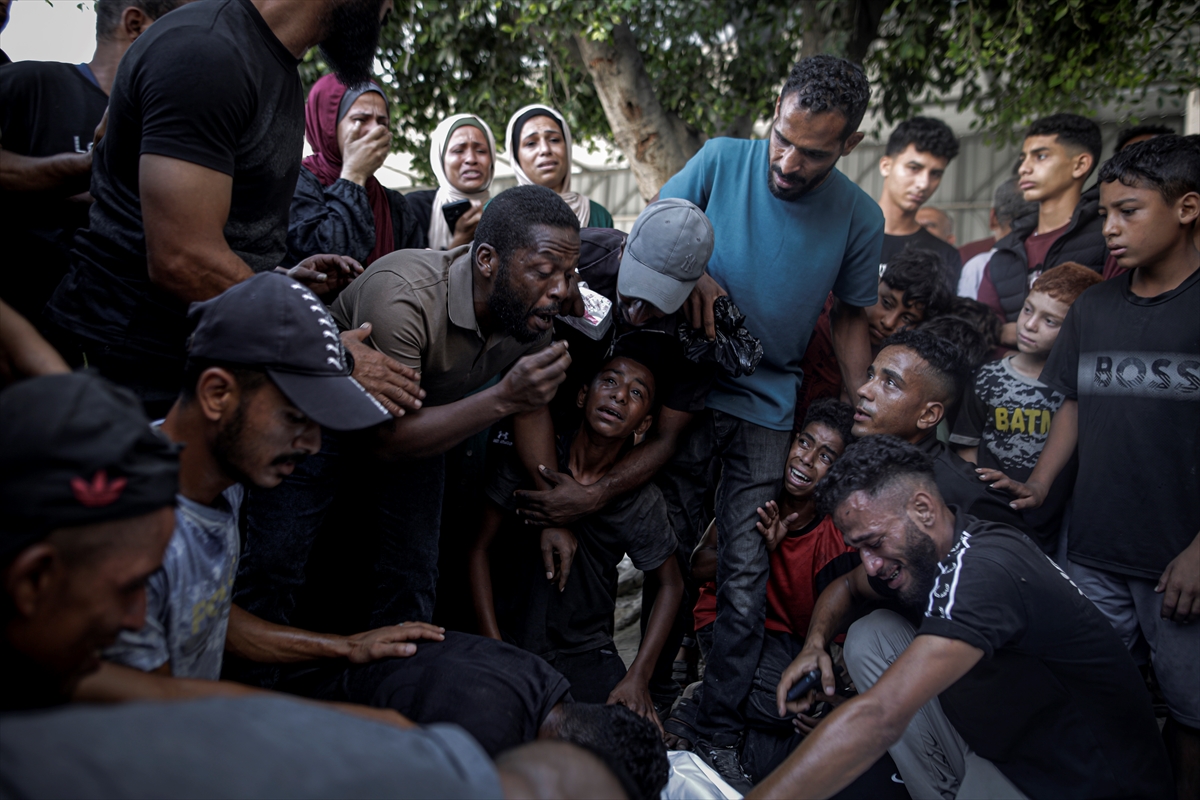
[Photo: Relatives of Palestinians killed in an Israeli drone attack mourn during their funeral procession at Al-Shifa Hospital in Gaza, Palestine on October 25, 2026. Three Palestinians were killed and several others injured after an Israeli military unmanned aerial vehicle targeted the Islamic University in Gaza with two missiles, following which the victims were laid to rest after procedures at the hospital. Photojournalist: Saeed M. M. T. Jaras/AA]