By Middle East Correspondent
London, (The Muslim News): Eight Palestinians, including a mother and her young daughter, were killed in a fresh wave of Israeli attacks across the Gaza Strip on Monday, as Israel continued military operations despite a ceasefire that has officially been in force since last October.
Medical officials said dozens more were wounded in airstrikes, drone attacks and shelling that struck multiple locations across the besieged enclave.
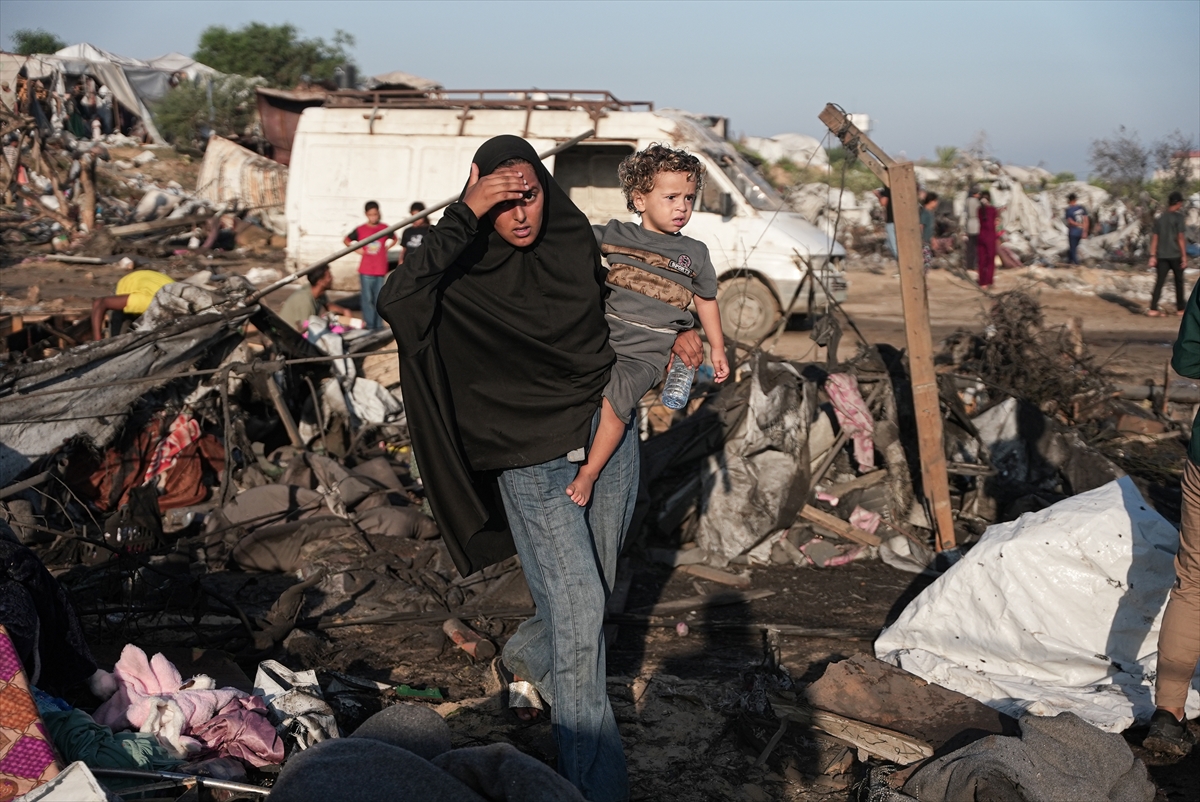
The deadliest attack hit tents sheltering displaced families in the Al-Mawasi humanitarian zone west of Khan Younis, where an Israeli strike killed a woman and her daughter after tearing through the encampment. Witnesses said the blast destroyed makeshift shelters and the few belongings families had managed to salvage during months of displacement.
Earlier, an Israeli drone targeted another tent on Al-Mawasi beach, killing two Palestinians and injuring 27 others. The wounded were taken to Nasser Medical Complex, the Kuwaiti Field Hospital and Al-Mawasi Field Hospital, where medical staff said most injuries ranged from minor to moderate.
Elsewhere in southern Gaza, another Palestinian was killed and a young girl wounded after Israeli forces opened fire near the Bani Suheila roundabout east of Khan Younis, according to medical sources.
In central Gaza, three Palestinians, including a child, were killed and several others wounded when an Israeli drone struck a group of civilians on Al-Baraka Street in Deir al-Balah. Further north, Israeli artillery shelling in Beit Lahia left a young man and a woman with moderate injuries.
Residents also reported powerful explosions northeast of Khan Younis as Israeli forces demolished buildings while military vehicles opened heavy fire across surrounding areas.
Meanwhile, residents of central Gaza said Israeli military vehicles advanced along Salah al-Din Street in the Nuseirat refugee camp under artillery cover before removing concrete barriers marking the so-called “Yellow Line” and repositioning them around 150 metres west towards Wadi Gaza Bridge.
Witnesses later discovered newly installed barriers, fuelling concerns that Israel had expanded the territory under its effective control despite the ceasefire. Israeli forces continue to occupy positions along the “Yellow Line”, a security zone barring Palestinians from entering surrounding areas, while Israeli officials have previously acknowledged that the military now controls more than 70 per cent of the Gaza Strip.
According to Gaza’s Health Ministry, more than 1,045 Palestinians have been killed and 3,380 injured in alleged Israeli ceasefire violations since the truce came into force on October 10, 2025, with women and children accounting for most of the casualties.
Since the war began in October 2023, more than 73,000 Palestinians have been killed, over 173,000 wounded and around 90 per cent of Gaza’s civilian infrastructure destroyed.
Diplomatic uncertainty over US-Iran talks
As fighting continued in Gaza, uncertainty also surrounded diplomatic efforts to ease wider regional tensions after US President Donald Trump announced that American and Iranian officials would meet in Doha on Tuesday.
“Iran requested a meeting. It will take place tomorrow in Doha,” Trump wrote on his Truth Social platform.
The White House subsequently confirmed that senior envoys Steve Witkoff and Jared Kushner would travel to Qatar for discussions centred on implementing the US-Iran memorandum of understanding signed on June 18. Press Secretary Karoline
Leavitt said the meetings would include technical-level discussions and reiterated that Washington remained committed to the ceasefire while reserving the right to respond militarily if necessary.
“Violence will be met with violence,” Leavitt said.
Tehran, however, rejected Trump’s account.
Iran’s Deputy Foreign Minister Kazem Gharibabadi said no technical negotiations with the United States were scheduled in Doha this week, although discussions with international mediators remained ongoing.
Foreign Ministry spokesman Esmaeil Baqaei likewise dismissed reports that broader negotiations were imminent, saying Iran’s immediate priority was implementing the June 18 memorandum rather than negotiating a comprehensive agreement.
According to Baqaei, Washington has already issued the licences required under Article 10 governing Iranian oil exports, while implementation of Article 11 concerning the release of frozen Iranian assets is also progressing.
He said an Iranian expert delegation would nevertheless travel to Doha later this week to oversee implementation of the memorandum, stressing that negotiations on a broader agreement could only begin once its initial provisions had been fully carried out.
Iranian President Masoud Pezeshkian later reaffirmed Tehran’s commitment to the memorandum, saying Iran would continue honouring its obligations provided the United States fulfilled its own.
“The understanding is a reciprocal matter. If the American side remains committed to the memorandum, we will also fulfil our commitments,” he said.
Iran rejects French proposal over Strait of Hormuz
The diplomatic dispute also extended to maritime security in the Strait of Hormuz after Iran rejected a French-backed proposal to assist with demining operations in the strategic waterway.
Deputy Foreign Minister Kazem Gharibabadi said all mine-clearing operations envisaged under the memorandum would be conducted exclusively by Iran, warning that no foreign involvement would be accepted.
“We strongly advise France not to make the situation more complicated with its provocations,” he wrote on X.
His remarks came after French President Emmanuel Macron announced that France and Oman intended to work with international partners on demining operations to safeguard commercial shipping through the Strait of Hormuz.
Oman’s Foreign Minister Badr Albusaidi later said Muscat opposed imposing transit fees on vessels using the Strait, although discussions over charges linked to maritime safety services could be considered. He reiterated Oman’s commitment to maintaining free and secure navigation and voiced support for implementing the US-Iran memorandum in accordance with international law and the UN Convention on the Law of the Sea.
Israeli strikes continue in Lebanon
Elsewhere, military operations continued on another front despite parallel efforts to reduce regional tensions.
The Israeli military launched fresh strikes across southern Lebanon on Monday evening, days after a US-sponsored framework agreement intended to reduce cross-border hostilities was signed.
Lebanon’s state-run National News Agency said Israeli aircraft struck the area between Qantara and Deir Siryan in Nabatieh Governorate, while heavy artillery shelling targeted the outskirts of Deir Siryan and the town of Hadatha in Bint Jbeil District.
No casualties were immediately reported.
The framework agreement, signed on Friday, was designed to facilitate a phased Israeli withdrawal from Lebanese territory and reduce fighting along the border.
According to Lebanon’s Health Ministry, Israel’s military campaign in Lebanon since March 2 has killed at least 4,247 people, wounded more than 12,000 and displaced more than one million residents.
[Photo: A view of widespread destruction following an Israeli strike on tents sheltering displaced Palestinians in the Al-Mawasi area west of Khan Yunis in the southern Gaza Strip, Palestine on June 30, 2026. Israeli army carried out the attack despite the ceasefire, causing extensive damage in the area. Photojournalist: Mahmoud Bassam/AA]