By Ahmed J Versi
At least seven people were killed and several others wounded on Saturday as Israeli artillery shelling and airstrikes struck multiple areas in southern Lebanon, despite a recently extended ceasefire agreement between Lebanon and Israel, according to Lebanese media reports.
Lebanon’s National News Agency (NNA) reported that Israeli artillery targeted the vicinity of the Srebbine junction in the Bint Jbeil district of Nabatieh province, killing one person and injuring another.
Israeli warplanes also launched strikes on the town of Jebal al-Botm in the Tyre district and the Housh area east of the city of Tyre.
In Tayr Felsay, an Israeli strike hit a residential house, causing multiple injuries. Later reports confirmed that a woman and her son — a paramedic with the Islamic Risala Scout Association emergency unit — were killed in the attack. Five others were wounded and transferred to hospitals in Tyre.
Rescue crews continued searching through the rubble for additional victims.
In the Nabatieh district, an Israeli airstrike struck the al-Saha neighborhood in Habboush, destroying a home and killing a husband and wife.
Another strike targeted a house in Tebnine, killing former Aitaroun mayor and current municipal council member Haidar Mawasi. Earlier reports said the attack caused extensive destruction and several injuries.
Separately, rescue teams recovered the body of a person killed after an Israeli strike hit the town square in Abbassiyeh in the Tyre district.
Among those reported killed elsewhere in the day’s attacks were civilian paramedics Ali Faour, Moustapha Kamal, and Mousa Miqdad, who were reportedly attempting to rescue civilians in Debaal. Dr. Rayan Ftouni was killed in Abbassiyeh, while Fatima Ramadan was killed in Tyre. Abed Bourji and his wife Nada were also killed together in Deir Qanoun al-Nahr.
The escalation came just one day after the United States announced a 45-day extension of the ceasefire agreement between Israel and Lebanon following negotiations held in Washington on May 14 and 15.
Earlier Saturday, the Israeli military reportedly targeted nearly 100 locations across southern Lebanon and issued evacuation warnings to residents in nine towns and villages ahead of planned strikes.
According to Lebanese officials, Israeli attacks since March 2 have killed nearly 3,000 people, wounded approximately 9,000 others, and displaced more than 1.6 million people — nearly one-fifth of Lebanon’s population.
Israeli officer killed in Southern Lebanon
The Israeli military also announced the death of a soldier during fighting in southern Lebanon.
In a statement, the army identified the soldier as 24-year-old Captain Maoz Israel Recanati, a platoon commander in the Golani Brigade’s 12th Battalion. Israeli media reported that he was killed when an explosive-laden drone detonated during clashes in southern Lebanon.
According to Yedioth Ahronoth, Recanati was the 20th Israeli soldier killed in Lebanon since the war with Iran began on Feb. 28, and the seventh killed since the ceasefire took effect on April 16.
His death marked the second Israeli officer killed in fighting with Hezbollah within 24 hours.
Israeli forces and settlers intensify raids in West Bank and Jerusalem
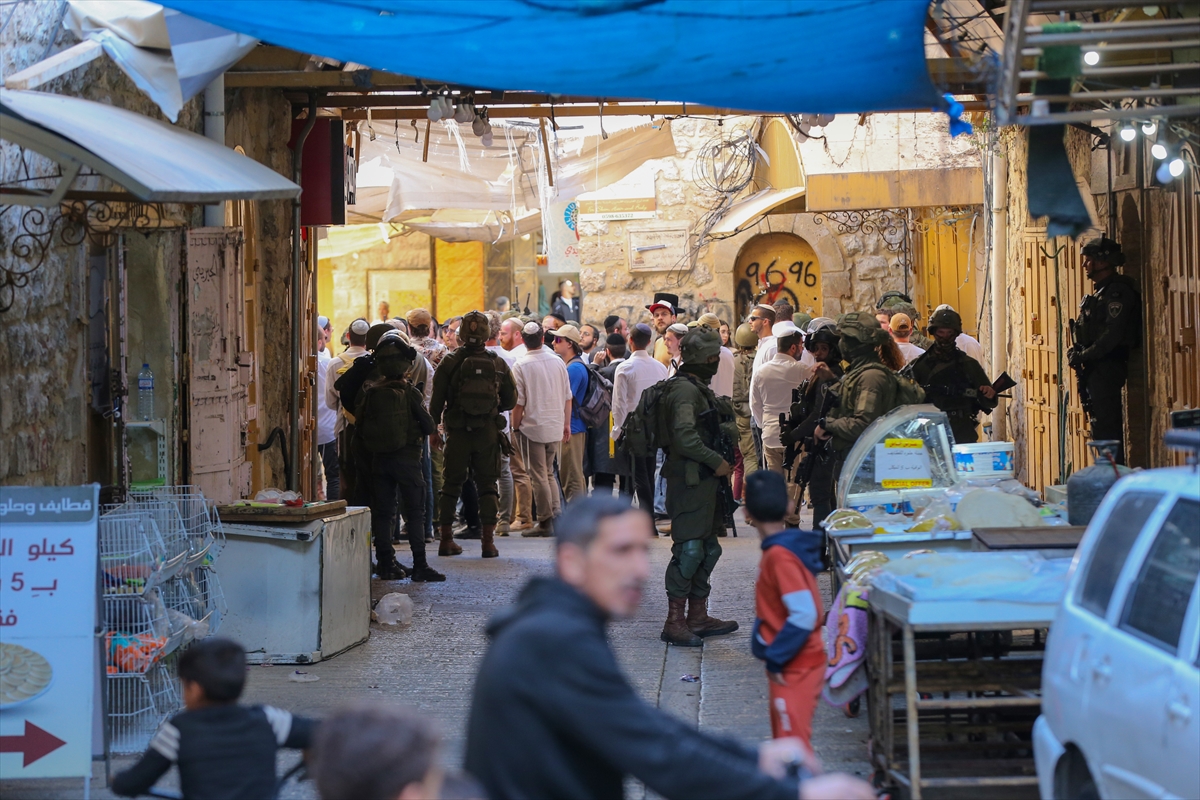
Meanwhile, Israeli soldiers stormed the Old City of Hebron in the occupied West Bank on Saturday, raiding Palestinian homes and restricting movement throughout the area.
According to an Anadolu Agency correspondent, Israeli troops and illegal settlers deployed heavily across the Old City, detaining several residents and confiscating vehicles. Shop owners were reportedly forced to close their businesses while settlers climbed onto rooftops and spread through residential neighbourhoods.
Human rights activist Aref Jaber said a Palestinian man was beaten by Israeli soldiers in the city center before later being released.
The Palestinian news agency WAFA reported that settlers also attacked Palestinians in the Wadi al-Rakhim area south of Hebron, releasing livestock into agricultural fields and injuring at least one farmer.
In occupied East Jerusalem, dozens of Israeli settlers attacked Palestinian-owned shops along Al-Wad Street in the Old City, according to the Jerusalem Governorate’s Media Office. Witnesses said settlers vandalized commercial property while Israeli police stood by.
Footage released by the office showed settlers chanting provocative slogans during the attacks.
The Palestinian Colonization and Wall Resistance Commission reported that Israeli forces and settlers carried out 1,637 attacks across the West Bank in April alone, including 540 attacks conducted solely by settlers.
The commission also said settlers attempted to establish 21 new illegal settlement outposts during the month, most of them on agricultural or pastoral land.
Around 750,000 Israeli settlers currently live in the occupied West Bank, including approximately 250,000 in East Jerusalem, according to Palestinian estimates. The settlements are considered illegal under international law.
Since the outbreak of the Gaza war in October 2023, Israeli military operations and settler attacks across the West Bank have intensified sharply. Palestinian figures say at least 1,155 Palestinians have been killed, roughly 11,750 injured, and nearly 22,000 arrested during that period.
UN expert accuses Israel of systematic torture
UN Special Rapporteur on Palestine Francesca Albanese said Saturday that Israel has used torture systematically against Palestinian detainees and, more broadly, against Palestinians living under occupation.
Her comments followed a New York Times investigation by columnist Nicholas Kristof alleging widespread torture and sexual violence against Palestinian prisoners in Israeli detention facilities.
Albanese shared findings from her report, Torture and Genocide, prepared for the 61st session of the UN Human Rights Council.
The report argues that torture has long been embedded in Israel’s treatment of Palestinians but says practices intensified dramatically after Oct. 7, 2023, reaching a scale that suggests collective punishment and coordinated state policy.
It alleges that torture extends beyond prisons and interrogation centers to include mass displacement, siege tactics, restrictions on food and humanitarian aid, military assaults, and settler violence.
The report also cited Israeli National Security Minister Itamar Ben-Gvir, alleging that Palestinian detainees labelled as “terrorists” were ordered kept handcuffed in dark cells while being continuously exposed to the Israeli national anthem.
According to Albanese, such practices are designed to break Palestinian resistance, dignity, and social cohesion, and may constitute evidence of genocidal intent under the Genocide Convention.
The New York Times investigation, published May 11, included allegations of rape, abuse of children, degrading treatment, and physical torture by Israeli soldiers, settlers, and prison guards.
Israeli Prime Minister Benjamin Netanyahu said Thursday that Israel would sue The New York Times over the allegations.
Deadly strike reported in Gaza City
In Gaza, two Palestinians were killed and three others injured Saturday when an Israeli airstrike targeted a civilian vehicle near Al-Wahda Tower on Al-Shifa Street in western Gaza City, according to the Gaza Civil Defense Authority.
Medical sources told Anadolu Agency that the victims were civilians.
The strike reportedly occurred in an area from which Israeli troops had previously withdrawn under the ceasefire arrangement.
According to Gaza health authorities, more than 72,000 people — most of them women and children — have been killed and over 172,000 injured since the war began in October 2023.
Although a ceasefire officially took effect on Oct. 10, 2025, Gaza’s Health Ministry says Israeli attacks have continued, killing at least 870 people and injuring more than 2,500 since then.
US and Iran reportedly exchange conditions for negotiations
Meanwhile, Iran’s semi-official Fars news agency reported Sunday that the United States has presented five key conditions for reaching a deal with Tehran.
Among the reported demands are allowing only one Iranian nuclear facility to remain operational, transferring 400 kilograms of enriched uranium to the United States, refusing compensation payments, withholding the release of most frozen Iranian assets, and linking any broader halt in regional fighting to the outcome of negotiations.
Iran’s reported conditions include an end to fighting across all fronts — including Lebanon — the lifting of sanctions, release of frozen Iranian assets, compensation for war damage, and recognition of Iran’s sovereignty over the Strait of Hormuz.
[Photo: Israeli settlers, under the protection of Israeli forces, raid the Old City area of Hebron, West Bank, Palestine, on May 16, 2026. During the raid, Israeli forces took extensive security measures and patrolled the area, restricting the movement of Palestinians. Photojournalist: Wisam Hashlamoun/AA]